
























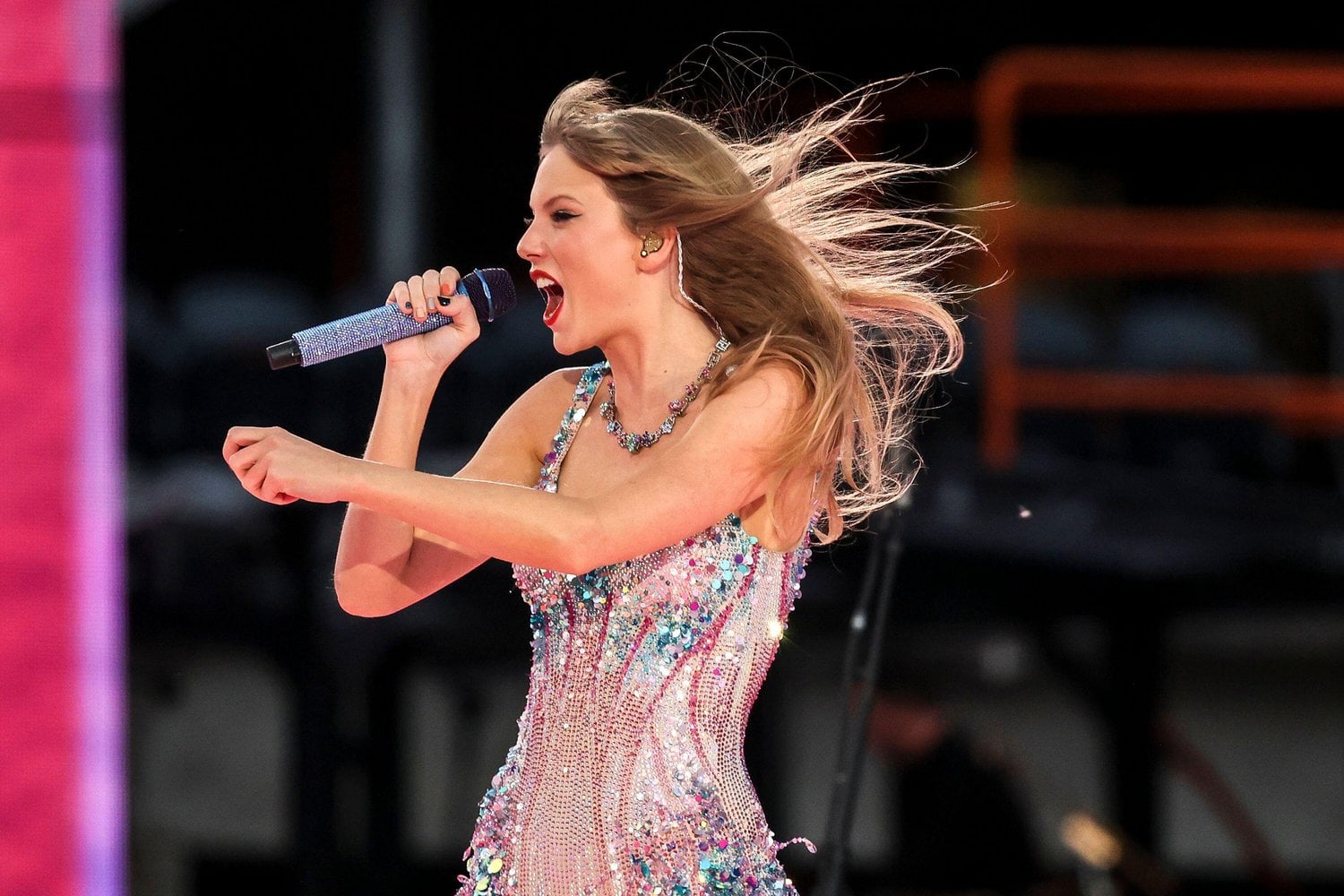
Taylor Swift’s legal team has asked the court to dismiss the trademark infringement lawsuit brought by Las Vegas performer Maren Flagg (who performs as Maren Wade), calling the case “merely [the] Plaintiff’s latest attempt to generate publicity by associating herself with Ms. Swift.”
The motion, filed on Tuesday (May 26) in the US District Court for the Central District of California, which you can read here, argues that Flagg’s complaint should be thrown out for failing to state a viable claim and for lacking personal jurisdiction over Swift and her rights management company, TAS Rights Management.
A hearing on the motion is scheduled for August 5.
The motion was filed on behalf of all four defendants – Swift, TAS Rights Management (TASRM), UMG Recordings, and UMG’s merchandise arm Bravado International Group Merchandising Services – by attorneys at Venable LLP.
“Plaintiff’s impermissible shotgun pleading fails to identify facts supporting the alleged actions of each individual defendant in violation of Fed. R. Civ. P. 8,” according to the motion.
“PLAINTIFF’S IMPERMISSIBLE SHOTGUN PLEADING FAILS TO IDENTIFY FACTS SUPPORTING THE ALLEGED ACTIONS OF EACH INDIVIDUAL DEFENDANT IN VIOLATION OF FED. R. CIV. P. 8.”
TAYLOR SWIFT’S MOTION TO DISMISS
“Plaintiff repeatedly refers to the Defendants – Ms. Swift, TASRM, UMG, and Bravado – collectively in her allegations without specifying which Defendant(s) are responsible for any particular act, despite their highly distinct roles in the music industry, and in the creation and distribution of Ms. Swift’s art,” the filing states.
“In total, Plaintiff impermissibly lumps Defendants together over 90 times.”
On the substance of Flagg’s trademark claims, the motion is equally direct.
“The premise of Plaintiff’s reverse confusion claims – that consumers will believe Plaintiff’s cabaret-style goods and services are affiliated with or sponsored by Ms. Swift – is absurd,” the filing reads.
“THE PREMISE OF PLAINTIFF’S REVERSE CONFUSION CLAIMS – THAT CONSUMERS WILL BELIEVE PLAINTIFF’S CABARET-STYLE GOODS AND SERVICES ARE AFFILIATED WITH OR SPONSORED BY MS. SWIFT – IS ABSURD.”
TAYLOR SWIFT’S MOTION TO DISMISS
“Plaintiff utterly fails to plausibly allege likelihood of confusion.”
The motion argues that the goods and services offered by Flagg, a cabaret show, a book, a podcast, and video content, are fundamentally different from a musical album and its promotional merchandise.
“She does not allege she has ever sold any of the products Defendants sell, nor does she allege that she has released musical albums or performed musical concerts,” the filing states.
In a footnote, Swift’s lawyers went further, noting that “Flagg has no currently scheduled performances, her book is unavailable, there is not a single podcast episode available despite Plaintiff releasing a podcast ‘teaser’ over nine months ago.”
The only digital content Flagg has posted since September 2025, the filing alleges, consists of social media posts “in which she repeatedly attempts to associate herself with Ms. Swift” through “unauthorized use of Ms. Swift’s intellectual property.”
The motion also takes aim at Flagg’s reliance on the US Patent and Trademark Office’s initial refusal of TASRM’s application to register The Life of a Showgirl as a trademark.
“Plaintiff’s attempt to dress up a non-final Office Action into dispositive proof of a likelihood of confusion not only fails as a matter of law, but also highlights Plaintiff’s lack of plausible facts to support consumer confusion and, further, her fundamental misunderstanding of trademark law and USPTO procedure,” the filing states.
The motion notes that the USPTO’s action was non-final, related to an intent-to-use application where no specimens of use were submitted, and “explicitly did not find a likelihood of confusion between Plaintiff’s Mark and the majority of the goods/services covered in the Application.”
On the question of California’s unfair competition law, the motion argues that Flagg – a Nevada resident – has not alleged that any relevant conduct “emanated from” or caused injury in California.
And on the question of jurisdiction, Swift’s lawyers state that the singer “is domiciled, with her permanent home, in Tennessee” – contradicting Flagg’s complaint, which alleges Swift is a California resident.
“Plaintiff’s pleading failures are inescapable and doom her purported claims,” the motion concludes.
The motion to dismiss was filed the day before a previously scheduled hearing on Flagg’s motion for a preliminary injunction – a request that, if granted, would block the defendants from selling merchandise bearing The Life of a Showgirl branding while the case proceeds.
That timing drew a swift procedural objection from Flagg’s attorney, Jaymie Parkkinen.
In a notice filed with the court on the same day, which you can read here, Parkkinen flagged that the defendants had not complied with Local Rule 7-3, which requires parties to meet and confer at least seven days before filing a motion.
“Defendants concede they did not comply with Local Rule 7-3,” the notice states. Their counsel’s declaration acknowledges that defendants “were not able to conduct the meet and confer seven days prior to the filing of the Motion.”
According to the filing, the parties conferred on May 22 – seven days from which would have been May 29.
The defendants’ deadline to respond to the complaint was June 2.
Instead, they filed on May 26 – the day before the May 27 hearing on the preliminary injunction, “which has been on calendar since April 7, 2026,” the notice states.
The hearing on Flagg’s preliminary injunction motion took place yesterday (May 27). Judge Murillo did not rule from the bench, indicating a written decision would follow.
Defendants’ counsel acknowledged in a declaration that they filed early so that the court would “have the benefit of the Motion to Dismiss prior to” the hearing.
Parkkinen’s notice states that Flagg “objected to the timing during the conference and in the correspondence Defendants have attached to their Motion.”
Flagg “expressly reserves all rights, including the right to oppose the Motion on any ground and to amend under Federal Rule of Civil Procedure 15,” the notice adds.
Separately, Judge Serena R. Murillo on Tuesday granted an application from the defendants to file under seal certain declarations containing “non-public financial and strategic business information” submitted in support of their opposition to the preliminary injunction, according to a filing, which you can read here.
Redacted versions of the sealed declarations remain publicly available on the docket.
Flagg filed the lawsuit in March, alleging that Swift’s twelfth studio album title infringed on her trademark for Confessions of a Showgirl, a phrase she registered in 2015 and has used for a cabaret show, a book, a podcast, and a column for Las Vegas Weekly.
The Life of a Showgirl was released in October 2025 and shattered US sales records, selling nearly 3.5 million copies in its first week and debuting with 4 million equivalent album units.Music Business Worldwide



