


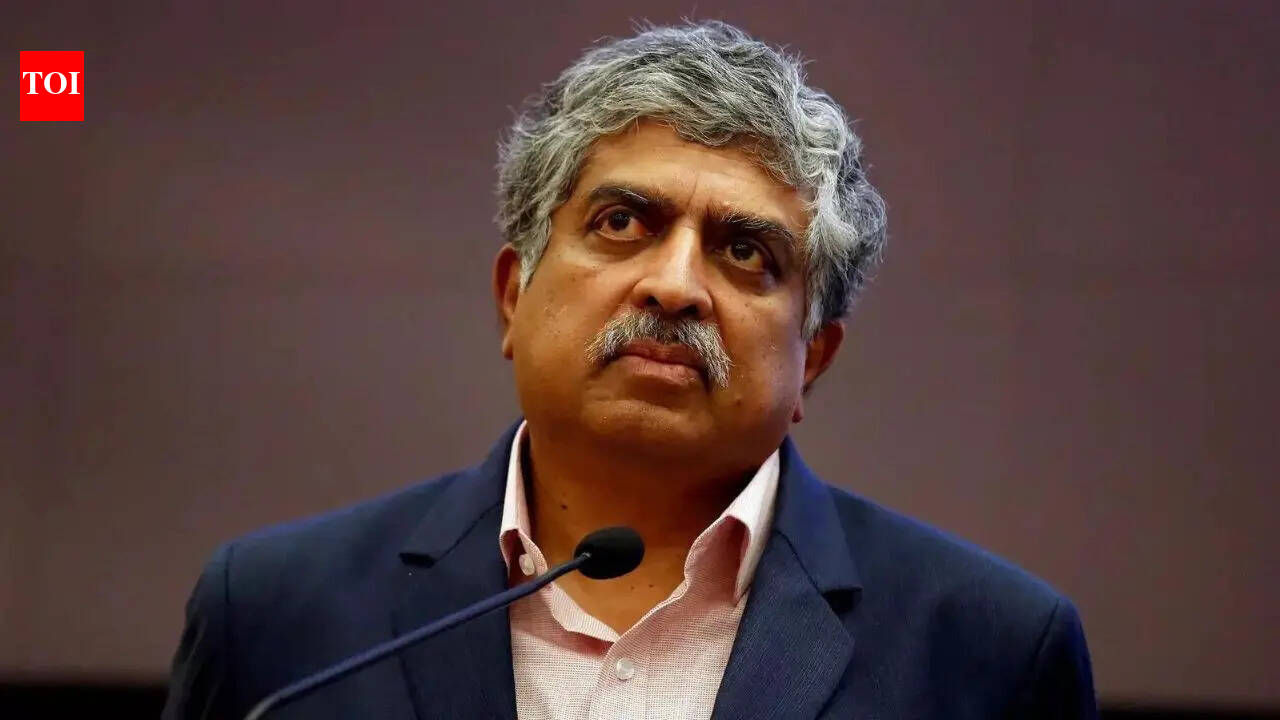
BENGALURU: Nandan Nilekani turns 71 on Tuesday, and if all goes as per plan, Infosys shareholders will re-elect him as non-executive chairman for a third successive term at the company’s annual general meeting to be held later this month.Since his reentry into Infosys in 2017, after the tumultuous period under then CEO Vishal Sikka, things have largely gone as planned for him. What hasn’t gone as per plan-be it the surprising rise in business when Covid struck, the huge fall in business a couple of years later, and the more recent slump in share price in response to agentic AI – have all been industry-wide trends. Even through these periods, Infosys has done reasonably well compared to peers.Nilekani had said in 2017 that he wanted to make Infosys “boring” again, following the noisy years under Sikka. And in that, he’s been eminently successful-no-drama, no-surprises. He brought a steady hand, and together with CEO Salil Parekh-observers say there’s great chemistry between the two – has overseen a period of relative stability and growth. That partnership has taken the company’s revenue from $10.9 billion in 2017-18 to more than $20 billion in 2025-26, a CAGR of 8.3%, and net profit from $2.5 billion to $3.3 billion. This explains why the Board is keen on Nilekani continuing, and Parekh as well.In his third term, assuming shareholders give their nod, Nilekani will have some challenges to deal with. First, finding his own successor, as Infosys’ rules require him to step down once he’s 75. The recent appointment of former HUL CEO Nitin Paranjpe as vice-chairman looks like a signal from the Board about what’s coming. Nilekani will also have to find a new CEO, because Parekh-who turns 62 on Friday-is already past the retirement age set for executives, and has been continuing in the role with shareholder approvals. Parekh’s current term ends next year, but with no formal search process having yet been initiated, analysts believe Parekh will likely be given another shorter extension. But Nilekani will certainly want to settle in a new CEO before he himself exits.“Infosys has deliberately strengthened the governance bench around him (Nilekani) with leaders like Paranjpe, which suggests the company is quietly building succession resilience without creating uncertainty around the chairman role itself. That is usually a sign of a mature board preparing for the long term, not reacting to immediate pressure,” says Phil Fersht, CEO of IT research and consulting firm HFS Research.During Infosys’ 40th anniversary celebrations, Nilekani had noted the next chairman would almost certainly be a non-founder. “There is no plan B if I hand it over to somebody and it doesn’t work. I can’t come back at 75, and I don’t think any of these guys (other founders) want to come back either,” he had said.“Nilekani is well accepted by the board, management, employees and investors. He wants to ensure Infosys is safeguarded for the future,” says Navnit Singh, chairman and regional managing director at executive search firm Korn Ferry India. “With the vice-chairman’s appointment, we can expect the next phase of leadership evolution. The key challenge is how he prepares the firm for an AI-led world.”Venkat Shastry, founder, leadership consulting firm QuantumV, says AI era is reshaping the technology services industry at a speed and scale few have witnessed before. “At a moment like this, having someone of Nilekani’s standing at the helm of Infosys is genuinely valuable.”



