














The report was filed. The last line was sent to my teammates at the desk, the laptop shut. There were still a few balls left in the IPL 2026 final, and I had already reached for the binoculars because when Royal Challengers Bengaluru crossed the line, there was only one place worth looking at.
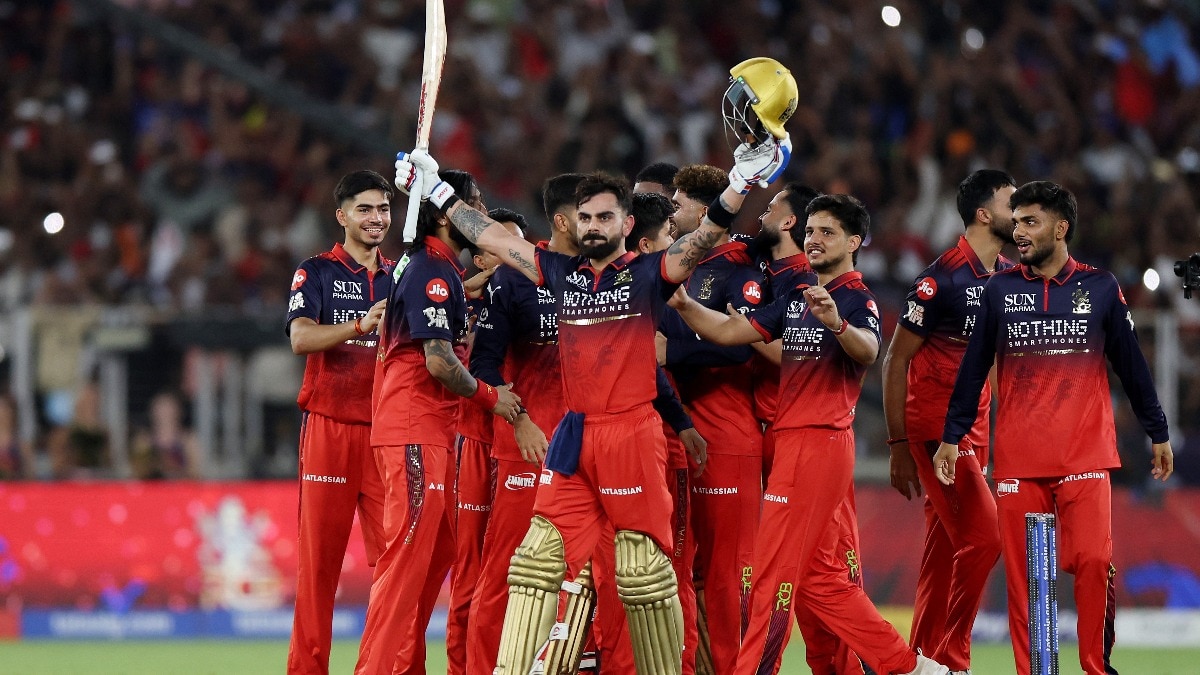
I trained them on him well before the winning six. He hit it: 75 off 42 balls, nine fours, three sixes, the last of them sealing the chase with two overs to spare. And then I waited.
He blew a flying kiss toward the stands where Anushka Sharma sat. He raised his bat, briefly, at the crowd. And then he walked across to shake hands, opponents first, then teammates, in the manner of a man who had known all evening how this would end. I kept the binoculars on him, waiting for the knees to buckle, for the chest to open, for the Kohli I knew to come flooding through.
He didn’t arrive.
The thing about Virat Kohli is that he celebrates a wicket like he has just won a World Cup. Arms spread, chest out, roaring at no one and everyone, as though the act of a batsman losing his stumps is the most significant event in human history. It is instinct, not performance — or perhaps, with Kohli, the two have always been the same thing. For seventeen years at Royal Challengers Bengaluru, that intensity was the heartbeat of the franchise. When he hurt, the team hurt. When he wanted it, you could feel it from the stands.
Which is why anyone watching closely, on television or from the press box in Ahmedabad, spent much of the IPL 2026 final searching for that man and finding someone else entirely.
To understand why that mattered, you had to have been in the same stadium twelve months earlier.
In the 2025 final against Punjab Kings, Kohli had started crying before the last delivery was bowled. Standing along the boundary rope, he sank to his knees, tears running freely. It was not a celebration, not yet. It was the release of 17 years of weight, the accumulated pressure of four runner-up finishes and a franchise that had taken everything he had and kept asking for more.
AB de Villiers flew in for the occasion. Chris Gayle too. Both were invited onto the podium. The broadcaster could not look away from Virat. Rajat Patidar was the captain, but the night belonged to someone else, and everyone knew it.
When Kohli spoke, the words came out raw: “I’ve given this team my youth, my prime, and my experience. I never thought this day would come.”
That was a relief. Pure, unguarded, 17-years-in-the-making relief.
What unfolded in 2026 was something altogether quieter. Before the final, Kohli met AB de Villiers, back this time for broadcast duties, in a brief, private exchange. A hug, a few words. That was the extent of it. The pre-match ceremony was Patidar’s. The post-match ceremony was Patidar’s too. And when the trophy was brought out, it was Patidar who had to physically guide
Kohli to the centre of the dais before he could lift it. The loudest Kohli was seen all evening was at the victory party afterwards, dancing with his wife. On the field, he seemed to be making himself smaller, as though the space he usually fills by nature required a conscious effort to vacate.
Those who followed RCB through the tournament saw the same quality at training. He completed his work at the nets without ceremony and drifted back to the dugout. He was present without imposing. He scored runs, as he always has, but the tournament’s narrative moved around him rather than through him — eight different players won Player of the Match across the campaign, and Patidar turned 33 on the day of the final, becoming only the third captain after MS Dhoni and Rohit Sharma to successfully defend an IPL title.
HAS KOHLI DONE WHAT DHONI AND ROHIT HAVEN’T?
Now consider that comparison for a moment.
Dhoni rebuilt CSK so thoroughly in his own image that the franchise and the man became, effectively, the same entity. Rohit did the same at Mumbai Indians across five titles — patient, unbothered, immovable at the centre of everything. It was never a failure of generosity on their part. The identity of the club was always, inextricably, theirs, and so the question of stepping back never quite arose. The spotlight stayed because it had nowhere else to go.
Both franchises are paying for it now. Mumbai Indians spent much of IPL 2026 searching for an identity, the leadership shift to Hardik Pandya, yet to produce a coherent team in the image of anything. CSK, without a fit and available Dhoni, encountered a crisis of their own. For the first time in the tournament’s history, three consecutive years have passed without a title going to either of them. The machine outlasted the men, but only just — and without a clear idea of what it is when they are not there.
Which is the context in which what Kohli has done carries its full weight.
He remained, indisputably, the best player in the final: 75 not out, Player of the Match, the winning six off his bat. But zoom out and the picture is even sharper: 675 runs across the tournament at an average of over 50, a strike rate of 165.84, and a complete dismantling of the anchor role he once treated as a professional credo.
He attacked from the first ball, trusted the innings to absorb the risk, and quietly did more for this team than the numbers alone suggest. None of it was accompanied by a single moment of look-at-me.
Afterwards, he spoke with the clarity of a man who had genuinely stopped needing to be the only engine: “Even tonight, I know it’s a chase, and they probably look to get me out early, but I was very confident that even if I get out early, we have a champion team that’s going to finish the job. When you have that kind of confidence, you can go out there and really take the bowlers on.”
He was, in other words, free, because he had chosen to make himself replaceable. In R Ashwin’s words, he had become “a mentor figure, a big brother and the alpha who allowed others to lead.”
AB de Villiers, watching from the commentary box at the exact moment Kohli hit the winning runs, reached for the detail that said it cleanest:
“A lot more calmness in the camp. They came here with a mission and executed to perfection. From the top, right to the bottom, clear plans were handed out to each member.”
That is what RCB never quite had before — not a star, they always had one of those, but a structure that could breathe without him at the centre of it. Dhoni and Rohit shaped their franchises just as profoundly, just as devotedly. But their success made them inseparable from the identity they built. Their success made them the franchise. The transition, when it came, had nothing to hold its shape.
Kohli, by a strange twist, was spared that trap by 17 years of failure. He never got to build an empire, so there was none to protect. When success came, it arrived as a collective release rather than a personal coronation, and he understood, perhaps better than anyone, that it had to stay that way.
The commercials will always want his face. The dressing room, by his own quiet choosing, does not need it. The franchise was always the man. Then Virat changed the script.
IPL 2026 | IPL Schedule | IPL Points Table | IPL Player Stats | Purple Cap | Orange Cap | IPL Videos | Cricket News | Live Score
– Ends



