


Last Updated:
Bharat Bhhagya Viddhaata review: Kangana Ranaut shines in Manoj Tapadia’s 26/11 drama that honours the brave nurses of Cama Hospital.




Bharat Bhhagya Viddhaata review: Kangana Ranaut leads Manoj Tapadia’s moving 26/11 drama, which pays tribute to the nurses and healthcare workers of Cama Hospital.
Bharat Bhhagya ViddhaataU/A
3.5/5
Starring: Kangana Ranaut, Girija Oak Godbole, Smita Tambe Dwivedi, Sunita Thatte, Asha Shelar, Esha Dey, Prieya L Berde, Rasika Agashe, Prasad Oak, ZahidDirector: Manoj TapadiaMusic: Aman Pant, Krsna Solo
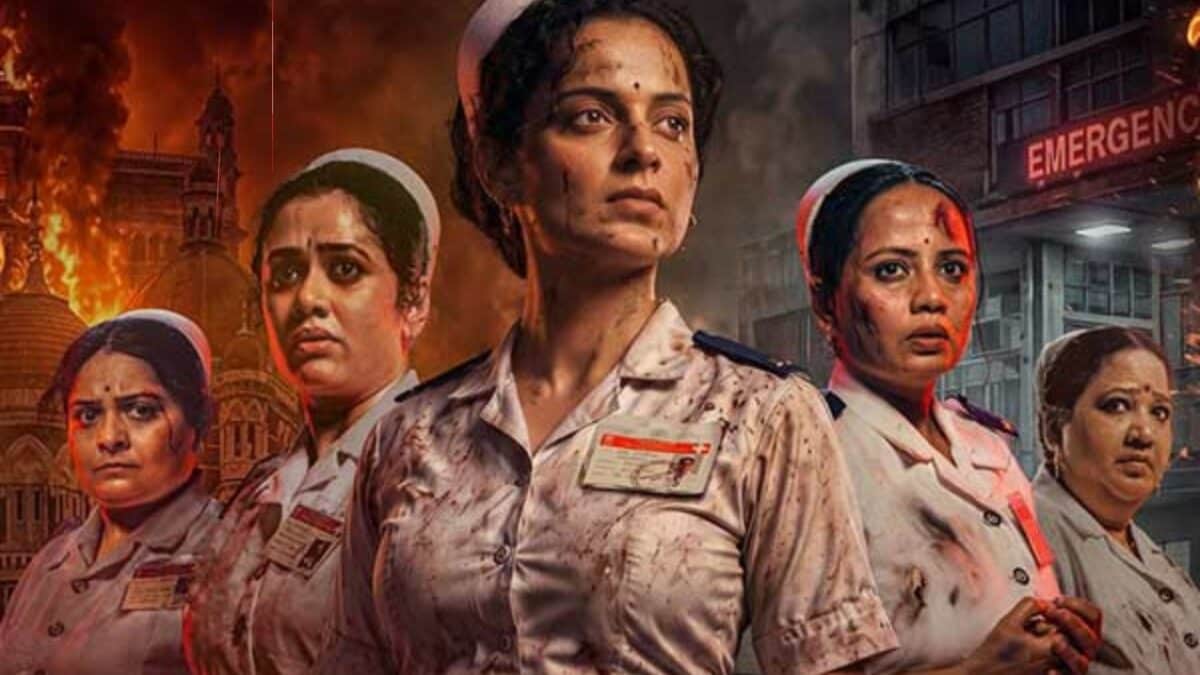
Bharat Bhhagya Viddhaata Review: 26/11 remains one of the darkest chapters in India’s recent memory. Over the years, popular culture has returned to those four harrowing days repeatedly, often chronicling the valour of our armed forces and the barbarity of the terrorists who brought Mumbai to a standstill. Yet, a significant part of the country remains only faintly aware of what unfolded inside Cama Hospital, located barely a walking distance away from CST, and how its nurses emerged as unlikely saviours when Ajmal Kasab and Abu Ismail Khan tried to drag their blood-soaked rampage into another sanctuary of civilians. That is where Kangana Ranaut-starrer Bharat Bhhagya Viddhaata steps in, bringing to the proscenium a story many may not fully know. This Manoj Tapadia directorial shakes you, moves you, and most importantly, leaves you with renewed respect and reverence for nurses.
The film opens with Geeta Madhav, played by Kangana Ranaut, walking into a police station almost a month after the 26/11 attack. The cop acknowledges her as an eyewitness and urges her to give her statement and help identify the terrorist, as her testimony would help the police build an impregnable case against the only captured attacker. Geeta is forthcoming and ready, but her family does not want her to get involved, fearing that her statement might bring them into the spotlight, make them possible targets for any terrorist still lurking outside, or simply drag them through endless rounds of court and police stations. So, when she gets a call from the cop, she initially tells him she will not be able to come for the identification. The police request her once again, stressing that her statement would go a long way in delivering justice to those slain during the attack. With the phone still held to her ear, the film yanks us into a flashback, taking us to November 25.
Since it is the day before the attack, we are introduced to the nursing staff, as the camera beautifully captures the varied employees of Cama Hospital and their camaraderie. For instance, we see a group of nurses standing up to the medical superintendent when she accuses one of them of doing gender determination, even though the nurse had only helped a woman who was in the middle of labour. In the scenes that follow, the film establishes the obvious sisterhood among the nurses. There is Trupti Takle, played by Smita Tambe Dwivedi, and her recitation of a Marathi-tinged version of Ghalib’s verses. There is Sheetal Revagade, played by Girija Oak Godbole, whose dedication to her job remains intact despite verbal jibes from her mother-in-law for being a bad cook and not prioritising household chores. And then there is Geeta Madhav, played by Kangana Ranaut, who extends extra warmth to all her patients and remains composed in every situation. She works extra hard, does not hesitate to take on additional and unwarranted duty, and does not even mind missing her mother’s birthday party because the nurse assigned to the night shift fails to turn up. She occasionally calls her husband for updates about the party, fondly calls him Kaddu, talks to him in adorable code words, has a sharp instinct for understanding medical symptoms and the medicine that can palliate a condition, shares easy banter with her colleagues and remains absolutely selfless and giving. Geeta wants to win the prestigious Florence Nightingale Award. She even has a wooden replica of the same, kept neatly on a shelf. In many ways, she embodies all the qualities of her deceased father, who was in the Merchant Navy: empathy, duty before self, and others before self.
We also get to see the ward boys, security personnel, doctors and workers toiling efficiently, and that is exactly what forms the soul of Bharat Bhhagya Viddhaata. November 25 passes without any trouble, and then the fateful date of November 26, 2008 rolls in. Geeta, who had done a late-night shift the previous night, drops her daughter at her mother’s place, where her mother expresses displeasure over her long shifts, leading to a small verbal argument. As Geeta steps out of the house, her mother mutters, “Mar jaa”, completely unaware of the dreadful situation that will unfold only a few hours later. Back at Cama Hospital, things seem ordinary until Geeta and a few others hear gunshots, mistaking them for firecrackers. But within moments, they find themselves in the middle of a grave situation, as news begins to trickle in about the attack at CST. As the two terrorists, armed with AK-47s and grenades, make their way towards the outskirts of Cama Hospital, the staff, including Geeta, slips into preparation mode. She calms her fellow nurses, who are visibly panicking, and pulls them back to reality by reciting the oath she had taken when she became a nurse, prompting others not to flee, but to save their patients. As the terrorists advance, the entire hospital scrambles to lock the gates, shift patients and take every possible precaution. But will that be enough? That is what the film takes you through in its 2 hours and 7 minutes runtime.
What works in the film’s favour is its pace and how realistic and lived-in it feels, especially as we are slowly acquainted with the characters and their world. The film moves from one scene to another without haste, gradually acclimatising us to the everyday pulse of the hospital: the banter between nurses, the way they tend to patients, endure personal hardships, tolerate the whims and tantrums of patients and their families, and continue doing their duty without complaint. This is where the decision to divide the film between November 25 and November 26 really shines. On November 25, the frames are high in contrast, happy music lingers in the background, people smile, joke and breathe with ease. In contrast, November 26 turns bleak and dark, the music begins to evoke anxiety and uncertainty, and a general sense of tension gathers in the air, something the audience can almost feel tightening around them from across the screen.
The film also subtly highlights how underappreciated our nursing workforce is and how nurses are often looked down upon, their importance diluted in comparison to doctors. In one scene, while Geeta is commuting on a local train with fellow nurses Babita and Sheetal after their shift, they hear a mother scolding her daughter, saying that if she does not study well, she will not become a doctor and will have to settle for becoming a nurse. Babita and Sheetal are clearly enraged by the statement, but Geeta calms them down by saying, “Humara kaam bimari se ladna hai, bimar se nahi.” Their work, she says, is to fight the disease, not the diseased.
This kind of attitude towards nurses can be seen in several scenes, subtly emphasising how they are not revered enough for their contribution. The cinematography is also stellar, especially in the second half, where most scenes unfold in darkness. Unlike many films where low-light sequences become visually muddy, here we are able to decipher what is happening in every scene. That largely works in the film’s favour, because the viewer does not have to make an extra effort to understand what is unfolding on screen. There are also a few well-placed moments of humour that land effectively, irrespective of how tense the scene is, giving the audience momentary respite before pulling them back into the film’s anxious atmosphere.
Another strong aspect of the film is its casting and how the actors never come across as glamorised. For a film like this, that restraint matters. Even the most prominent character, Geeta Madhav, is perceived as an ordinary human being, someone who could be your neighbour or a person you may have crossed paths with in a market. This, along with a strong ensemble cast, elevates the film’s authenticity and realism.
The scenes involving the terrorists, as they make their way into the hospital, climb the stairs and try to locate people to kill, are genuinely nerve-racking. They make your skin crawl with anxiety and might even have you biting your nails, wondering what horror will unfold next. The actor playing Kasab does a phenomenal job of portraying him as closely as possible, and the dialogues between the terrorists make the experience even more horrific.
The music of the film, composed by Aman Pant and Krsna Solo, is both soulful and patriotic. While “Nabz Nabz” has a jazzy and folksy flavour, “O Bharat Mere” carries a slow patriotic fervour, and the title track feels energetic.
The film remains unblemished for the most part, but the only gripe one might have is that the makers could have elaborated more on the lives of the other nurses, much like they do with Kangana Ranaut’s character. That would have made the emotional connection even stronger. It is not that we do not get glimpses into their lives, because we do. But had there been more, the experience would have been even more enriching.
On the acting front, Kangana Ranaut, as always, aces yet another role. Her portrayal of Geeta comes with a dash of simplicity, balance, level-headedness and an overall calm demeanour. Equally, Girija Oak Godbole as Sheetal, Smita Tambe Dwivedi as Trupti, Sunita Thatte as the matron, Asha Shelar as the medical superintendent, Esha Dey as Babita, Prieya L Berde as Harshada, Rasika Agashe as Mohini, Prasad Oak as Kedar, Geeta’s husband, Zahid as Ajmal Kasab, and the other actors do a phenomenal job.
In a nutshell, this Manoj Tapadia directorial is a decent watch, as it brings to light the bravado, duty-bound nature, dedication and service of those who may not wear a conventional uniform, but when push comes to shove, will do anything to safeguard and protect people, irrespective of whether they receive applause or a medal for it. The film is not only a glowing tribute to the brave doctors, nurses and healthcare workers who devoted themselves to serving humanity during the 26/11 terrorist attacks, but also to those who continue to do so at this very moment, selflessly and without caveat.
About the Author

Yatamanyu Narain is a Sub-Editor at News18.com with a passion for all things entertainment. Whether he’s breaking the latest Bollywood news or chatting with rising stars in the OTT world, he’s always …Read More



