


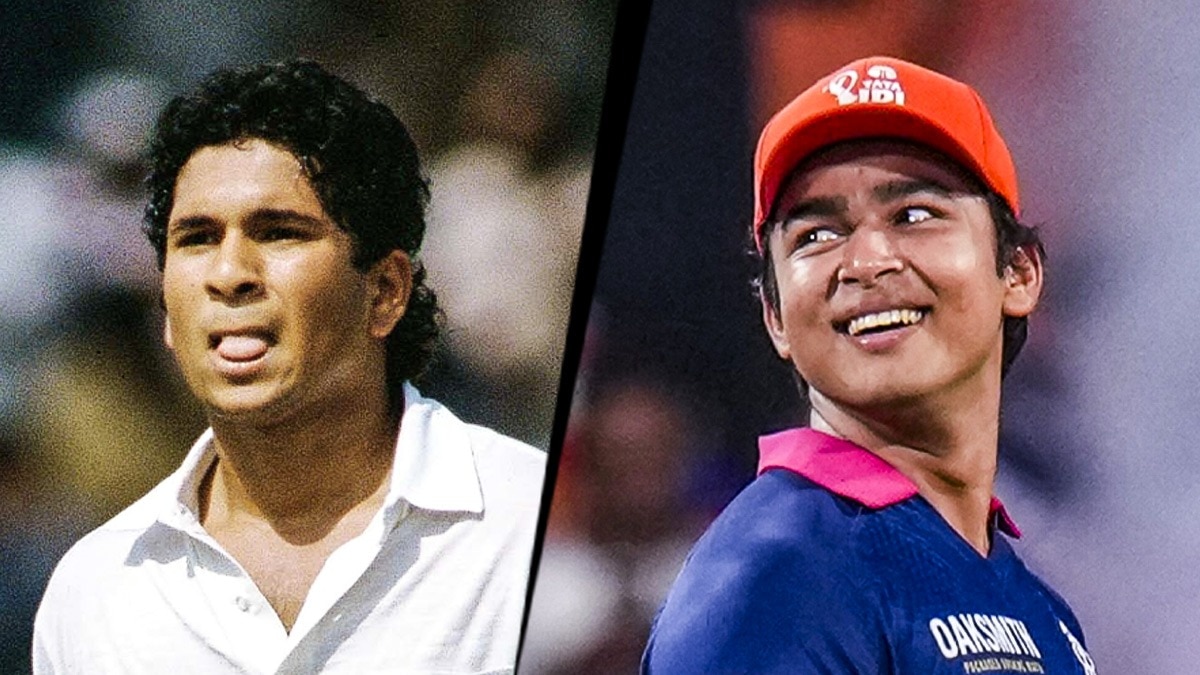
Your phone buzzes. A high-definition vertical video rolls down your feed, set to a bass-heavy Anirudh track. A 15-year-old kid with a helmet three sizes too big effortlessly steps inside a 145 clicks thunderbolt and deposits it into the second tier of an IPL stadium. Within thirty seconds, you’ve dissected his wrist-work, liked the post, and decided exactly where he fits in the pantheon of Indian greats.
Before Vaibhav Sooryavanshi has even earned his senior cap, likely in Ireland later today, he has already been algorithmically mapped, memeified, and consumed by millions. By the time he makes his international debut, there is nothing left to discover. His rise has unfolded entirely in a public cloud.
Which raises a rather surreal question: If this is how we discover our geniuses today, how on earth did India discover Sachin Tendulkar in 1989?
For anyone under thirty, teenage Sachin is essentially family folklore. We didn’t discover him through an algorithm; we inherited him from our fathers, who leaned back in their chairs to recite the gospel of a bloodied nose in Sialkot and four legendary sixes against Abdul Qadir in Peshawar.
We treat those grainy, endlessly recycled clips as Sachin’s definitive origin story, none more famous than that iconic, slightly awkward BBC interview where a curly-haired teenager softly explains his game to Tom Alter.
Except, they weren’t.
By the time Tendulkar walked out for his Test debut in Karachi, India wasn’t discovering a teenager; they were unveiling a deity. Long before anyone pointed a heavy television camera at him, fans knew his name, journalists queued at his school gates, and purists travelled across state lines just to watch a child bat.
Today, seeing is the absolute prerequisite for believing. We demand visual proof in milliseconds. But in the mid-1980s, India had no glowing glass rectangles. You couldn’t stream Azad Maidan or track a schoolboy’s strike rate on an app.
Instead, a simple four-word sentence travelled across the country like high-grade espionage: “There is a boy.”
It was murmured on the parched maidans of Bombay, debated over gin and tonics at the Cricket Club of India, and typed out in smoky newsrooms. Without a single fibre-optic cable, the story travelled. An entire nation had to assemble Sachin Tendulkar in their minds, constructing a prodigy out of cold newspaper typography, crackling radio commentary, and the sheer weight of word of mouth.
If you were born too late to breathe that era in, or if the digital noise has made you forget, let us take you back. This is how Indian cricket fell completely, hopelessly in love with a myth built on whispers instead of wireless data.
THE CRADLE OF CREDIBILITY
Ask four journalists from different parts of the country when they first heard the name Sachin Tendulkar and a remarkable pattern emerges. None of them begin with Pakistan. None of them begin with Tom Alter. None of them begin with Abdul Qadir. They begin with Bombay.
Rajdeep Sardesai’s memory takes him back to the Cricket Club of India. He had not yet become one of India’s best-known television journalists. He was a young cricketer, son of a legendary cricketer, spending time around a club that had become one of Bombay cricket’s meeting points.
“Well, I first heard of Sachin Tendulkar when he was about 13 or 14, playing school cricket,” Sardesai recalls.
“A friend at the Cricket Club of India mentioned that he had seen what he felt was the next big thing in Indian cricket.”
Notice the certainty. Not a promising youngster. Not a talented schoolboy. The next big thing.
The excitement spread quickly through Bombay’s cricket circles. Sardesai remembers signing a petition at the Cricket Club of India requesting that the rules be relaxed so Sachin, despite his age, could become a playing member.
“At the age of 13 or 14, he was already seen as the next big thing,” he says.
“I think this was around the time, or soon after, he was scoring all those hundreds, or shambars as we call them in Mumbai cricket, for Sharadashram Vidyamandir.”
Pause there for a moment and consider the audacity of that reputation. Sachin had not played first-class cricket. He had not represented India. Most people outside Bombay had never watched him bat. Yet conversations around him had become serious enough for one of India’s most prestigious, starch-collared cricket clubs to consider changing its own rules for a child who should have been at home doing his homework. That tells you something about the teenager. It tells you even more about Bombay.
The temptation today is to assume Sachin remained a provincial Bombay secret until Pakistan. He didn’t.
That is where the recollection of senior cricket journalist R. Kaushik becomes so valuable. Long before he went on to cover more than a 100 Test matches, Kaushik was just a student in Coimbatore. He had no afternoons at Azad Maidan, no conversations at the CCI, and no chance of watching Sharadashram Vidyamandir. Yet Sachin’s reputation had already arrived on his doorstep without the help of a single fibre-optic cable.
“Growing up, he was always a phenomenon,” Kaushik says.
“When he was 13 or 14, he and Vinod Kambli had that big partnership in school cricket. Once that happened, and also unlike now, Bombay was pretty much the cradle of Indian cricket. The Bombay cricket pundits and the Bombay media built up their players tremendously. You had no option but to hear about Tendulkar.”
The wording is revealing: You had no option but to hear about Tendulkar. Not because somebody was aggressively promoting him, but because Bombay cricket carried extraordinary, institutional credibility.
“So even though I was studying in Coimbatore,” Kaushik continues, “everybody knew who Tendulkar was long before he made his India debut.”
When asked whether that awareness was limited to hardcore cricket followers, he shakes his head.
“No, not at all. Anybody with even a basic interest in cricket knew who he was. You didn’t have to be obsessed with cricket.”
Pakistan, then, wasn’t India’s introduction to Sachin Tendulkar. It was merely television’s.
THE VIRAL ANALOGUE NETWORK
If Kaushik establishes that the stories travelled, Vikrant Gupta explains how.
“There was no social media. There were no news channels. Nothing,” he says.
“But you had newspapers, and in those days word of mouth travelled. Whatever came out of Bombay, the entire country came to know about it.”
For anyone raised entirely on algorithms, that sounds almost impossible. How could stories about one schoolboy go viral across India without a single clip on your timeline? The answer lies in an India that consumes cricket very differently.
“Today’s fan watches; the fan of the late 1980s read. They devoured publications voraciously: Sportstar, Sportsweek, Cricket Samrat. Newspapers carried full Ranji Trophy scoreboards. County Championship reports found space every morning. Radio commentary drifted out of paan shops, tea stalls, and rickshaws,” Vikrant says.
“We probably knew more about domestic cricket then than people know today.
“If you sat in a rickshaw, commentary would be playing. You walked through a market and a shop would have commentary on with people gathered outside.”
Cricket moved differently. It lingered. A remarkable innings became tomorrow morning’s headline, then an afternoon conversation, then a recommendation passed from one former cricketer to another. Bombay wasn’t merely producing players; it was producing reputations. And no reputation travelled faster than Sachin Tendulkar’s.
The whispers needed proof. They got it one summer afternoon in 1988.
Today, you and I remember the Harris Shield partnership between Sachin Tendulkar and Vinod Kambli as a cold, static number. Mention “664” to anyone who follows Indian cricket, and they know exactly what it refers to. But the number has completely overshadowed the cultural story.
The partnership did far more than create a record. It turned Bombay’s whispers into India’s conversation.
Two teenagers from Sharadashram Vidyamandir batted through an entire day against St Xavier’s in the Harris Shield. Wickets simply stopped falling. Bowlers disappeared into exhaustion. By the time stumps were drawn, Tendulkar was unbeaten on 326 and Kambli on 349. Together they had put on 664 runs, a partnership that became the stuff of cricketing folklore.
If that happened today, every boundary from that innings would have found its way onto social media within minutes. Back then, every run became an oral history. The newspapers did the rest. For Kaushik, sitting hundreds of kilometres away in Chennai, that innings became impossible to ignore.
“Once that happened, everybody started talking about him,” he recalls.
The Harris Shield didn’t introduce Sachin to Bombay; it introduced Bombay’s Sachin to the rest of India.
THE PIED PIPER OF THE MAIDANS
Rajdeep Sardesai remembers just how inevitable Tendulkar’s rise already felt by then.
“Well, Sachin Tendulkar was a schoolboy sensation, and certainly everyone who followed cricket in Mumbai, which is the home of cricket, knew about Sachin Tendulkar. There was this schoolboy prodigy who was poised for great things.”
He believes that was the first stage of Sachin’s rise.
“I think Sachin Tendulkar was first a Mumbai cricket star because he became such a prolific scorer in Mumbai school cricket. The rest of the country came to know of him when he made his first-class Ranji debut and then, of course, he was picked for India at the age of 16.”
That distinction matters. Sachin did not become famous overnight. He graduated from a neighbourhood sensation to a city phenomenon, and finally to a national curiosity. Every single step happened before Pakistan.
Vikrant Gupta believes Bombay itself was the catalyst.
“Bombay was pretty much the centre of Indian cricket,” he says.
“The former players, selectors, journalists, everybody was there.”
He paints a picture that feels almost impossible to recreate today. The day’s cricket would end, but the conversations wouldn’t. Former India cricketers gathered at the Wankhede or the Cricket Club of India over tea. Coaches discussed promising youngsters, journalists swapped notes, and administrators listened. If one respected voice endorsed a teenager, the story travelled quickly through cricket’s tightly knit circles.
This was Indian cricket’s information network before the internet. It wasn’t driven by algorithms; it was driven entirely by credibility. If Bombay’s cricket fraternity said there was a prodigy worth watching, people listened.
No one understood that ecosystem better than the players growing up within it.
Naz remembers another vignette, perhaps even more revealing of the era. The day after scoring a century on his Ranji Trophy debut for Bombay, Sachin did not spend the next morning celebrating. He went back to school to play for Sharadashram in a school match. The crowd, however, was no longer a school crowd.
“I heard this from Amol Muzumdar, Sairaj Bahutule and others who were there,” Naz says.
“The whole ground was packed. He hadn’t even played for India yet, but people just came to watch Sachin.”
Think about that image. A school match, no television coverage, no social media promotion, and no broadcaster
asking fans to turn up. Just pure word of mouth. Naz smiles when he recalls the phrase Amol Muzumdar once used for the teenager.
“He was the Pied Piper of cricket.”
Wherever Sachin went, people followed. Not because they had watched him on a screen, but because they had heard enough to believe they were about to witness someone extraordinary.
THE NEW DAWN
By the time Sachin made his Ranji Trophy debut for Bombay against Gujarat in December 1988, the anticipation had become impossible to escape. Rajdeep Sardesai had joined The Times of India as a young reporter barely a month earlier. He desperately wanted to watch the teenager everyone had been talking about
.
“The Times of India office wasn’t too far from the Wankhede,” he recalls.
“I requested my editor to give me the afternoon off. He reluctantly agreed.”
It wasn’t an assignment; it was pure curiosity. For nearly three years, Bombay had insisted there was a once-in-a-generation cricketer growing up in its maidans. Sardesai simply wanted to know if the city had exaggerated. It hadn’t. Sachin scored a century on debut. Sardesai rushed back to the newsroom convinced he had seen something remarkable.
“I came back to the office and told Darryl D’Monte, my editor, that I’d seen a new dawn in Indian cricket. I asked if I could write about it.”
The piece became Sardesai’s first front-page byline.
“I may not have got many of my political predictions right,” he says with a laugh, “but I certainly got that cricket prediction right. Sachin Tendulkar was going to be very, very special.”
Perhaps that is the most remarkable part of the story. The Ranji hundred did not create the hype; it justified everything Bombay had been saying for years. By then, the sentence had travelled almost everywhere. There is a boy. The rest of India was finally beginning to believe it.
The stories, however, still needed one final examination. No school tournament, no Ranji Trophy match, and no glowing recommendation from Bombay’s cricket establishment could answer the question everyone was really asking. Could a 16-year-old survive international cricket?
In November 1989, India finally found out. The tour to Pakistan has since become one of the most replayed chapters in Indian cricket history. Every generation has watched the same archive footage: the teenager adjusting his floppy hat, the Tom Alter interview, Waqar Younis striking him on the face in Sialkot, the blood trickling down his nose, and the over against Abdul Qadir in the Peshawar exhibition game.
For millions of younger fans, those moments are where the Sachin story begins. Rajdeep Sardesai remembers watching them unfold in real time.
“I think most of the country saw Sachin Tendulkar play for the first time on TV when India went to Pakistan in 1989,” he says. “That’s when we saw him on black-and-white television playing the likes of Imran Khan, Waqar Younis and Wasim Akram.”
He pauses when he reaches the image almost everyone remembers.
“I remember when he was hit on the head. Most people thought, ‘What’s going to happen to this 16-year-old?’ Guess what? He got up and went on to play a great innings.”
Then came Peshawar. The exhibition match. Abdul Qadir. The teenager dancing down the wicket against one of the world’s finest leg-spinners.
TWO DIFFERENT ERAS
It is impossible to disagree, but perhaps arrival isn’t quite the right word. Pakistan introduced Sachin Tendulkar to television audiences; it did not introduce Sachin Tendulkar to India. That had happened much earlier.
It is a tale of two entirely different civilisations.
Vaibhav belongs to an era of instant gratification, where every boundary is clipped for a vertical feed and every milestone becomes a push notification. Sachin belonged to an analogue India that traded in patience: a country that had to construct its heroes entirely in the mind, building a prodigy out of cold newspaper typography, crackling radio commentary, and pure, unadulterated word of mouth.
When a 16-year-old Tendulkar finally walked out to bat in Karachi in November 1989, India wasn’t meeting a stranger. It was finally putting a face to a myth. And perhaps that is the most extraordinary part of his rise: the rumour had already conquered a nation, but the boy still managed to exceed it.
All because of four whispered words that changed Indian cricket forever:
“There is a boy.”
– Ends



