


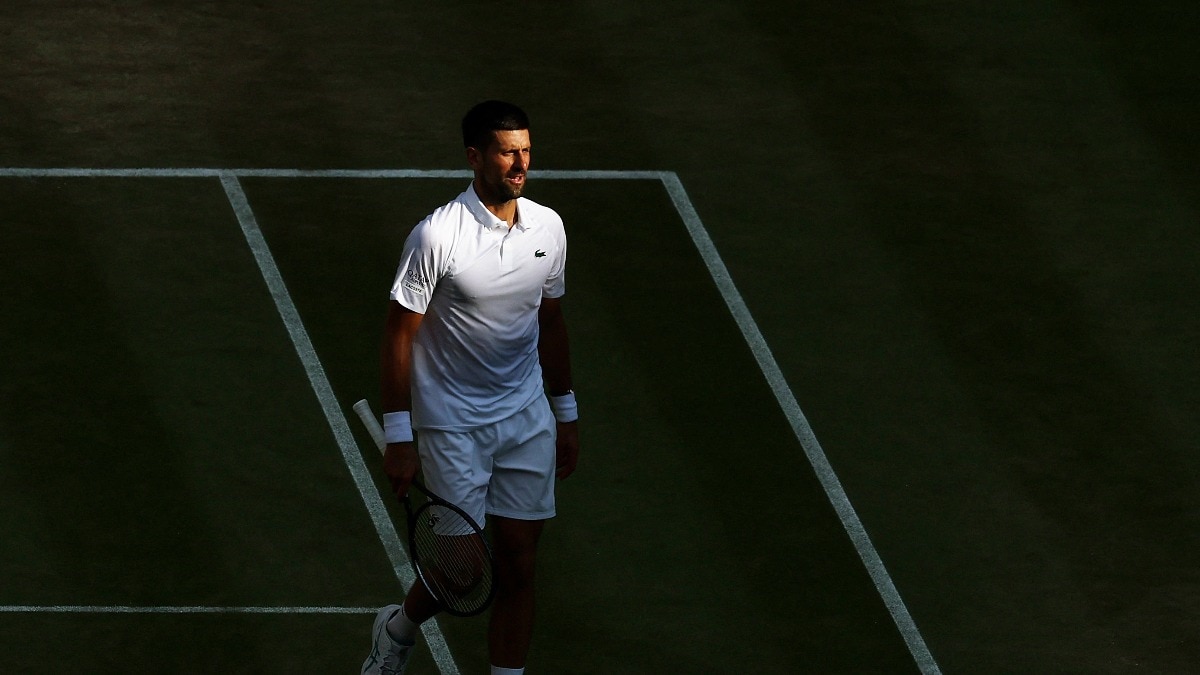
Time doesn’t announce itself. It waits. And on one Friday evening in July, it came to collect.
In January, in Melbourne, Novak Djokovic had made that debt look avoidable. Four hours and nine minutes, 3-6, 6-3, 4-6, 6-4, 6-4, and Jannik Sinner, the man tennis now calls the robot version of prime Djokovic, a serve with a sting in it, a return as good as the sport has ever produced, no discernible weak side, had simply been outlasted. Something in Djokovic that afternoon refused to be 38. Semi-final in five sets, the record books rewritten again.
Cut to Centre Court, six months on. Djokovic was 39 now, and he’d reached this semi-final, against Sinner again, off the back of an all-timer: five hours and fifteen minutes to see off Felix Auger-Aliassime the previous Tuesday, the longest quarter-final in Wimbledon’s history. Two full days and an extra afternoon to recover. Against most men, that would have been plenty.
Sinner gave him nothing. This wasn’t a contest so much as a settling of accounts, a serve that arrived like it had been fired rather than struck, sometimes cramping Djokovic’s body, sometimes disappearing out wide, always followed by a sprint to the net to end the point before it had a chance to become one. Djokovic matched him for a while, levelling at 4-4 in the first set. Then the break came, and Sinner never so much as glanced back. Two hours and twenty minutes, and it was done: 6-4, 6-4, 6-4. A knockout dressed up, politely, as a tennis match.
If Tuesday had said Djokovic was still outrunning time, Friday was the correction. He gave everything he had, and it wasn’t enough against a serve with no weaknesses and a baseline game with no give. There was something almost cruelly poetic in it: Sinner did to Djokovic, point for point, exactly what Djokovic spent two decades doing to everyone else.
The gap was in the smallest margins. Sinner handed him precisely one break point all match, in the third set, nearly two hours in, and answered it with one of sixteen aces nobody got a racquet to. Djokovic didn’t break Sinner’s serve once, all afternoon. He saved ten of thirteen break points against him. In Melbourne, he’d saved sixteen of eighteen. The difference between those two numbers was, more or less, the entire match.
“It was a good old blow out. Not much I could do,” Djokovic said afterwards, the most efficient postmortem of a demolition ever delivered by the man who’d just survived it.
THE CONUNDRUM
Here’s the number underneath all of it: nearly three years since his last Grand Slam. The 25th major, the one that would leave him alone at the top of the only list that has ever mattered to him, keeps receding a tournament at a time. By every visible measure, the clock is winning. And yet Djokovic has already promised one more dance at SW19 next year, as if daring it to try and stop him showing up.
So why keep going, when the number keeps not arriving?
Partly, it’s the number itself, the singular pull of becoming the only player in history with 25 Grand Slam singles titles. Records have driven Djokovic for too long to pretend otherwise.
But something quieter has begun to matter too.
For years, he lived as the third name in a rivalry that belonged emotionally to Roger Federer and Rafael Nadal. He won more than both, broke more records than either, yet rarely inspired the same affection. Respect came easily. Love often didn’t.
It is one of sport’s oldest ironies: sometimes greatness has to begin disappearing before people fully appreciate it.
That has begun to change only as the finish line has come into view. Centre Court rose for him on Friday with a warmth that would’ve felt unfamiliar a decade ago. Every winner drew applause. Every impossible retrieve earned another roar. The crowd tried to carry him through one more fight against time.
It changed nothing about the scoreline.
At 39, that’s the question in front of him, one that demands as much defending as anything he ever produced with a racquet in hand.
Should he keep going?
The case for yes sits right there in the results: four Grand Slam semi-finals last year, a final this year, now a semi-final in London, a man still dismantling players half his tennis age without visible strain. The case against is just as plain: he cannot get past the two men currently running the sport. Sinner and Alcaraz have shut the door on him, then shut it again, then shut it a third time.
He’d explained the shift in his own thinking after Melbourne. Not long before that win, he’d said getting past the Big Two felt improbable. Having done it, he corrected himself, in real time: not impossible. He proved it, in front of everyone. And still, between the two of them, Sinner and Alcaraz keep finding a way to hold the 25th one match out of reach.
BLESSING AND CURSE
He keeps arriving. He never quite arrives the rest of the way. In his own words from Friday, that’s the blessing and the curse, refusing to sit apart from each other.
“Last year I reached four semifinals. This year, out of three Slams, I reached one final and one semifinal. For 99% of players that would be a very good Grand Slam result. For me, it’s not good enough. Because I’m blessed and cursed to be used to something of the highest degree in terms of results and achievements. In some way I’m also dealing with myself in a sense that I’m telling myself, look, this is amazing that you’re still able to play at such a high level and push the youngsters to the limit for Grand Slam titles,” he said.
It’s a strange kind of admission, a man consoling himself with a version of success that would flatten most careers, while refusing, in the same breath, to accept it as enough for his own. He kept working through exactly that tension out loud:
“But at the same time, I always have the highest expectations for myself. It’s kind of that internal battle of what I’ve been through for 20+ years of my career, what the goals were, the expectations… and trying to also balance it out and trying to be a bit more humble in that sense. I still enjoy the thrill of competition. Maybe I don’t enjoy all the hard weeks leading up to big tournaments, putting myself over and over again through a lot of pain, physically mostly.
“I’m glad that this tournament the body held pretty well. Pretty much every other tournament the last few years it was always something. I feel like when I’m healthy I’m still able to play as a top 5 player, still able to compete at the highest level. I like it. I like this life. Tennis has given me everything in my life and has allowed me an opportunity to become who I am.
“At the same time of course there’s always a question of how far do you wanna go, what you wanna play, how you wanna play, etc. I try to take it, in a sense, a day at a time and see how I feel.
“I don’t have any pressure or no one is forcing me to play. I do it because I really want to and because I still can play as a top 5 player. Let’s see what the future brings.”
No pressure, nobody forcing him, just a man who still wants it enough to keep paying for it in full. Call it what he called it, a blessing and a curse. He never once tried to separate the two. The blessing is that, at 39, he is still good enough to stand in the ring with the only two men who can deny him. The curse is that standing in the ring and winning it are no longer the same thing.
Sinner shut the door on Friday the way doors get shut on a man running out of Fridays.
But Djokovic will be back. Because the blessing and the curse of believing is that it never lets you stop.
– Ends



