


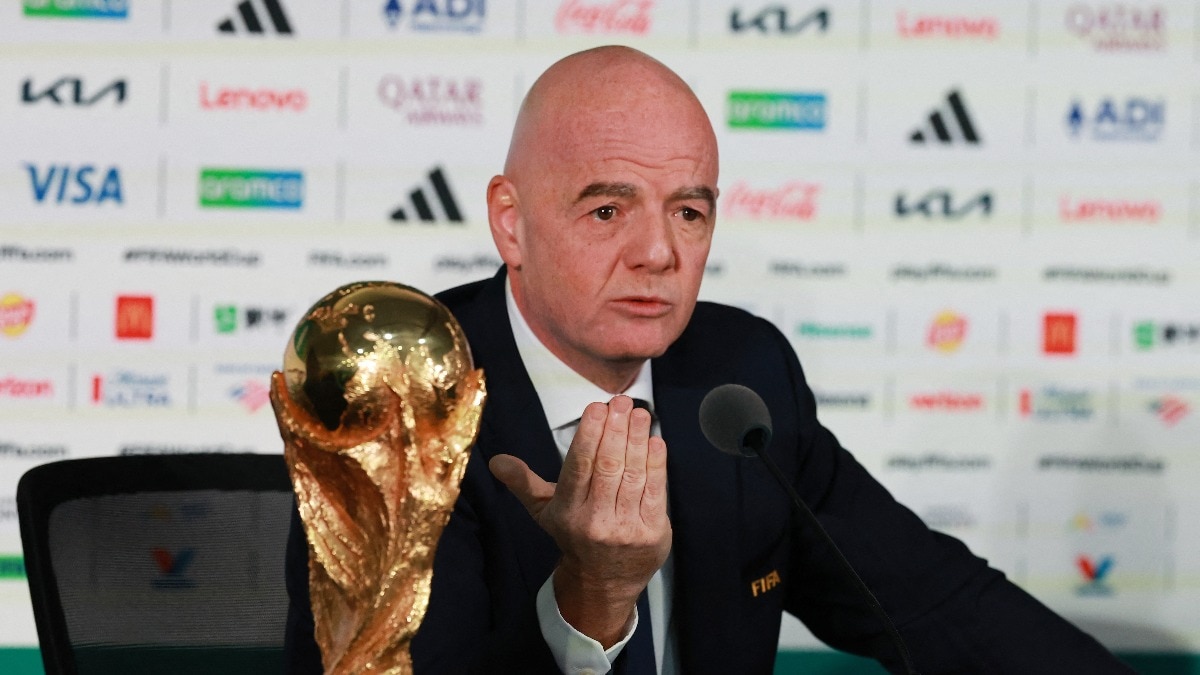
Fresh from the quarter-final stage of the 2026 FIFA World Cup, president Gianni Infantino has dropped a significant hint that the tournament could swell even further, confirming that a 64-team format will be evaluated ahead of the 2030 edition.
Speaking to Swiss media outlet Bluewin, Infantino defended the governing body’s relentless drive for expansion, declaring the current 48-team experiment in North America a “100 per cent success”.
His remarks come just as the tournament’s semi-final line-up was confirmed, featuring traditional heavyweights England, Spain, France, and Argentina. Ironically, despite an expanded field designed to offer greater global representation, the final four consists entirely of established European and South American powerhouses.
Yet, Infantino remains adamant that the path forward involves widening the net.
“It [a 64-team tournament] is definitely an issue that will be examined and discussed in the relevant committees after this World Cup,” Infantino said.
The FIFA president reiterated his long-held stance that football’s marquee event must genuinely reflect the global game, rather than acting as a closed shop for elite nations.
“The World Cup is for the whole world, not just Europe and South America,” he said.
“Every nation should be allowed to dream of participating in the World Cup.
“You can see that the quality of the teams is extremely high – and it’s getting higher and higher, all over the world.”
The expansion to 48 teams for the ongoing edition across the United States, Canada, and Mexico was initially met with widespread scepticism. Critics warned of diluted quality, logistical nightmares, and a punishing schedule for players already bearing the brunt of a congested domestic calendar.
HOW WILL A 64-TEAM WORLD CUP WORK
However, Infantino believes the format has vindicated FIFA’s vision by accelerating the development of emerging footballing nations.
“If you don’t give smaller countries a chance to participate in the World Cup, they’ll lack the incentive to keep improving,” he added.
Should the 64-team proposal gain traction in the boardroom, it would mark a radical overhaul for the 2030 World Cup-the centenary edition slated to be hosted primarily across Spain, Portugal, and Morocco, alongside celebratory opening fixtures in Uruguay, Argentina, and Paraguay.
In the ongoing FIFA World Cup, there were 12 groups of four teams each in the group stage. The top two from each group and the eight best third-placed teams made it to the Round of 32.
A 64-team structure would theoretically simplify the group stages, eradicating the complex mathematics of third-place qualifications in favour of 16 groups of four, where the top two advance to a straight knockout Round of 32.
However, it would also bloat the competition to a staggering 128 matches, inevitably triggering fresh backlash from UEFA, domestic leagues, and player unions over welfare concerns. For now, FIFA’s immediate focus remains on crowning a champion from the familiar continents, but the groundwork for further expansion has been firmly laid.
FIFA World Cup | FIFA World Cup Schedule | FIFA World Cup Points Table | Football News
– Ends



