



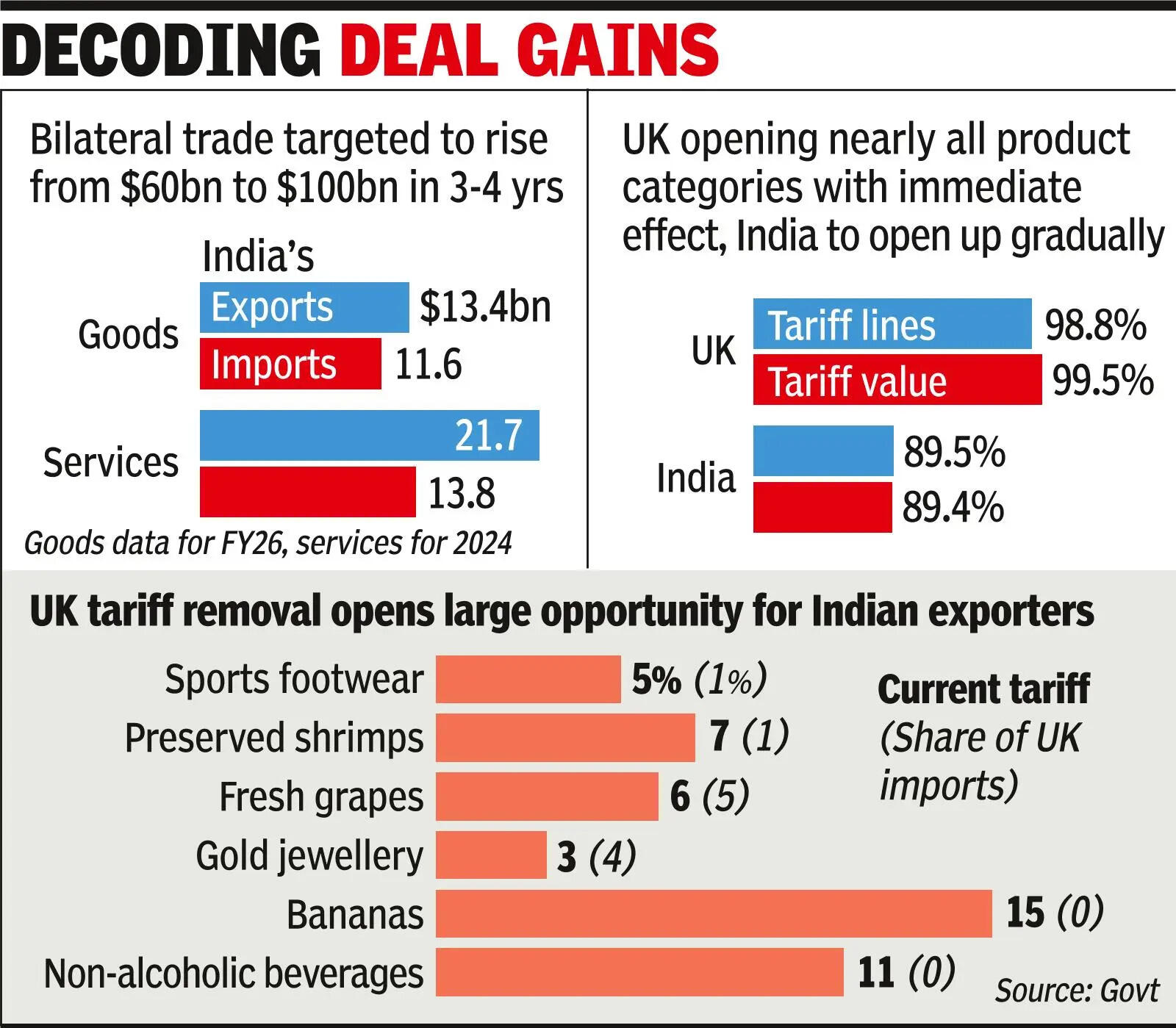
NEW DELHI: After years of negotiations and an over year-long implementation process, the free trade agreement between India and the UK is set to be rolled out Wednesday, opening up the possibility of Indian exporters competing more favourably with shipments from Bangladesh and China, and allowing greater access to Indian service providers and professionals.“The target is that in the next three-four years, we will be able to reach $100 billion,” commerce secretary Rajesh Agrawal told reporters, ahead of the implementation of Comprehensive Economic and Trade Agreement.While Indian textiles, food products, leather and footwear, engineering goods and ph-arma will be among the major gainers from the zero-tariff regime in the UK that kicks in for nearly all products, barring 117, govt has agreed to remove or reduce duties on 89.5% of the 12,000 products. Over 64% products will see immediate duty-free entry into India, while phased elimination has been committed to for the remaining ones. Another 536 items of 4.4% tariff lines, including cars, will see duty cuts. Electric vehicles are not part of the commitment in the first five years.
Expect $100bn Trade In 3-4 Yrs: Commerce Secy
Darpan Jain, additional secretary in the commerce department, said sensitive segments such as dairy, cereals and several farm products are excluded. While India has granted duty concessions on silver imports from the UK, Agrawal said the rules of origin were very stringent.Jain said there was a massive opportunity for India as goods from the country accounted for less than 2% of the $949 billion imports into the UK. Digital delivery of service has also been completely opened up, providing a boost to global capability centres, which have seen interest from global giants looking to tap into skilled and cheaper manpower in India.While there is a more predictable visa regime for business visitors and professionals, companies in the UK will also gain from the Double Co-ntribution Convention as th-ey will not be required to make social security contributi-ons for up to five years for em-ployees they move from India. Currently, Indian employees and their employers contribute 23% of salaries to UK’s National Insurance System.“The contribution is like a tax as employees are unable to draw benefits. Double Contribution Convention will ensure workers will not pay double contributions towards their social security,” Jain said, adding this could result in annual savings of $600 million.The move will benefit over 75,000 Indian workers and over 900 employers.



