


Last Updated:
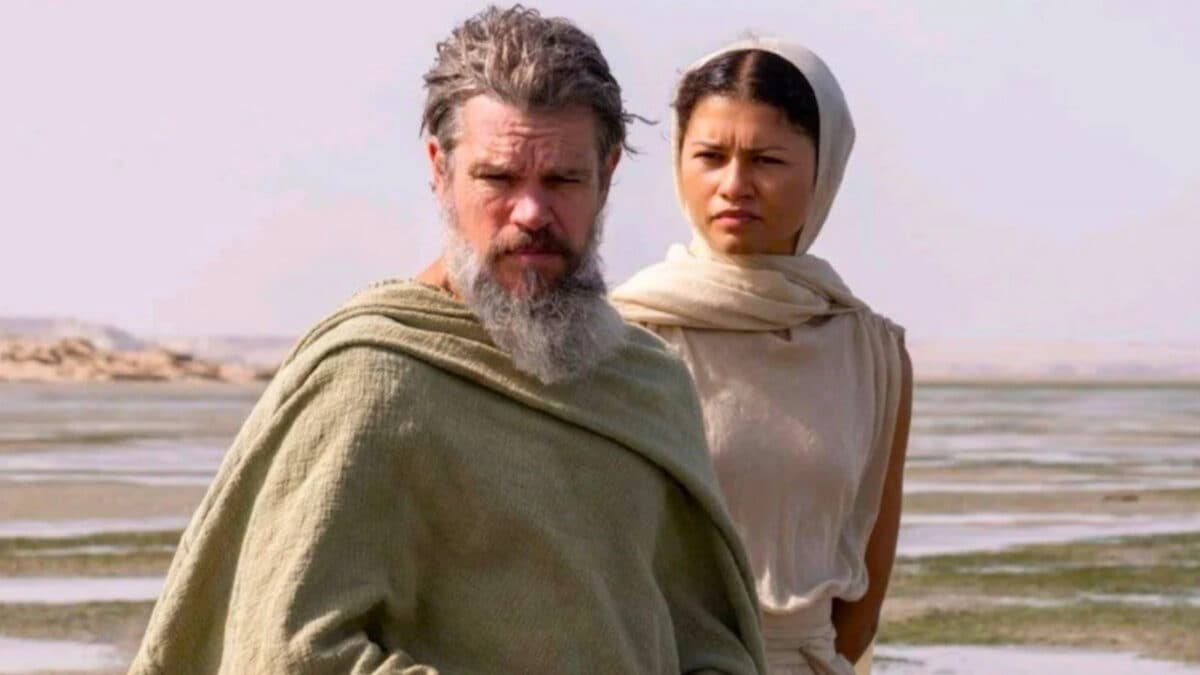
The Odyssey Movie Review: Matt Damon as Odysseus delivers the performance of his career. Anne Hathaway lends Penelope a quiet and steely resolve that anchors its emotional core.




The Odyssey Review: Matt Damon Anchors Christopher Nolan’s Most Visually Stunning, Emotionally Rich Epic Yet
The OdysseyA
4.5/5
Starring: Matt Damon, Anne Hathaway, Tom Holland, Robert Pattinson, Charlize Theron, Zendaya, Lupita Nyong’o and Elliot PageDirector: Christopher NolanMusic: Ludwig Göransson
The Odyssey Movie Review And Rating: In one of the earliest scenes in Christopher Nolan’s The Odyssey, Anne Hathaway’s Penelope says, ‘In this world, a man does what he chooses.’ This forms the core essence of the magnum opus. This privilege of choice and agency is complex as the hero is trapped between choice and duty.
Plot Summary
Odysseus (Matt Damon) spends years trying to return home, yet he is constantly at the mercy of gods, fate, war, temptation and circumstance. His journey is defined by the tension between personal desire and obligations he cannot escape. That complicated interplay of identity, responsibility, individual will and its consequences lies at the heart of The Odyssey.
Based on Homer’s ancient Greek epic, The Odyssey opens with Odysseus having to leave Ithaca to fight the Trojan War to reclaim Helen, the queen of Sparta. After the fall of Troy, his attempt to return home is thwarted by the sea god Poseidon, turning his journey into a grueling ten-year long ordeal packed with spectacular adventures, betrayals and mythological threats.
As they wander the Mediterranean Sea to sail back west, Odysseus and his crew encounter the man-eating Polyphemus, the enchanting but deadly Sirens, the sorceress-witch Circe and the sea nymph Calypso. Back in Ithaca, every night, a house of suitors, including the manipulative Antinous (Robert Pattinson), commandeers the palace and feasts there to win Penelope.
Ithaca has been without king for years and with Odysseus presumed to be dead, Penelope recalls something he told her before he left – if he didn’t return and their son Telemachus (Tom Holland) comes of age, she should decide for herself whether to remarry. To delay her decision and the possibility of remarrying, she tells herself that she would do it only after she finishes weaving a shroud.
But behind the curtains, she quietly keeps unravelling the shroud. For Penelope, ‘a man does what he chooses’ highlights a gendered reality. Men are allowed to leave, fight wars, seek glory and shape their destinies. Women are often left to endure. She waits for twenty years because of decisions made by men – first the Greek kings who launched the Trojan War and then Odysseus himself.
Also See: The Odyssey Cast And Crew
Meanwhile, Telemachus leaves for Pylos and Sparta to learn of his father, who has been missing since the end of the Trojan war. There’s a fraught scene that unravels between Penelope and Telemachus. As her son asserts that the city has been without a king, she argues that she has ruled as the queen and has exercised the power. It’s a clash between authority, gender and legitimacy.
Direction, Visuals And Score
Nolan paints her as not just the ornamental queen consort waiting faithfully for her husband. She’s a political figure in her own right who has kept the kingdom of Ithaca together, maintained order as the men chased glory in Troy and dealt with suitors. But in doing so, Telemachus isn’t reduced to a mere misogynist either.
This is a son who has been waiting as eagerly for the return of his father, the Trojan war hero. He hasn’t met him but has grown up listening to stories about his might. He knows his inheritance is uncertain but that stems from an identity battle. He’s frustrated as his mother’s authority is something everyone benefits from but nobody acknowledges openly.
Back in the sea, Odysseus too is faced with multiple moral and lesser-than-two-evils dilemmas – one among them being choosing to lose his entire ship to a dangerous whirlpool or letting a sea monster devour six of his men. In doing so, he breaks down and succumbs to his sense of self. But these extraordinary emotional complexities, nuances and undercurrents aren’t all that there’s to The Odyssey.
Shot in IMAX cameras, there’s a particular scene at the sea that stands out. It’s a masterclass in framing and portraying a spectacle-driven set piece. The scale and visual grandeur laced with tension and peril is, for the lack of a better word, captivating. After Zeus unleashes a catastrophic storm at sea, the ship is shattered amid intense thundering and lightening.
This sequence is pure cinematic mayhem. The camera rocks, swirls and crashes through the action with the same ferocity as the waves battering Odysseus’ ship. Credit goes to the lighting team for creating a chiaroscuro-like thunder effect. The sequence of complete helplessness and defeat is almost palpable, almost pushing you to the edge of your seat.
In yet another elaborate sequence, Odysseus and his men fight the gigantic Polyphemus, a one-eyed monster inside a cave. Nolan resists the temptation to rush through the spectacle. And gradually, you find yourself completely immersed in this supernatural world. You can barely look away from the screen. At 2 hours 55 minutes, he embraces a deliberately measured pace.
The iconic Trojan Horse episode deserves a mention too. The sequence is depicted in the most cinematic way. The tension comes from the claustrophobia of the warriors trapped inside the wooden horse and Ludwig Göransson’s background score. Here too, Nolan allows the narrative to breathe and the tension to simmer, letting dread accumulate scene-by-scene rather than relying on constant action.
He stretches moments just enough for the audience to feel the weight of what is at stake. By prioritising atmosphere, character and suspense over instant gratification, he transforms familiar mythological episodes into deeply immersive and emotionally charged cinematic experiences. Echoing the sentiment of the internet, The Odyssey is truly peak cinema.
What leaves an indelible impression is that the film doesn’t treat war as a spectacle. The battle sequence where men perish amid flames and devastation, lingers in Odysseus’ mind long after the smoke clears. The images return to him like a recurring nightmare. After breaking Athena’s statue, she starts accompanying him as his figment of imagination. The effect is palpable.
This extraordinary screenplay is further elevated by a string of powerful acts. Damon as Odysseus delivers what may well be the performance of his career. Even in the physically fraught scenes, his vulnerability is what stands out. He brings remarkable restraint to the role, allowing Odysseus’ inner turmoil to surface without ever slipping into melodrama.
Credit must also go to Nolan for resisting the temptation to sacrifice emotional depth at the altar of heroism. Though Odysseus is the quintessential larger-than-life figure, the film never loses sight of his humanity.
Cast Performances
Hathaway as Penelope is like a simmering volcano. She lends the part a quiet dignity and steely resolve that anchors the emotional core of the film. She’s particularly effective in the more intimate moments, conveying longing, loneliness and unwavering determination through the subtlest shifts in expression. Her luminous screen presence will stay with you. Holland as Telemachus brings a sense of sincerity to the part. While Odysseus looms large over the narrative, Holland ensures that his Telemachus isn’t overshadowed.
He gets one of the film’s most rewarding arcs and captures the character’s frustration, vulnerability and quiet resilience with remarkable conviction. Charlize Theron plays Calypso, a nymph, who keeps Odysseus protected in an island for seven years by offering him lotus to ‘cloud his mind and sap his will’. She’s enchanting and the mystery and intrigue that she carries is memorable.
Zendaya as Athena gets a short screen time but leaves an impact and so does Samantha Morton as Circe. Pattinson as Antinous brings an air of unpredictability that constantly keeps you on the edge. He effortlessly oscillates between charm and menace and has a magnetic screen presence even when surrounded by a stellar ensemble.
Nolan also deserves points for his creative liberties – casting black actor Lupita Nyong’o to play Helen, Indian origin actor Himesh Patel as Odysseus’s second-in-command Eurylochus and trans-actor Elliot Page as Greek warrior Sinon. Ultimately, Nolan appears less interested in producing a recreation of Homer and more invested in crafting an interpretation that speaks to contemporary audiences.
Final Verdict
The Odyssey is beguiling, visually breathtaking and emotionally resonant. It’s a monumental achievement. It isn’t just one of Nolan’s finest films but also modern epic filmmaking at its most ambitious and rewarding.
FAQs About Christopher Nolan’s The Odyssey
How long is The Odyssey?
172.33 minutes, that’s 2 hours, 52 minutes and 33 seconds, per its CBFC-certified runtime.
Is The Odyssey based on a book?
Yes, it’s based on Homer’s ancient epic poem of the same name.
Who plays Helen of Troy?
Lupita Nyong’o plays Helen of Troy (she also plays Clytemnestra).
Christopher Nolan’s “The Odyssey” is being hailed as a visually stunning and emotionally resonant epic, with critics calling it a monumental achievement and one of his finest works.
About the Author

Titas Chowdhury is a Special Correspondent at News18 Showsha. She writes about cinema, music and gender in cinema. Interviewing actors and filmmakers, writing about latest trends in showbiz and bringi…Read More



