


President Donald Trump has blamed vandals, but a Washington Post analysis finds that the peeling tracks closely with stages of the renovation process.
The lining of the Lincoln Memorial’s Reflecting Pool peeled away in at least seven places along seams that were created when the material was applied in large rectangular sections, indicating likely problems in how it was installed, according to a Washington Post analysis of visuals and interviews with experts.
President Donald Trump has repeatedly said vandals are to blame for the damage that appeared just two weeks after the $14 million renovation was completed in early June. “The slashes were 300 yards long, and the floor of the pool was cut and then pulled upward, with great force, by these thugs,” he wrote in a post on his Truth Social platform on Monday. On Tuesday, photos emerged on social media that showed the pool had been drained in preparation for repairs.
Interior Secretary Doug Burgum made similar claims in television interviews in early July, saying on Fox News that vandals left gashes totaling 350 feet. “[The lining] didn’t peel off,” he said on CNN, adding that people were “literally trying to destroy part of a monument.”
Post reporters visited the Reflecting Pool on June 25 and identified seven locations where the lining — a waterproof membrane that was painted onto the concrete basin — had partially or entirely peeled away. The peeling occurred in irregularly shaped patches that stretched alongside the long edges of the pool. The pieces ranged in size from a few inches to as long as six feet. In one case, the concrete was visible underneath. (Reporters could not see the condition of the lining in the middle of the basin.)
By comparing the seven locations with satellite imagery, photos and videos taken during the renovation process, the analysis found that all of the failures occurred at the seams — lines between two areas that were painted at different times.

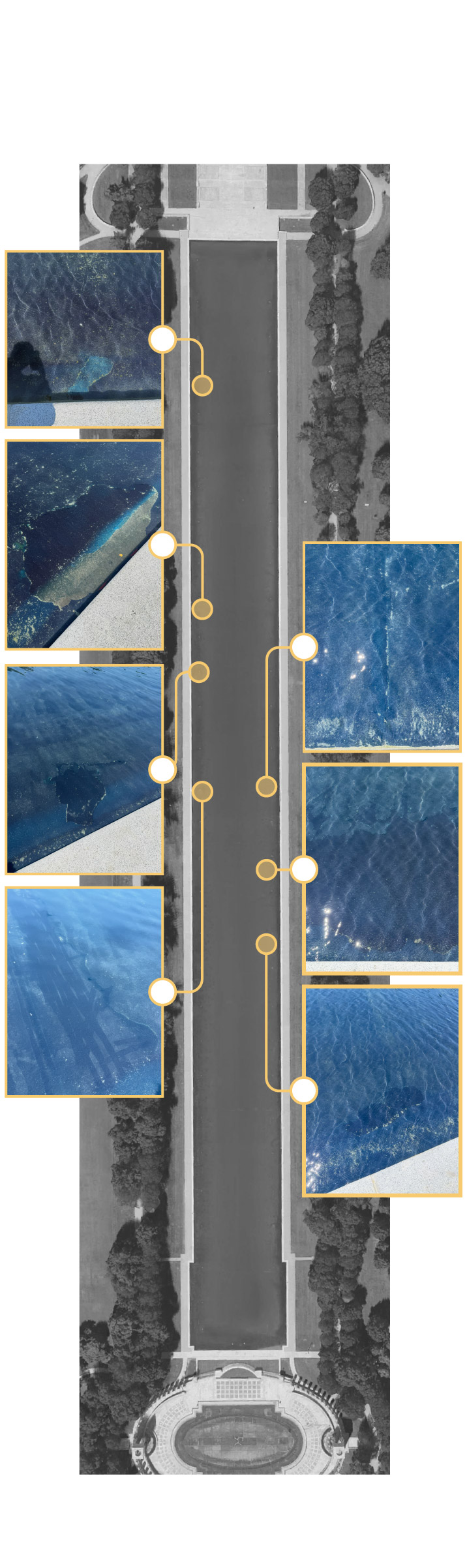
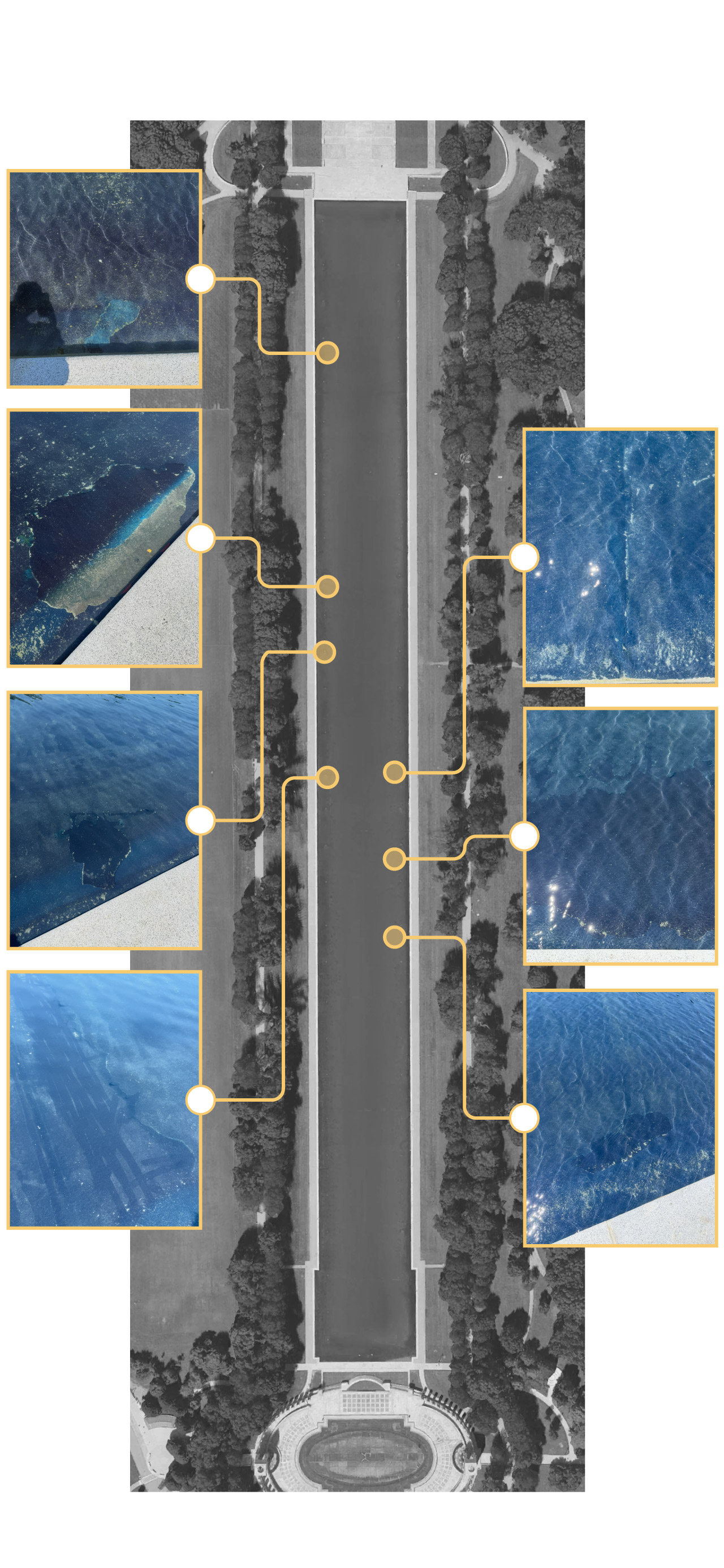
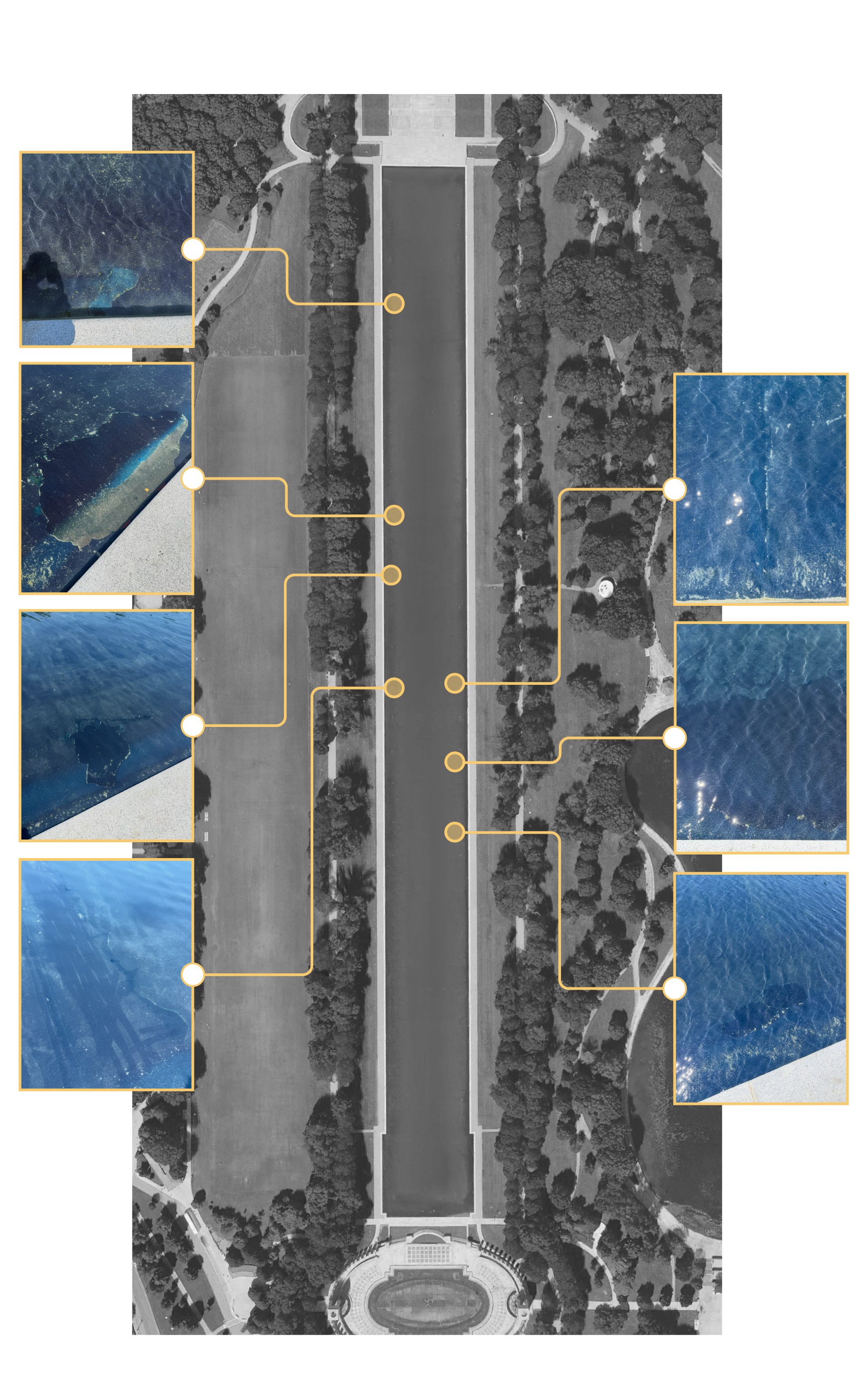
Four experts in waterproofing materials — who have decades of experience and have served as educators and expert witnesses in pool-related construction lawsuits — reviewed The Post’s findings and said the failure pattern strongly suggested errors in the application process. They said that while a precise cause cannot be determined without onsite examination and lab testing, such seams require careful attention and are especially prone to failure.
When The Post shared its findings with the White House and the Interior Department, spokespeople disputed that the surface had been improperly applied. “There were no missteps during the initial repairs to the pool,” said White House spokeswoman Taylor Rogers. “Unfortunately, deranged individuals made several gashes in the side of the pool and destroyed over 300 feet of the pool’s siding. Once the necessary repairs to fix the vandalism are complete, the Reflecting Pool will be restored to all its glory.”
An Interior spokesperson said that “the National Park Service team has walked every foot of the Reflecting Pool, and unlike the exorbitant Obama renovation, the Reflecting Pool is now leak-proof. This project was executed after consultation with the Army Corps of Engineers Engineering Research and Design Center and other leading experts who have experience working on the Reflecting Pool.” Interior said “gashes” are located along the edge of the pool on its perimeter expansion joint, which is where the coating is soft enough to be cut. Officials provided no evidence to support the administration’s assertion that the pool was vandalized.
After the concrete basin was emptied, cleaned and dried, the Reflecting Pool was painted in sections. The sections were coated with two products, both made by the San Diego-based company Rhino Linings, according to the imagery, government records, and public statements by the company and contractors. The process began with Rhino 406, a light blue epoxy base coat applied on the concrete to seal surface irregularities and establish a protective barrier. Next, a thick, sprayed layer of Pipeliner 5000 — a dark blue hybrid polyurea — was applied to complete the waterproof membrane.
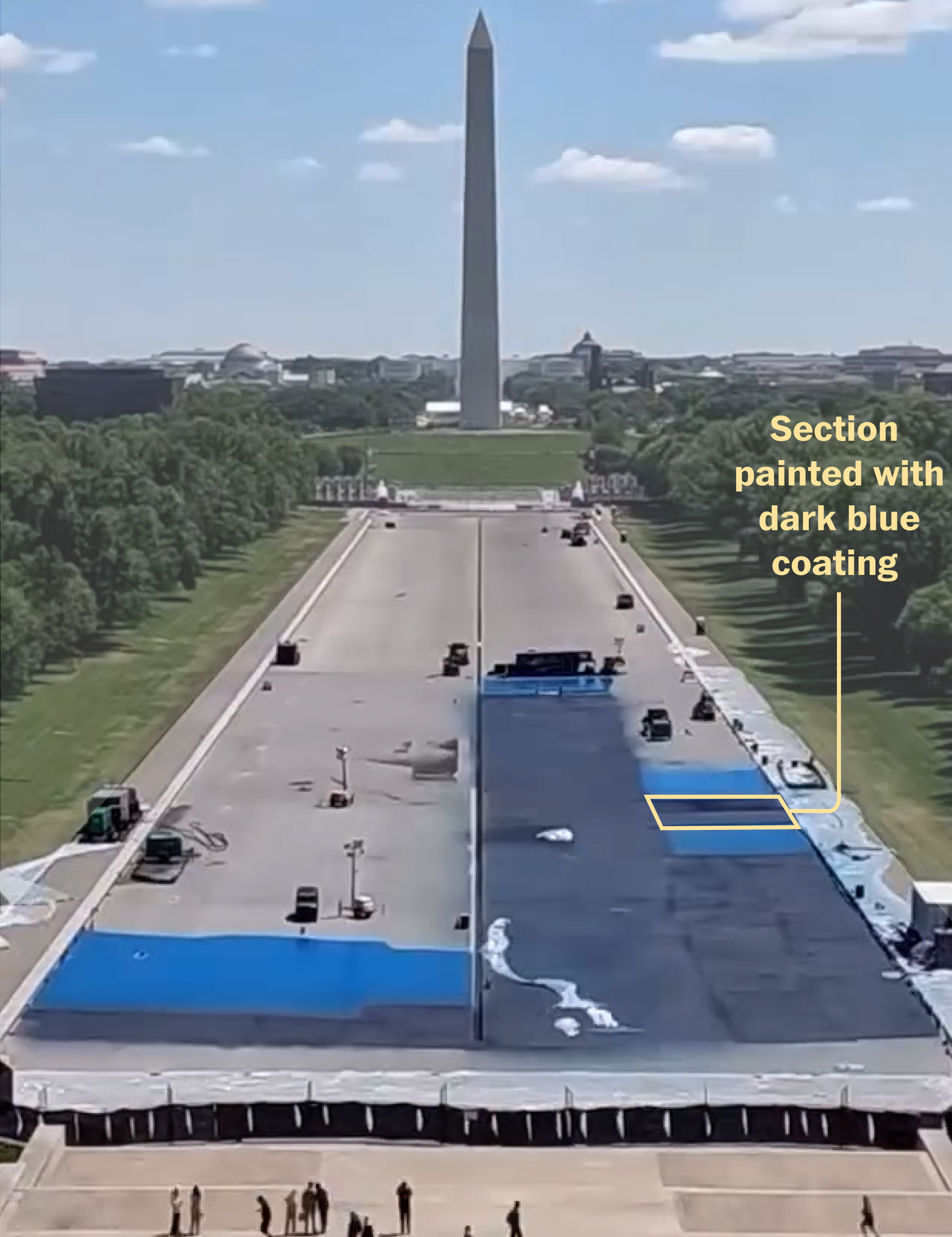
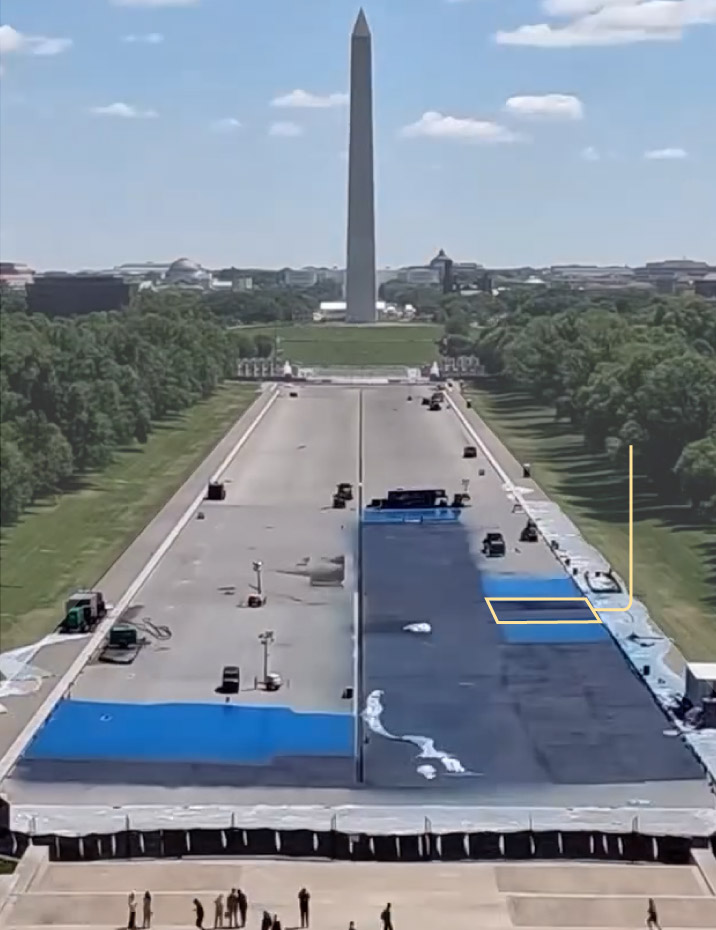
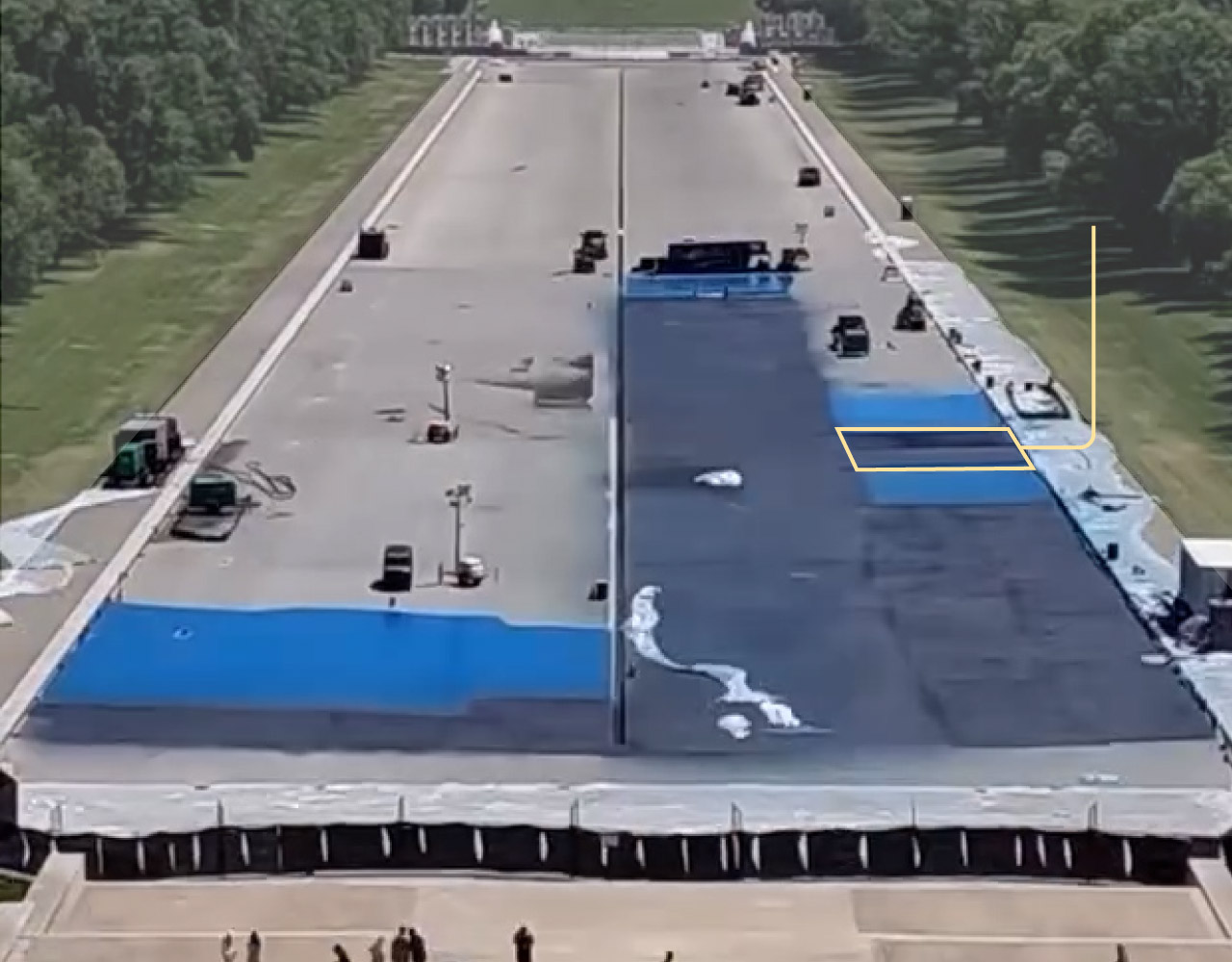
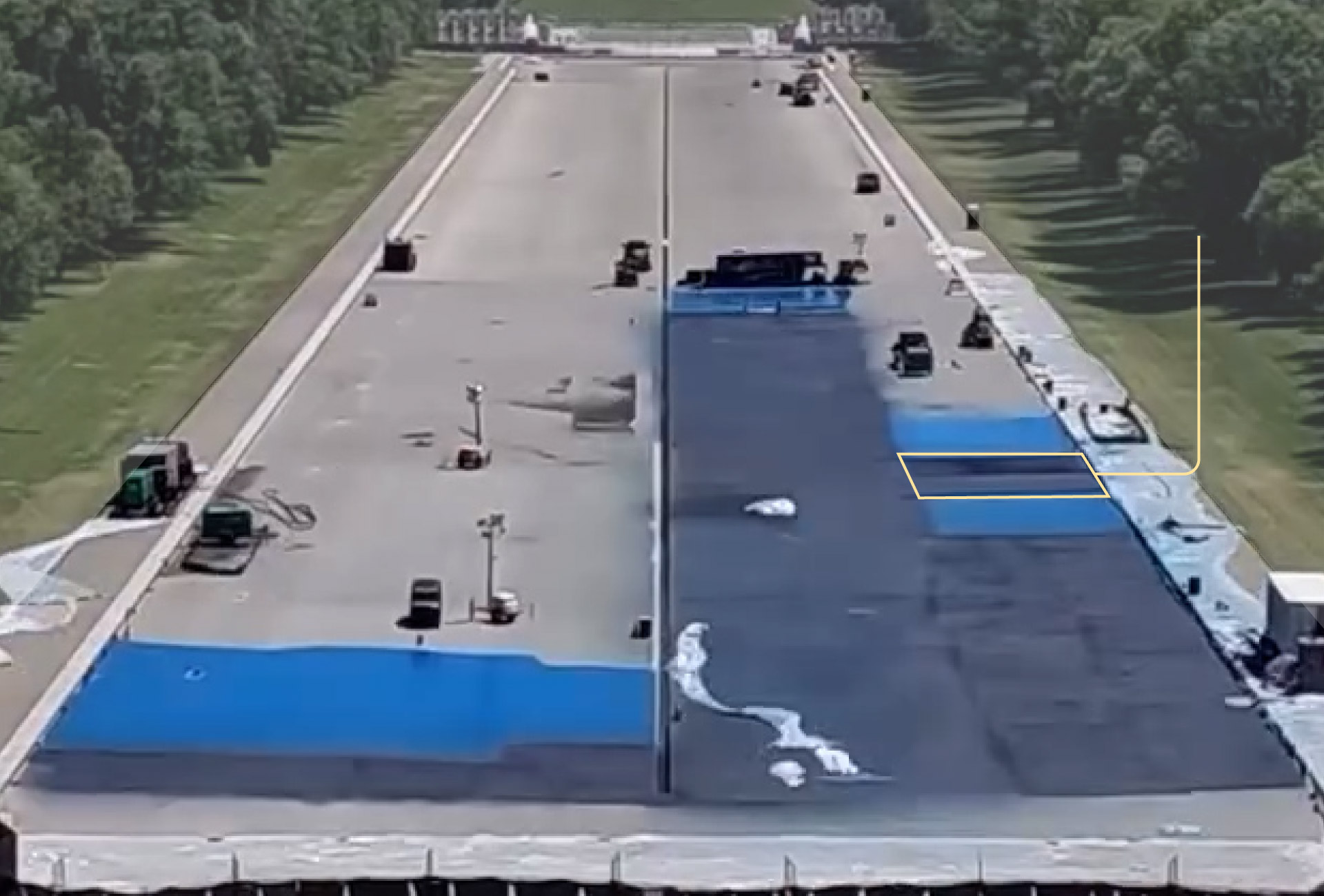
First, the light blue epoxy is applied as a base coat. Then, the dark blue is added as a durable top layer.
On May 3, workers applied the dark blue coating across a rectangular section of the pool.
The next day, they applied the same coating to an adjacent area, producing a visible seam. This is one of the places where the coating failed.
More than a week later, on May 12, multiple sections had been sealed. The new coating failed in at least three places.
By May 15, several more sections were completed toward the east end of the pool. That coating failed in three more places.
In five of the spots, the dark blue Pipeliner 5000 coating had peeled off to reveal more of the same material. Experts said this appears consistent with an adhesion failure caused by an overlap of the dark blue over a dried layer of the same material at the seams. For any overlapping Pipeliner 5000 to adhere, the underlying layer would need to still be wet or, if not, steps would need to be taken to prepare the surface.
Pipeliner 5000 dries within four hours, according to technical documents, depending on temperature and humidity. The Post confirmed that in each of the five spots, more than 24 hours had elapsed between when adjacent sections were sprayed.
At a sixth spot The Post identified, the dark blue Pipeliner 5000 had peeled back to reveal the light blue Rhino 406 primer. The Pipeliner 5000 should be applied within 24 hours of the primer, according to technical specifications. Photos and a video of the renovation process showed that, at this location, it was applied more than 24 hours after the primer, which experts said made it less likely that the two materials bonded properly.
At the seventh spot, both the dark blue coating and light blue epoxy primer underneath had peeled away, leaving the concrete exposed. This was one of three failure points that occurred on top of visible expansion joints built across the concrete basin — which experts said would also strain the coating. The width of the perimeter expansion joint referenced by the Interior spokesperson is not clear from visuals, but at least one failure point appeared directly on the pool’s edge.
When applying the product, the goal should be to have the coating be “as monolithic as possible” and to lay down as much material at one time as possible, said Vito Mariano, president of waterproofing company Basecrete Technologies. “Anytime you have a stop [and] go, you’re going to open yourself up to a problem that might occur,” he said.
The experts agreed that the seams required special treatment, but their assessment of the best approach varied. After reviewing The Post’s timelines, photos and video of the peeling sections and the technical specifications of the sealants used, they said several techniques might have prevented the failures but stopped short of diagnosing a definitive cause.
“If [the seams] are the only place where the failure is occurring, it’s strongly indicative of improper [edge] preparation,” said Michael Bushnell, a retired certified coating inspector for the U.S. Navy.
If a section has already cured, its edges need to be sanded to rough up the surface and cut at an angle before a new set of coatings is applied next to it, otherwise they will fail to bond properly along the new seam, Bushnell said.
Derek Downey, an expert in pool failure analysis who frequently testifies as an expert witness in construction defect lawsuits, recommends placing a separate material, such as tile and grout, between pool sections. That material would act as a physical barrier between separate coating applications, preventing adhesion failures when the coatings overlap.
The available visuals do not show workers applying special treatment at the seams where The Post found failure points, although it’s possible those steps were taken but not photographed. Atlantic Industrial Coatings, the contractor responsible for the project, and Mid-America Industrial Coatings, the subcontractor whose crews helped line the basin, did not respond to questions from The Post. Rhino Linings also did not respond.
On June 21, Atlantic Industrial Coatings said in a statement on its website that the company, along with the U.S. Park Service, had identified areas in the Reflecting Pool that needed repairs. “These areas are a very small part of the massive 7 acre project, and do not indicate a failure of the liner,” the statement said.
Rhino Linings, in a statement on its website, said the company is “aware of reports regarding localized areas of finish coat separation within portions of the Washington DC Reflecting Pool rehabilitation project.” The company added that, based on information provided by the project team, the condition “does not affect the underlying waterproofing membrane.”
New Canton, Virginia-based Atlantic Industrial Coatings was awarded a no-bid contract in April to repaint and waterproof the pool’s concrete floor. A March 31 Interior Department memo justifying the sole-source award said that “only a limited pool of contractors possess the qualification and equipment necessary” to complete the project in time for the 250th anniversary celebration.
In turn, Atlantic Industrial Coatings hired the Oklahoma-based Mid-America Industrial Coatings as a subcontractor to assist in the renovation. The company advertises its prior work with Rhino materials. Its website states that the company aimed to create “a seamless, protective barrier” for the pool.
The pool, which holds approximately 4 million gallons of water, has long had problems with algae and leaks. In 2012, it completed a two-year, $34 million renovation that shored up its floor support system to prevent the pool from sinking. For that project, contractors poured new, tinted concrete for the bottom of the pool and utilized a hydrophilic joint sealing strip, Hydrotite, from the New Jersey company Sika. In June, CNN reported that Sika declined to work on Trump’s renovation after being asked to do so, saying that the quick time frame and the color change made the project “unfeasible.” Sika did not respond to a request for comment.
In addition to the peeling paint, the pool experienced one of the biggest recorded algae blooms in years just days after its reopening.
On CNN’s “State of the Union” on July 5, Burgum said that the pool will be partially drained and that repairs will be completed by Atlantic Industrial Coatings. “We’ll use the same company, because they did a fantastic job,” he said, noting that the repairs could cost tens of thousands of dollars.
Federal authorities have charged at least four people in connection with alleged vandalism, and three of them have pleaded not guilty to misdemeanor charges after allegedly peeling paint off the bottom of the pool and being caught in possession of pieces of liner. One person has been indicted, former Olympian David Hearn, and he has pleaded not guilty to a felony vandalism charge. At a news conference on July 2, U.S. Attorney Jeanine Pirro said National Park Service employees witnessed Hearn “forcefully and violently” pulling at the liner with both hands and turning belligerent when told to stop. No one has been accused of making gashes, according to charging documents.
Salvador Rizzo and Luis Melgar contributed to this report.



