


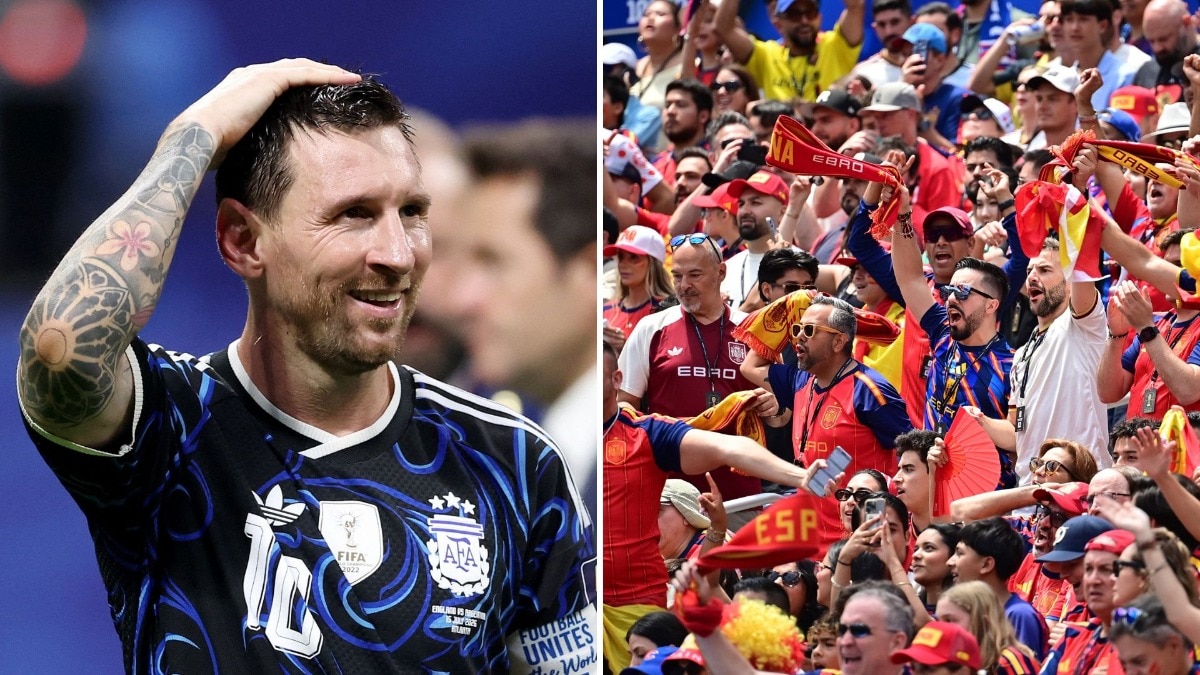
In another version of football history, Lionel Messi walks into the World Cup final wearing red.
The stadium is still packed. The noise is still deafening. Argentina are still on one side and Spain on the other. But the player at the centre of it all stands in a different line.
He is not wrapped in sky blue and white. He wears the colours of Spain.
For years, that possibility existed not in fantasy but in reality.
Before the Ballon d’Ors, before Barcelona’s golden era, before the Copa America triumphs and World Cup glory, Messi was a teenage footballer whose international future remained uncertain. Spain had discovered him, developed him, and, for a brief period, believed it could convince him to become one of its own.
As Argentina prepares to meet Spain in the World Cup final, football finds itself confronting one of the sport’s most intriguing alternate histories. What if the greatest player of his generation had chosen the other side?
One of the most revealing details from that period comes from Gines Melendez, the influential Spanish youth coach who was among the first officials tasked with assessing Messi’s potential. Recalling the first tapes he watched of the teenager, Melendez admitted he barely knew who the youngster was.
“In fact, I thought he was called Leonardo because everyone called him Leo,” he told ESPN, as he recalled the battle for Messi’s international allegiance.
The remark has since become one of the most memorable anecdotes from football’s most famous recruitment battle. At the time, however, it reflected how early Spain’s interest in Messi really was. Officials were still trying to understand who this gifted teenager in Barcelona’s academy system might become.
By then, Messi was already living in Spain. At 13, he had left Rosario and moved to Barcelona after the Catalan club agreed to fund treatment for his growth hormone deficiency. His football education took place almost entirely in Spain. He attended school there, trained within La Masia, and rose through the ranks alongside players who would later become members of Spain’s national team.
Under FIFA regulations, representing Spain was a genuine possibility.
Spanish football authorities quickly recognised what was at stake. The coaches and federation officials followed Messi’s development closely and explored avenues that could eventually bring him into Spain’s youth setup.
Years later, Vicente del Bosque, the former Spain manager who led the country to its only World Cup title in 2010, would openly acknowledge the effort.
“The federation made every effort to get Messi to play for Spain,” Del Bosque said in comments later reported by AS and The Independent. In another interview, he admitted: “We tried everything.”
The pursuit was understandable.
Spain’s golden generation would go on to win Euro 2008, the 2010 World Cup and Euro 2012. Yet much of that success arrived after the period when Messi’s international future remained unresolved. At the time, officials were looking at a teenager who was already generating extraordinary excitement within Barcelona’s academy.
Adding Messi to a side that would later feature Xavi Hernandez, Andres Iniesta, David Villa, Sergio Busquets and others remains one of football’s most tantalising hypotheticals.
Imagine the dominant possession-based football of that Spanish era combined with a player who would eventually become Barcelona’s all-time leading scorer and an eight-time Ballon d’Or winner.
Perhaps no international team has ever come closer to adding a player of Messi’s calibre at precisely the moment its own golden generation was emerging.
But while Spain explored its options, Argentina grew increasingly concerned.
Argentina’s football authorities understood the risk. Reports about Messi’s development were filtering back from Spain, yet many within the Argentine setup had never seen him play in person. Some relied on recordings, recommendations and scouting reports from contacts in Europe.
The concern was straightforward: if Argentina moved too slowly, Spain could move first.
Jose Pekerman, the architect of Argentina’s celebrated youth system and later the country’s national team coach, was among the first senior figures within Argentine football to recognise the urgency of securing Messi’s international future.
In later interviews with AS, Jose Pekerman recalled that he became aware of Messi’s potential while tracking young Argentine players in Europe. Convinced that the teenager could not be allowed to slip through the cracks, he alerted Hugo Tocalli and other officials within the Argentine setup. Together, they began efforts to bring Messi into the country’s youth-team programme.
The story has often been presented as a straightforward battle between two football federations. The reality appears more complicated.
According to Horacio Gaggioli, Messi’s representative in Barcelona at the time, the teenager worried that Argentina knew little about his progress. In ESPN’s oral history of the recruitment battle, Gaggioli recalled that Messi asked him to reach out to Javier Saviola, hoping the Argentine forward could help bring him to the attention of youth-team coaches.
The episode offers a glimpse into how uncertain the situation remained during the early 2000s.
Today, with the benefit of hindsight, it seems almost impossible to imagine Messi representing anyone other than Argentina. Yet many of the people involved at the time describe a very different picture. Spain had a legitimate pathway. Messi lived there, developed there and qualified to play there.
Argentina could not afford to assume his allegiance.
The turning point came when Argentina finally integrated him into its youth setup. Once that happened, momentum shifted decisively.
Officials involved in the process believed Spain’s chances diminished significantly after Messi began representing Argentina at youth level, the ESPN report notes. While Spain continued to monitor developments, the practical reality increasingly pointed in one direction.
Years later, Del Bosque himself would acknowledge the difficulty Spain faced. In interviews reflecting on the episode, the former Spain manager suggested that convincing Messi was always likely to be an uphill battle despite the federation’s efforts.
That leaves football with one of its enduring “what if” questions.
Would Spain have become even more dominant with Messi? Could the side that won three major tournaments between 2008 and 2012 have extended its era of supremacy? Would the combination of Messi, Xavi and Iniesta have produced the greatest international team in modern football history?
There are no answers, only possibilities.
Spain’s story might have changed. Argentina’s certainly would have.
Messi became one of the defining figures in Argentina’s modern football history, helping the national team win the Copa Amrica, the Finalissima and the World Cup. Over two decades, his international career became intertwined with the fortunes of the Argentine national team in a way that few players have experienced with their countries.
That legacy almost belonged elsewhere.
More than two decades after Spain first realised what it might have in Messi, the two countries now find themselves on opposite sides of football’s biggest stage.
By the time the final kicks off, much of the conversation will revolve around tactics, form and legacy. Yet the match also carries a lesser-known subplot, one that began long before Messi became a global superstar.
Spain once imagined him as its future. Argentina ensured he became part of its own. The final offers a reminder of just how close those two stories came to being the same.
– Ends



