


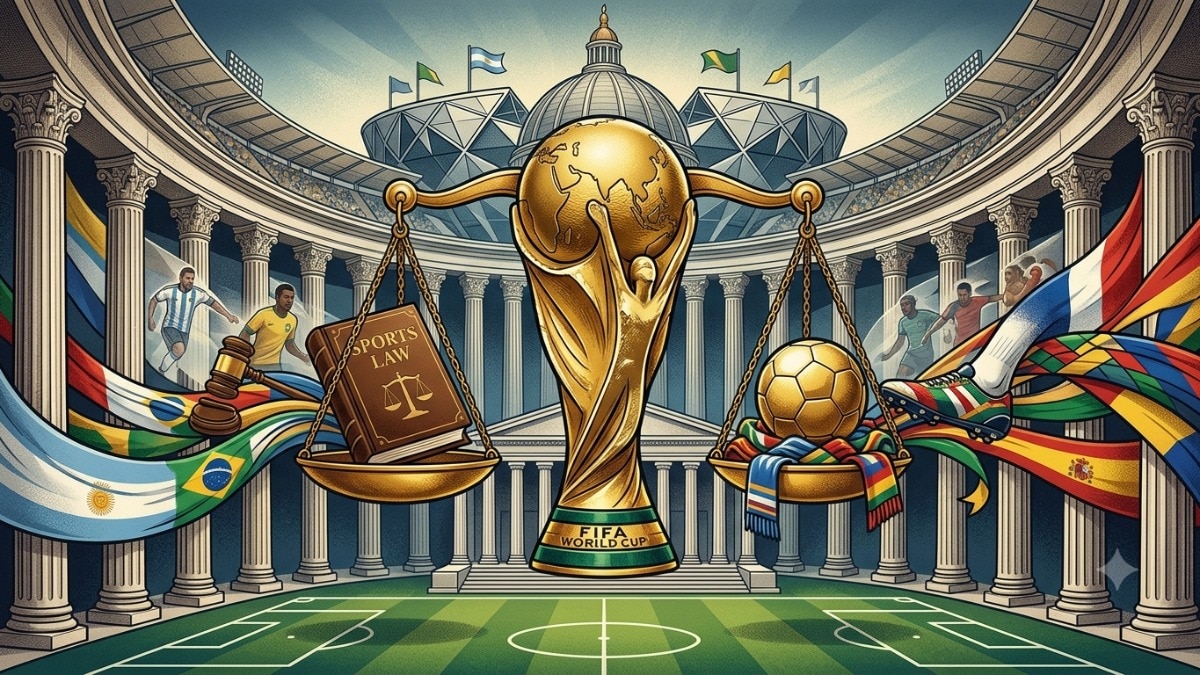
To step onto a football pitch is, in many ways, to enter an analogy of the courtroom. Both the field and the courtroom are ritual-driven arenas where conflict is stripped of chaos and disorder to live and die by a strict meshwork of rules. In both, final, unyielding authority – save for appeals – is delegated to a neutral arbiter (whether they be in referee’s kit, or upon the bench) with the sole responsibility of ensuring that due process triumphs over prejudice. A trial is built upon the foundations of procedure and the sacrosanct rules of evidence to uncover the truth and deliver justice.
A football match, likewise, relies on the sacrosanct Laws of the Game to ensure fairness. Both systems depend entirely on a fragile, hope-filled fiction: that the rules apply equally to all, and that the process is immune to external influence. Both are premised on a simple enough base principle to understand: may the best win.
THE SHARED RITUALS
Yet, as the 2026 FIFA World Cup comes to its final overture across the United States, Canada, and Mexico, that fiction has begun fracturing in real-time. This tournament has been defined as much by administrative and legal friction, or, well, rules-lawyering, as by sheer sporting brilliance. When, for instance, FIFA’s Disciplinary Committee chair, of his own accord, bypassed procedure to reverse US striker Folarin Balogun’s red card suspension, or when the organisation leveraged Article 27 of its code to freeze Cristiano Ronaldo’s competitive ban to allow him to compete in his final World Cup, the decisions did not solely play the role of sparking debate and discourse. They also happened to resemble a slow creep familiar to any legal scholar worth his salt, and certainly any constitutional scholar: the erosion of the protections of due process to protect the powerful and the profitable.
Where rules bend to uphold the interests of the elite, whether on the turf or in the courthouses, the legitimacy of the entire system crumbles soon after. Take away the foundation, and you’ll very quickly find that you’re left with, well, nothing of value.
For decades, the field was treated as a quaint, crude mix of rough-shod contracts and the internal bylaws of voluntary associations. It was the law of private clubs, to each their own, organised into rather disorganised leagues and associations thereafter. Today, however, the rules of the game have become formalised to the hilt, in some cases nonsensically niche, and in others all-consumingly rigid.
THE CORPORATE CREEP
The 2026 tournament demonstrates the shift from the quaint to the commercialised perfectly. In order to protect market value and broadcast revenue, FIFA implemented a tennis-style seeding system that guaranteed top-ranked teams were shielded from early elimination. Even more alarmingly, the introduction of dynamic pricing drove the prices for tickets to the final to over 11,000 USD, effectively pricing out the public from a game initially intended for the masses, and, in the process, triggering consumer protection investigations in New York, New Jersey, Texas, and California.
If the evolution of sports law from the quaint to the corporate represents a victory for the sovereignty of avarice above all else, the tournament itself bares to the world the rotting underbelly of the domestic policies of host nations. The nuance of modern sports lies here: sporting events, indeed, mega-sporting events like the FIFA World Cup, do not exist in a vacuum. They are lenses amplifying the existing flaws of the system they occur within.
Take, for instance, the (invariably Zionist) pre-World Cup backlash to Lamine Yamal celebrating by waving a Palestinian flag; a Spanish player, waving the flag of a nation the Spanish recognise, lauded by his own country’s leaders for the act, harassed by individuals and politicians half a world away demanding that his club (FC Barcelona) and his country strip him of the right to play for them for having dared voice his stance in public. Through the lens of sports, his act is amplified, and the cracks start to show.
THE HUMAN COST
Consider, further, the civil liberties warnings that were issued during the conduct of the tournament by organisations like the ACLU and Amnesty International. The World Cup coincided with an aggressive ramping up of domestic crackdowns on immigration in the United States, denoted by mass detentions, border enforcement surges, and invasive social media screenings for incoming travellers, all covered by the veil of the cause celebre that is the FIFA World Cup. The tournament, marketed down to its 2026 logo – as a celebration of unity, is held against a backdrop of restricted public spaces and unreasonably accelerated deportations. Under the guise of World Cup security, surveillance and vastly more stringent policing measures have ballooned.
Obviously, this friction trickles down to municipal governance, too, and, at a more granular level, to human rights. Across several host cities, local governments have swept their way through encampment removals, displacing homeless populations to pose a sanitised, commercially plastic-perfect image for broadcasters – not unlike what our government here in India seeks to do every time we host a global event, most notably seen in recent times with the hasty repainting, wall construction, and poverty denial that surrounded the G20 meeting.
Sports law is no longer merely about regulating the mechanics of a game alone, or arbitrating contractual disputes with respect to sport itself. It has, especially in recent years, become a key arena where avarice, pride, and human rights openly clash.
For those of us at home, studying the law and enthralled by the World Cup season, the modern, if somewhat nihilistic, message is abundantly clear: the pitch can no longer serve as an idle escape from reality. Nor, as a matter of fact, can sporting be considered a pointless pastime. Even looking beyond the fortunes minted in sports, we must recognise the sheer impact it has, not just in the moment the ball hits the back of the net, but in our daily lives, and in some ways, the very polity we live within.
(Neil Binoy is a Delhi-based Law Student and a columnist on legal issues and policy.)
FIFA World Cup | FIFA World Cup Schedule | FIFA World Cup Points Table | Football News
– Ends



