


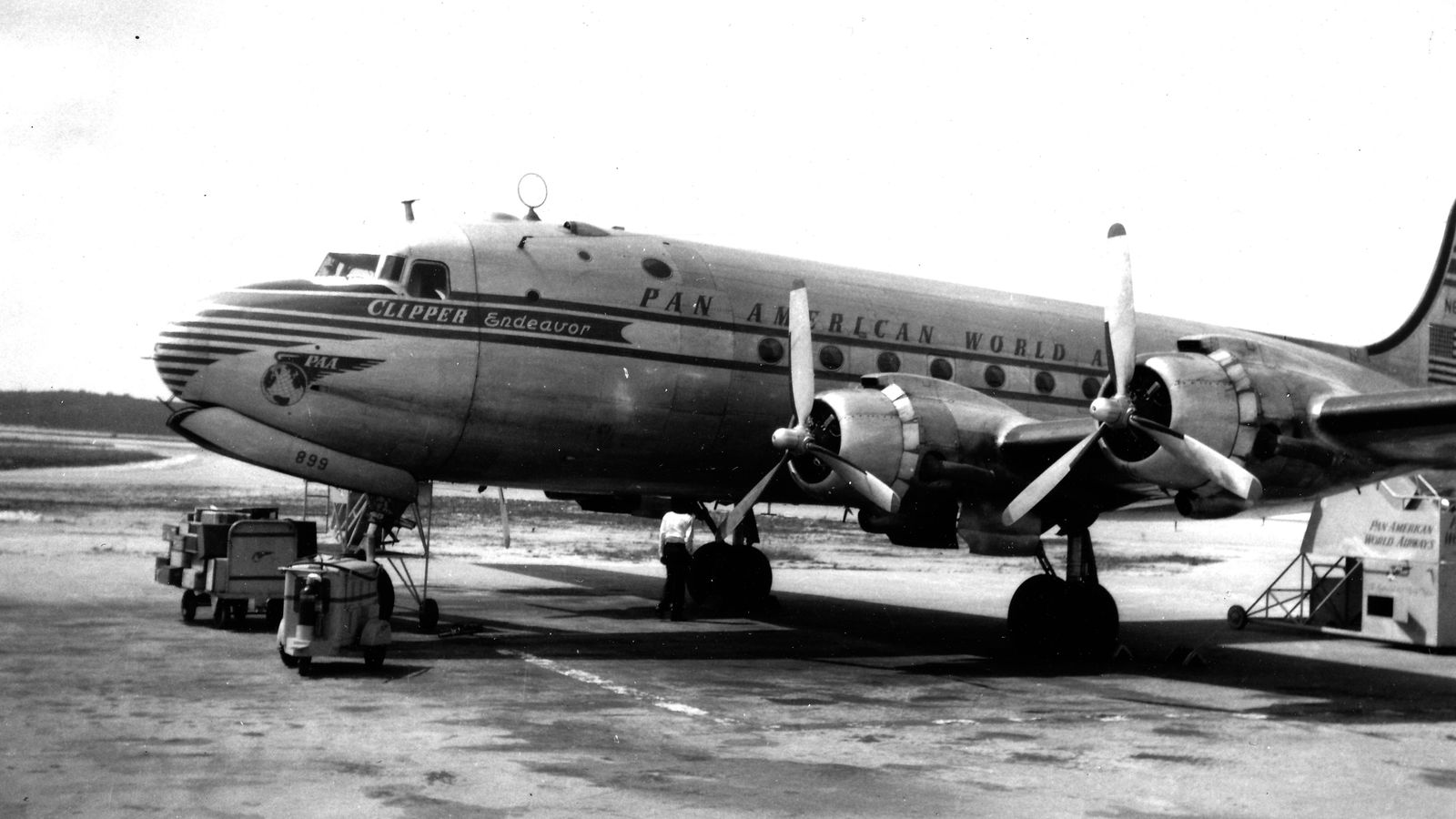
The wreckage of a Pan Am plane that crashed 74 years ago, and led to safety briefings becoming mandatory on flights, has been found off the coast of Puerto Rico.
Explorers found the wreckage of the Douglas DC-4 aircraft, known as the Clipper Endeavor, last month using an autonomous sonar drone to locate the fuselage and tail under 2,000 feet of water.
The plane plunged into the ocean after it lost engine power shortly after take-off from San Juan’s Isla Grande Airport in 1952, killing 52 people.
All 64 passengers and five crew members on board survived the initial water landing, but only 12 passengers along with all the staff were rescued, with the rest being lost with the plane.
In total, only 17 survived as panic set in when passengers struggled to find life jackets and the crew battled to pull out life rafts.
The plane sank and split into two pieces within around three minutes of landing and just nine minutes after leaving the airport in Puerto Rico, on its way to New York.
The tragedy prompted the aviation industry to adopt the requirement for flight attendants to instruct passengers about the location of exits and where life jackets are located.
The introduction of pre-flight safety briefings and emergency procedure demonstrations are still required before all flights to this day.
“This one became a catalyst, and it helped drive safety steps forward of better flotation equipment and the pre-flight briefings,” said aviation safety expert John Cox, a pilot and founder of Safety Operating Systems.
“So this is one stepping stone along the path to what we today enjoy as aviation safety. It was a rallying cry at the time.”
The expedition to find the wreckage was led by the Air/Sea Heritage Foundation, in partnership with the Discovery Channel’s Expedition Unknown show, and other groups.
The crash captured the attention of the foundation’s president and founder Russ Matthews in 2019, when he read that a luggage tag from the flight had washed ashore in Florida.
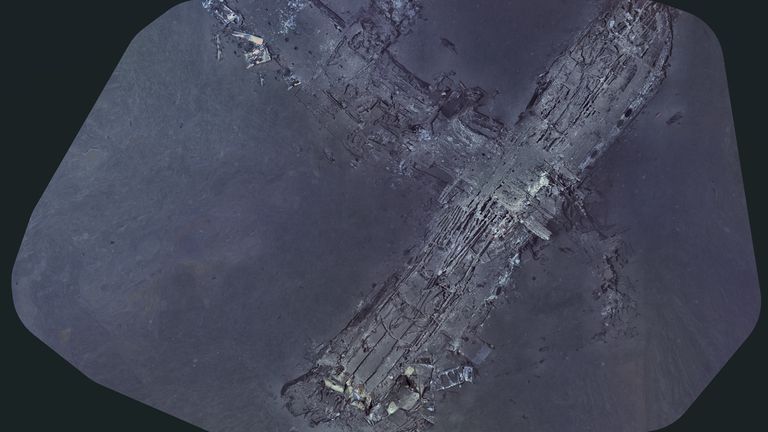
An image of the wreck, that broke into two pieces on the sea floor. Pic: Air/Sea Heritage Foundation and Deep Sea Vision
Driven by the Clipper Endeavor’s historical significance, Mr Matthews spent years digging through Pan Am Airlines and Coast Guard archives looking for clues as to the plane’s whereabouts.
Reports from the Civil Aeronautics Board, which was the predecessor to the Federal Aviation Administration, also offered insight.
But the key to finding the wreckage was in records from a hearing that was held in Puerto Rico on the crash, and a map estimating the location from the pilots on a training flight in the area.
An attempt to find the wreck using a towed sonar array in 2024 was disrupted by bad weather, but Mr Matthews and his team made a second attempt, this time using advanced drone technology.
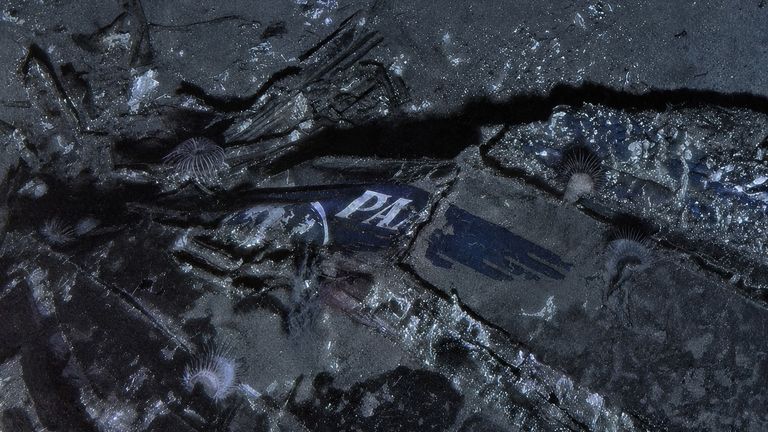
An image of the wreck with the Pan Am logo still visible. Pic: Air/Sea Heritage Foundation and Deep Sea Vision
Tony Romeo, CEO of the undersea exploration firm Deep Sea Vision, had discussed the possibility of deploying an underwater drone when a ship was in the area.
“There we were, and everything kind of came together at the moment: good weather, the right team, and the right equipment and ship. So we took a shot at it,” he said.
Read more from Sky News:
Flying taxis could be built in UK
AI models hacked company
Deep Sea Vision used Mr Matthew’s research and weather data to estimate an area of 10 square nautical miles where the plane was most likely to be.
The drone found the wreck on its first sweep, though this was not discovered until the footage was reviewed later.
“We are all stunned and elated by this discovery yet also humbled to remember what happened in that place so long
ago,” Mr Matthews said.
The moment the wreckage was first seen in the footage was captured in the Discovery Channel documentary, with the team in the control room exclaiming “oh God” and “that’s a plane”.
The documentary will air in autumn this year.
The discovery of this wreck offers new hope for families who lost loved ones in other ocean crashes like Malaysia Airlines Flight 370 that disappeared 12 years ago, killing all 239 people on board.



