



David Weiszfeld has a warning for music professionals rushing to automate using AI: the tech keeps changing, but the core job doesn’t.
Weiszfeld has spent the past decade building data tools for the music industry. After leaving Universal Music and a couple of years managing artists independently, he founded Soundcharts in 2015 to solve a problem he kept running into. The data he needed to understand an artist’s momentum was scattered across dozens of platforms and almost impossible to act on in real time.
Eleven years on, the Paris-headquartered firm says its platform is used by “tens of thousands of artists and companies,” among them all three majors, with some having “built entire products and experiences” on top of its data engine.
According to the company, that engine aggregates real-time information across more than 16 million artists, 84 million songs, 24,000 charts, 7.3 million playlists, and 2,465 radio stations, processing over 200 million data points a day.
When MBW profiled the then-six-year-old startup in 2021, Soundcharts argued it was more than a typical music data aggregator. Weiszfeld had been making a version of the argument since 2016, in an essay on how the music industry should work with data. Since then, he says, the question has shifted from having access to data to how people should work with it in a business reshaped by AI.
Until now, Soundcharts’ two main product lines have been the company’s desktop and mobile dashboards, and its API and data feeds for engineering teams. This month, it added a third, an official MCP server that sits in between the two.
Soundcharts’ MCP launch forms part of a wider trend in the analytics sector. Over the past month, a number of music data firms, including Viberate, Chartmetric, and even royalty-tracking startup Mogul, have launched their own MCP servers, as AI assistants become another place professionals go to interrogate data.
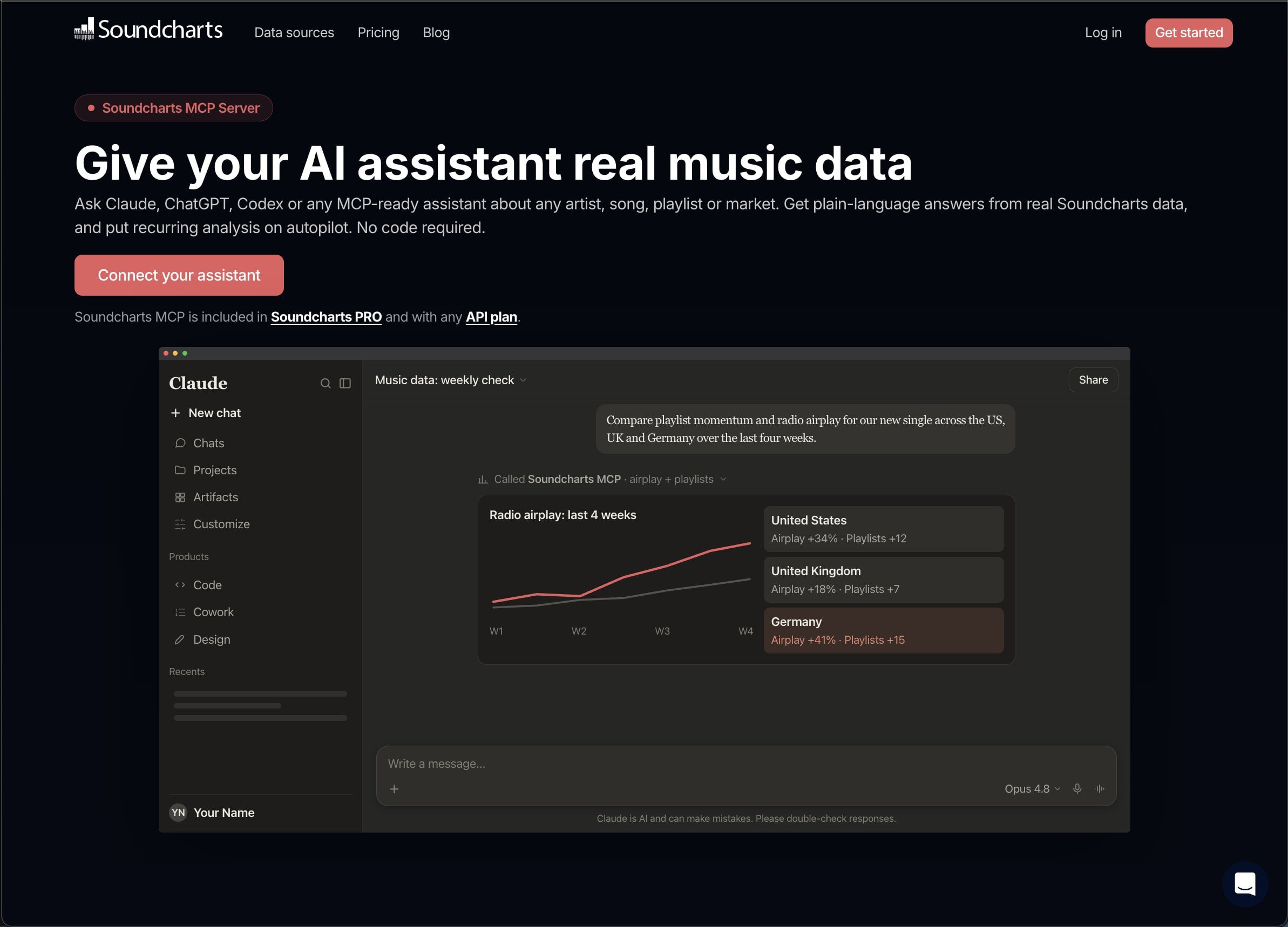
In plain terms, an MCP [Model Context Protocol] lets AI assistants such as Claude, ChatGPT and Gemini query Soundcharts directly in everyday language, then answer with the company’s own numbers rather than whatever the model might otherwise scrape from the open web.
MCP is an open standard introduced by AI company Anthropic in late 2024 and since adopted across the industry, including by OpenAI and Google. Anthropic describes it as a kind of USB-C for AI: a universal connector that lets any compatible assistant plug into an outside data source and pull from it without a custom-built integration.
Weiszfeld frames the three (Dashboard, API, and MCP) as tools for different jobs: the dashboard for the workflows a team repeats, the API for those building products or heavy integrations, and the MCP for the open-ended questions you’d normally ask a colleague. “The MCP was made for having a conversation with the data,” he tells MBW, “not for building products on top of it.”
Much of our conversation, though, is less about the product than about how the industry should be using AI at all.
“Be data-informed, never data-driven,” Weiszfeld says. “And be AI-informed, never AI-driven.”
He’s critical of a practice called “tokenmaxxing,” where AI consumption gets treated as a measure of productivity in its own right. He compares it to the 80-hour week: “Past a certain point you’re not more productive, you’re just busier, and you’ve lost the quiet moments where strategy actually happens.”
He expects a reckoning to follow. After two years of experimentation and rising bills, he says 2027 will be the year companies of every size are asked to show a return on their AI spending, in money and in time. “The boardroom question is already changing,” he says, “from ‘what’s our AI strategy’ to ‘what did it actually return.’”
That question, he argues, lands hardest on music professionals, who tend to feel new technology first; piracy reached music before film, he points out, because the files were smaller. Now, artists are told they “don’t need a label, a manager, a publisher, a distributor”, and the professional is told they will be “replaced by a robot, on margins that were already squeezed”.
He is also placing a bet on where this all leads. “The next user of music data isn’t a person, it’s an agent working on behalf of one,” he says, predicting that within a few years more of Soundcharts’ queries will come from software agents than from humans clicking through screens.
Here, Weiszfeld discusses the launch of Soundcharts’ MCP server, tokenmaxxing, the returns he expects the industry to demand in 2027, and why he believes the job at the heart of the music business will outlast the tools built to serve it…
MBW LAST PROFILED SOUNDCHARTS IN 2021. WHAT HAS CHANGED SINCE THEN?
The honest answer is that the important things haven’t changed. The mission was broad enough from day one: monitor the music market in real time and turn that into intelligence professionals can act on. In a way, that stability is our natural positioning.
Trends come and go, and we aim to be the reliable partner that enterprises and SMBs can count on to power their market intelligence.
What did change is our scale. Soundcharts is used by tens of thousands of artists and companies, and some have built entire products and experiences on top of our data engine.
Our product line grew, but everything we build sits on the same foundation: the at-scale, real-time music metadata and market data engine we’ve been improving for eleven years. Our job is to nurture it and keep building amazing products around it.
YOU NOW DESCRIBE THREE WAYS TO WORK WITH YOUR DATA: THE DASHBOARDS, THE API AND DATA FEEDS, AND THE NEW MCP SERVER. HOW SHOULD PEOPLE THINK ABOUT WHEN TO USE EACH?
It depends much less on who you are than on what you’re trying to do that day. The dashboard is for the workflows you repeat: you open the same view every morning, your roster, your market, and you want monitoring, alerts, reports, a screen the whole team shares.
The API is for when you’re building something, a product or an internal integration; once the volumes get heavy, data feeds make more sense, because we push the data directly into your stack instead of your team pulling it manually. And the MCP server is for questions: the open-ended, cross-cutting ones, the kind you’d normally ask a colleague.
Honestly, the most useful thing a vendor can do right now is tell you when not to use each one, because that’s where teams waste money. If your dashboard already shows the number, asking an assistant for it is just slower.
Refreshing a page beats chatting for anything repetitive, because we all have what I’d call an interface bias: when the information is presented exactly the same way every time, we know where to look and how to look, and chat hasn’t learned to do that yet.
Same logic on the technical side. If you’re building with a coding agent, don’t wire it to the MCP; feed it our documentation instead. The MCP was made for having a conversation with the data, not for building products on top of it.
THE MCP SERVER IS YOUR BIG AI MOVE THIS YEAR. WHAT DOES IT LET PEOPLE DO THAT THE DASHBOARD OR API DON’T?
The ambition goes back to why Soundcharts exists in the first place. When we spoke in 2021, I told you we love answering impossible questions, things like “who is the fastest-rising unsigned rap artist in the US right now.” The limitation was never the data. It was that asking [that question] meant clicking through screens until you’d reconstructed the answer yourself, or briefing a developer and waiting.
The MCP server aims to remove that step. You type the question in Claude, ChatGPT, Gemini, wherever you already work, and the assistant breaks it down into its own set of questions for our data, with the single goal of answering what you actually meant. And the answers come from our database, not from the open web or the model’s memory.
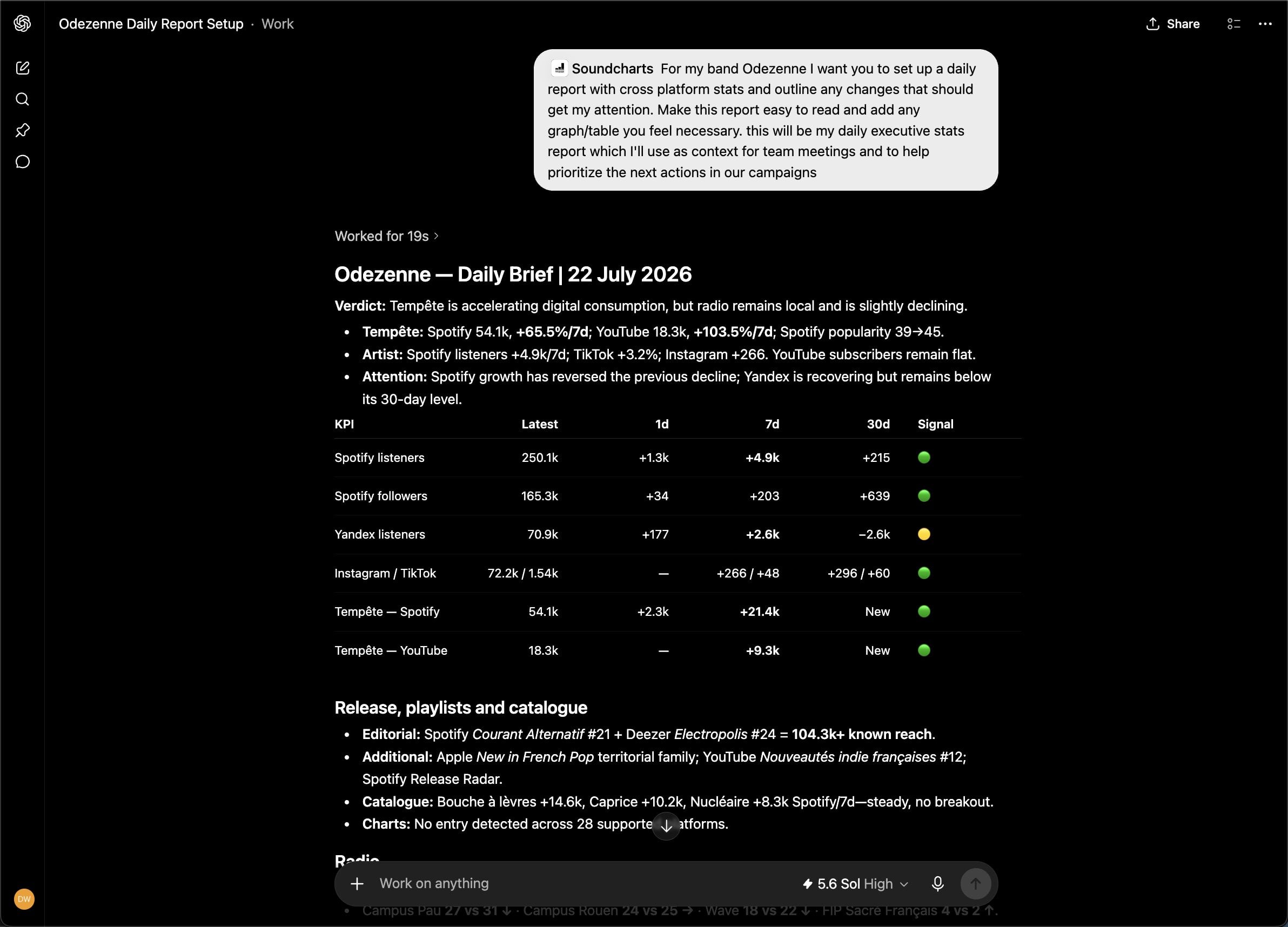
What it gives you that the dashboard and the API don’t is really the conversation itself. You can ask a follow-up, bring in outside context, compare playlists, airplay, socials and charts in one thread instead of four tabs. And you can schedule it, so a roster brief builds itself every Monday morning. The question becomes the interface.
Like every good thing, though, there’s a trade-off. You’re delegating part of the intelligence to a model that can interpret your question in many different ways, and choosing to trust its judgment rather than slicing your way through the analysis yourself.
The interface tends to make people lazier than they could be: instead of asking many incremental questions, they ask the crystal-ball question, and instead of prompting their way through a conversation, they try to one-shot it and judge the answer. That’s not how to extract maximum value from LLMs. The ones who get the most out of an MCP are those who iterate with it and challenge it along the way.
SINCE THE MCP SOFT LAUNCH, WHAT HAVE PEOPLE BEEN DOING WITH SOUNDCHARTS THAT YOU DIDN’T EXPECT?
That’s honestly my favorite part of a soft launch: users show you what you actually built, and it’s never quite what you thought.
A few patterns have surprised us. One is that people prototype in chat and then productionize on the API. They’ll explore a question conversationally, land on an analysis they want every week, and then hand it to a developer to turn into a proper pipeline. So the MCP is turning into a front door for the API rather than a replacement for it, which we didn’t design, but which makes complete sense in hindsight.
“PEOPLE WHO NEVER LIVED IN THE DASHBOARD ARE SUDDENLY GOING DEEP INTO THE DATA, A FINANCE PERSON, AN ARTIST’S LAWYER PREPARING A NEGOTIATION, BECAUSE PLAIN LANGUAGE REMOVED THE LEARNING CURVE.”
Another one is who shows up. People who never lived in the dashboard are suddenly going deep into the data, a finance person, an artist’s lawyer preparing a negotiation, because plain language removed the learning curve. Some of them ask in their own language, French or Japanese, and the assistant translates the intent in both directions.
And then there are the agents mixing us with other sources in the same conversation, pulling Soundcharts numbers straight into a deal memo or a CRM note next to the company’s internal data. For most SMBs that internal data is already connected to these model providers: a Google Workspace connection alone brings in all their docs, sheets and email, which is basically the company’s collective intelligence unified. That probably tells you more about where work is going than anything on our roadmap.
YOU’VE WARNED ABOUT “TOKENMAXXING,” THE PRACTICE OF TREATING AI CONSUMPTION AS A PRODUCTIVITY METRIC. WHERE ARE YOU SEEING IT?
You’re starting to see it everywhere. There was a Fortune story recently about Uber burning through its entire 2026 AI budget in four months, partly because they’d set up an internal leaderboard ranking teams by AI tool usage.
And Y Combinator did a whole podcast episode celebrating tokenmaxxing as the way one builder can do the work of 400 engineers. So you have developers comparing token bills, so to speak, the way people used to brag about their 80-hour weeks. And now it’s creeping into business teams, where AI usage gets presented as if it were output.
“PAST A CERTAIN POINT YOU’RE NOT MORE PRODUCTIVE, YOU’RE JUST BUSIER, AND YOU’VE LOST THE QUIET MOMENTS WHERE STRATEGY ACTUALLY HAPPENS.”
The problem is that it has the same failure mode as the 80-hour week. Past a certain point, you’re not more productive, you’re just busier, and you’ve lost the quiet moments where strategy actually happens.
Everything comes out 80% right and has to be redone anyway. Someone builds a clever little internal tool, the team starts relying on it, then that person leaves and nobody can explain how it works or where the code lives. Nobody wants a “sort of working” CRM, or a black-box scouting tool that even its creator struggles to explain.
And there’s an economic trap underneath all of it: compute is heavily subsidized right now. People are burning through thousands of dollars of equivalent tokens for twenty bucks a month because these companies are racing to go public. If you reorganize your business around that discount, you’re locked in when the real bill arrives.
YOU’VE SAID 2027 IS THE YEAR THE INDUSTRY HAS TO SHOW A REAL RETURN ON ITS AI INVESTMENT. HOW DO YOU SEE THAT PLAYING OUT?
We’ve all had a couple of years now of experimenting and watching the bills grow exponentially, and 2027 feels like the year the receipts get asked for, in money and in time.
I expect it to play out in three ways. First, consolidation: companies will cut from ten AI tools down to the two that demonstrably pay for themselves. Second, measurement, and here the metrics that matter were never tokens. Did the campaign improve? Did the roster grow? Did the meeting end in a decision? I wrote that last one in 2016 and it’s still the only adoption metric I really trust.
And third, repricing, as the subsidies fade and the real costs land on the invoice. The teams that come out of 2027 well will be the ones who can show a before and after, one workflow at a time. Which means the time to start measuring is now, not in eighteen months.
HOW CAN TEAMS STRIKE A BALANCE WITH DAILY AI USE SO THAT THOSE SOFT SKILLS AREN’T ERODED OVER TIME?
For me it’s the difference between reading the book and reading the summary. You can pass the exam on summaries, but the exam is only the front gate; real life is what’s behind it. And real life throws you curveballs, forces you into the edge cases, asks you to put everything into context. It says a lot that the AI field itself is now chasing exactly this, what researchers call world models, because they know a system that’s brilliant at exams still doesn’t understand the room.
“LET AI TAKE THE RETRIEVAL AND THE ASSEMBLY. KEEP HUMANS ON JUDGMENT, RELATIONSHIPS AND TIMING.”
So the balance I’d recommend is fairly simple. Let AI take the retrieval and the assembly, pulling the numbers, formatting the reports, all the chopping, and keep humans on judgment, relationships and timing.
And be careful with your juniors, because professionals built their instincts doing exactly that grunt work. If the machine does all the chopping, where does the next generation’s palate come from? I don’t have a complete answer to that one.
What I do know is that a team that never touches raw data slowly stops understanding it. Be data-informed, never data-driven. And be AI-informed, never AI-driven.
IS THE MCP THE START OF SOMETHING BIGGER? WHERE DOES SOUNDCHARTS’ AI ROADMAP GO FROM HERE?
We don’t usually discuss unannounced products, so I’ll stay at the level of direction, and what’s clear to us is that the next user of music data are agents.. Within a few months I expect more of our queries to come from agents than from humans clicking around or building tools themselves.
It doesn’t mean the MCP will sit at the center; agentic engineering, coding agents building on our API, might have a much bigger impact, as they’ll build products with a fine level of control. Chatbot interfaces have a built-in challenge: they funnel everyone through the same input field.
So the roadmap is about being a source that any interface can trust, whether that interface is human or machine. In practice, that means documentation an agent can read on its own, data that stays clean and real-time, and answers that carry their provenance, so you always know where a number came from.
FIVE YEARS FROM NOW, HOW WILL AI HAVE CHANGED THE MUSIC DATA BUSINESS, YOURS AND YOUR PEERS’?
By then I think the agent shift will be mostly behind us, and what follows from it is the interesting part. It changes some product priorities, but it doesn’t change our engineering principles or the mission. Machine-readable everything is the focus now; it’s been woven into how we work for a couple of years already. Engineers lived this shift before everyone else, as AI went from a plugin bolted onto their tools to being native to the work itself, and companies like Cursor scaled enormously on exactly that. Now the same shift is reaching the rest of software.
“THE CORE BUSINESS STAYS WHAT IT ALWAYS WAS, AND IF ANYTHING IT MATTERS MORE: THE BEST MUSIC MARKET INTELLIGENCE ENGINE YOU CAN FIND.”
The core business stays what it always was, though, and if anything it matters more: the best music market intelligence engine and product suite you can find. Coverage, cleanliness, speed, history, and a customer experience that’s a pleasure whichever product you’re in.
And there’s a paradox coming that I find quite healthy. An agent can test the technical limits and the pricing of vendors and judge ruthlessly which one serves its use case better, far more easily than any human buyer ever could. We welcome that, because we’ve been product-led from day one.Music Business Worldwide



