















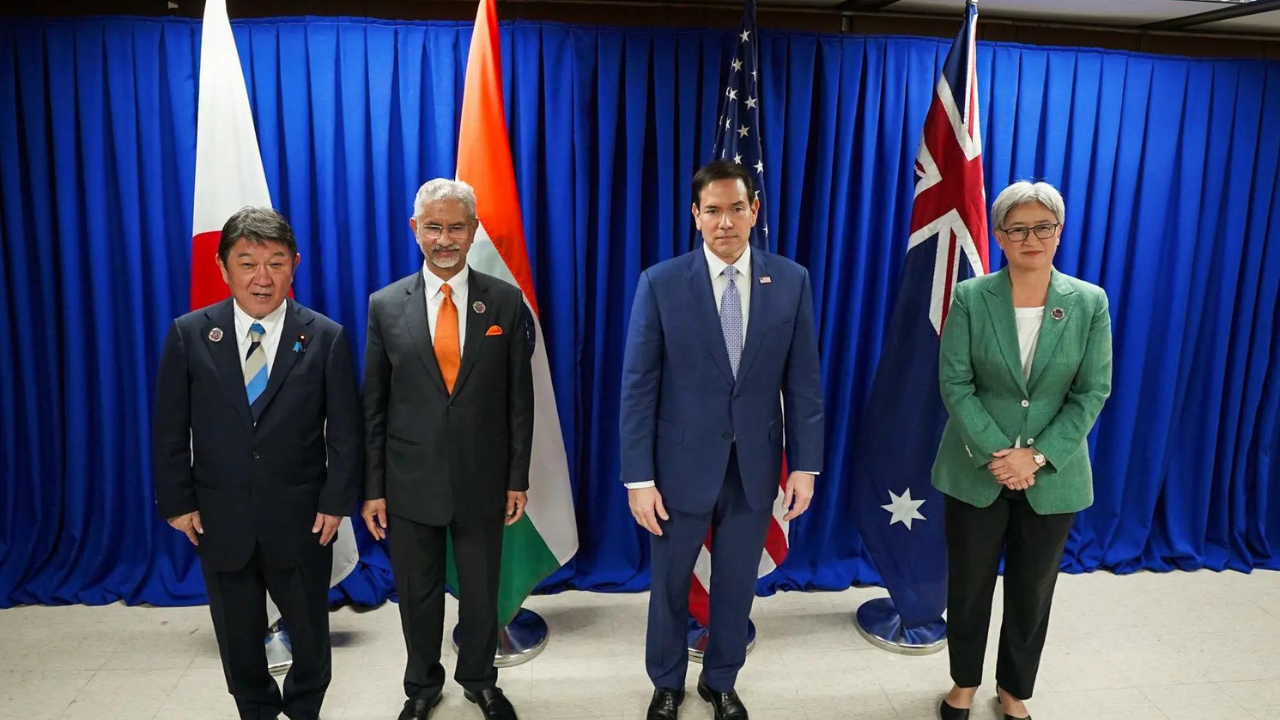
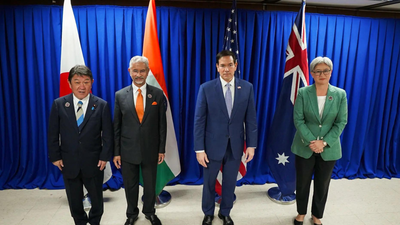
India’s policy of “multi-alignment” and strategic autonomy was evident in Manila Wednesday as external affairs minister S Jaishankar met his China counterpart Wang Yi in the Philippines and also joined a meeting of the Quad foreign ministers that had US secretary of state Marco Rubio declaring Quad remained a priority and will meet again later this year. The Quad meeting saw discussions on the situation in East China Sea and South China Sea, with Japan opposing any unilateral attempt to change the status quo by force or coercion and expressing grave concerns over export restrictions, including on critical minerals. The Quad meeting took place amid escalating China-Philippines tensions over another flare-up in the South China Sea. Even in the absence of a summit, Quad comprising Australia, India, Japan and the US has remained functional with the foreign ministers meeting for the second time this year, after they met in Delhi in May. Jaishankar, Rubio and their Australia and Japanese counterparts, Penny Wong and Toshimitsu Motegi respectively, met on the margins of the ASEAN-related meetings in Manila. In a joint press release, they reaffirmed their commitment to strengthening a free and open Indo-Pacific and their “unwavering” support for ASEAN unity and centrality, while also declaring they were united in their conviction that peace and stability in the Indo-Pacific maritime domain underpin the security and prosperity of the region. “We are deeply invested in the region’s success and in cooperating with ASEAN and its member states,” said the release. The statement outlined shared priorities related to maritime security and economic security, critical and emerging technologies, and humanitarian assistance in support for the implementation of the ASEAN Outlook on the Indo-Pacific (AOIP), which envisages ASEAN Centrality as the underlying principle for promoting cooperation in the Indo-Pacific. According to a Japanese readout, the ministers looked forward to the convening of the next Quad Leaders’ Summit. However, there was no word on the dates for the summit that India has tried unsuccessfully to host so far. In fact, unlike the joint statement issued after the meeting in Delhi, the joint press release made no mention of the summit. With President Donald Trump unlikely to visit India this year, the summit now is expected to take place only on the margins of the G20 summit in the US in December. The foreign ministers are likely to meet again though on the sidelines of a G20 ministerial in Atlanta in October. “The United States, India, Australia, and Japan share a vision of a free and open Indo-Pacific that is grounded in the rule of law, sovereignty, and territorial integrity,” said Rubio in a post on X, adding that strong cooperation is vital to supporting ASEAN’s own priority and centrality in the region. US ambassador Sergio Gor, who joined Rubio for the Quad meeting, said tere was a very productive discussion on delivering results related to a free and open Indo-Pacific. “Our four nations share a common vision,” he said.