









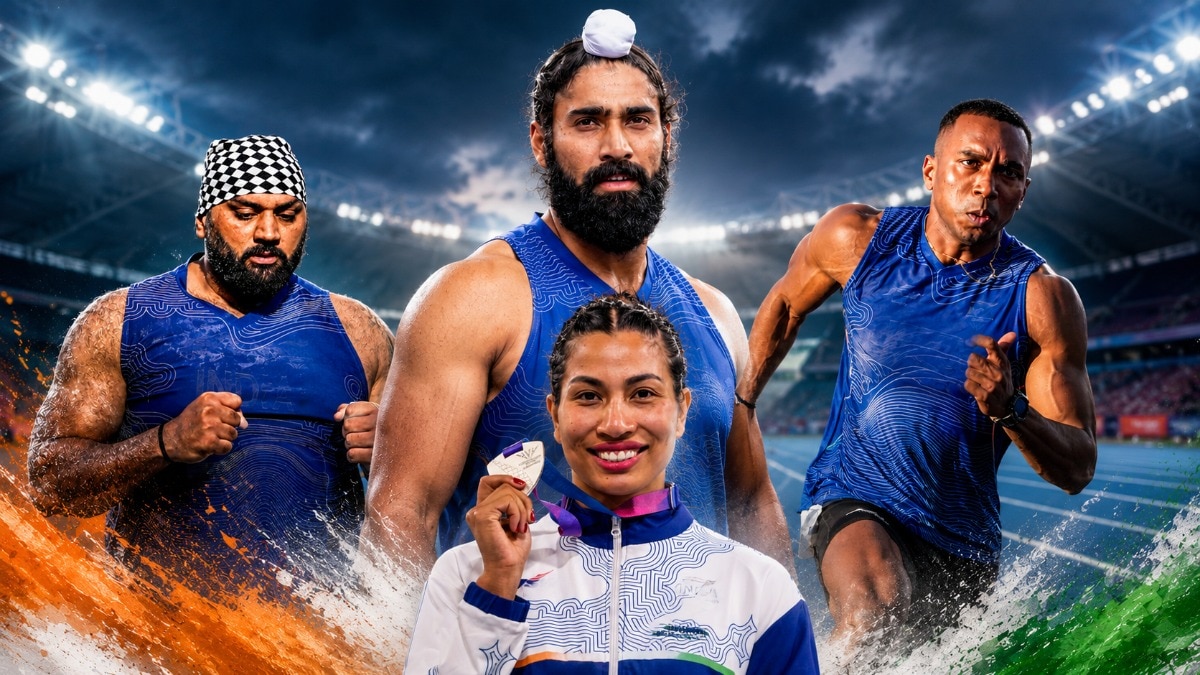
India returned from the 2026 Commonwealth Games with a respectable haul of 39 medals, powered by a dominant boxing campaign, a strong showing in athletics and another memorable display from its para athletes. But behind the celebrations were a handful of performances that fell short of the lofty expectations attached to some of the country’s biggest names.
Not every disappointment stemmed from poor form. Injuries, harsh weather and the finest of margins combined to derail the campaigns of several athletes who had arrived in Glasgow as genuine medal contenders. From India’s fastest man Gurindervir Singh and Asian Games champion, Parul Chaudhary to veteran shot putter Tajinderpal Singh Toor and Olympic medallist Lovlina Borgohain, here’s a look at the stars whose Commonwealth Games campaigns didn’t quite go according to plan.
GURINDERVIR SINGH: DREAM DERAILED
Few Indian athletes traveled to Glasgow with as much momentum as Gurindervir Singh. Having rewritten the national record earlier this season, the 100m sprinter was expected to spearhead India’s sprint challenge.
Instead, his campaign ended in the heats. Gurindervir clocked 10.39 seconds to finish second in his race but missed out on a semi-final berth after ranking 28th overall.
The performance immediately drew scrutiny, given how far it was from his personal best. However, coach James Hillier later revealed that Gurindervir had been battling a hamstring injury for nearly a month before the Games, with the issue limiting the second half of his race despite allowing him to stay competitive over the opening 60 metres.
The injury offers an explanation rather than an excuse. Gurindervir had entered Glasgow carrying genuine medal expectations after his rapid rise this season, making his first-round exit one of India’s biggest disappointments in athletics.
PARUL CHAUDHARY: CAUGHT COLD
Parul Chaudhary arrived in Glasgow as one of India’s strongest medal hopes in athletics. The Asian Games champion had realistic chances of reaching the podium in both the 3000m steeplechase and 5000m after entering the Games in career-best form.
Instead, she finished fifth in the steeplechase and 13th in the 5000m, ending her campaign without a medal.
The results, however, came under difficult conditions. Having prepared in India’s intense summer heat, Parul struggled to adapt to the cold and rain in Glasgow.
“For steeplechase conditions, the weather was quite difficult. The weather was cold. When I was running, my fingers were frozen in my spikes, so I couldn’t run,” Parul told reporters after the race.
She admitted the weather also prevented her from chasing a personal best, adding that she would now shift her attention to the Asian Games.
While the conditions explain part of the outcome, they do not change the fact that one of India’s biggest medal hopes returned home empty-handed. For an athlete who had broken the national record just weeks before the Games, Glasgow became a rare campaign where little went according to plan.
PRIYANKA GOSWAMI: PODIUM MISSED
Priyanka Goswami arrived in Glasgow hoping to build on the silver medal she won at the 2022 Commonwealth Games. One of India’s most experienced race walkers, she was expected to once again challenge for a place on the podium.
Instead, the event ended in disappointment. Priyanka finished fourth in the women’s race walk, missing out on a medal in a race where only five athletes completed the event after one competitor was disqualified. She crossed the line more than two minutes behind the bronze medallist as Australia completed a clean sweep of the podium.
India’s misery was compounded by teammate Ravina’s disqualification after she received four red cards from the judges.
For an athlete who had stood on the podium four years earlier, fourth place was a significant step backwards. While the Australians proved too strong on the day, Priyanka’s inability to stay in medal contention was one of India’s more disappointing performances in Glasgow.
TAJINDERPAL SINGH TOOR: INJURY BLOW
Tajinderpal Singh Toor looked every bit a medal contender after cruising through qualification. The two-time Asian Games champion cleared the automatic mark with a 20.14m throw, finishing second overall behind defending champion Tom Walsh and raising hopes of another podium finish.
However, the final told a different story. Toor’s best effort of 20.27m was only good enough for fifth, leaving him 72 centimetres short of bronze despite throwing over 20 metres.
The result looked surprising until the veteran revealed he had been competing through a Grade 1 groin tear suffered less than two weeks before the Games.
“Even two weeks ago I was consistently throwing 21.30m and 21.40m. But around 12 days before coming here, I suffered a Grade 1 tear in my groin. Because of that, I had to compromise on throwing and my entire training for about 8-10 days,” Toor told NNIS Sports.
The injury affected him physically and mentally, with Toor admitting he had even considered withdrawing before his coach convinced him to continue. Despite repeated treatment, he believed he still had a 21-metre throw in him but could not deliver when it mattered most.
The fifth-place finish was undoubtedly below expectations for one of India’s most decorated field athletes. Yet the injury provided crucial context to a campaign that was derailed before it truly began.
ANIMESH KUJUR: PROMISE UNFULFILLED
Fresh from breaking the national record in the 200m, Animesh Kujur entered Glasgow as one of India’s brightest sprint prospects. He reinforced that reputation in the heats, clocking a season’s best 20.46 seconds to win his race ahead of eventual 100m champion Emmanuel Eseme and qualify comfortably for the semi-finals.
The momentum, however, didn’t last.
Drawn in Lane 1, Kujur clocked 20.65 seconds to finish sixth in his semi-final, with his time ranking 10th overall, just two places outside the final.
Kujur later pointed to the lane draw as a key factor.
“In the 200 metres, the lane does matter. According to my height and running style, Lane 1 is much sharper, and it doesn’t allow me to open up my stride as well as I can. For someone of my build, the first and second lanes are more challenging,” Kujur told NNIS Sports.
The 23-year-old chose to focus on the positives, saying he was happy with his overall performance before turning his attention towards the Asian Games and India’s mixed relay team.
Although Glasgow ended earlier than expected, Kujur showed enough to suggest he remains central to India’s sprint ambitions. His campaign was less a collapse than a reminder of the fine margins that define elite sprinting.
LOVLINA BORGOHAIN: GOLD MISSED
No Indian boxer entered Glasgow with greater expectations than Lovlina Borgohain. An Olympic bronze medallist, multiple-time World Championships medallist and the top seed in her category, Lovlina was widely tipped to add Commonwealth gold to her decorated career.
She appeared on course after advancing to the final, but Australia’s Emma-Sue Greentree edged a closely fought contest 4-1 on a split decision, leaving the Indian with silver.
The result stood out because of India’s remarkable success in the ring. While Jaismine Lamboria, Preeti Pawar, Sakshi Chaudhary, Priya Ghanghas and Arundhati Choudhary all struck gold, Lovlina was the only Indian woman to fall short in a title bout.
“There’s a bit of disappointment because I couldn’t win the gold. I gave it my all, and my match was a very close contest,” Lovlina told ANI.
She, however, quickly shifted the focus towards the team’s success and dedicated her silver medal to the victims of the devastating floods in Assam.
In most circumstances, a Commonwealth Games silver would be celebrated as a major achievement. But for an athlete of Lovlina’s stature, who arrived in Glasgow as one of India’s strongest gold-medal hopes, the result inevitably felt like a missed opportunity rather than a triumph.
India’s 39-medal haul ensured Glasgow will be remembered as another successful Commonwealth Games campaign. Yet the stories of Gurindervir Singh, Parul Chaudhary, Priyanka Goswami, Tajinderpal Singh Toor, Animesh Kujur and Lovlina Borgohain showed how quickly expectations can unravel at the highest level.
Injuries, unfavourable conditions and the smallest of margins all played a role in denying India some of the medals it had expected. While each athlete left Glasgow with a different story, they also left with the opportunity to put those disappointments behind them.
With the Asian Games looming and the road to the Los Angeles Olympics gathering pace, Glasgow is unlikely to define their careers. Instead, it may serve as the setback that fuels their next chapter.
– Ends