



“Our artist roster acts as a magnet for the next generation of talent… this virtuous cycle is why we invest for decades, not just quarters.”
The assembled Wall Street analysts couldn’t have missed Sir Lucian Grainge’s not-so-subtle message on Universal Music Group’s Q2 earnings call last Thursday (July 30).
The uneasy balance between long-term A&R and predictable quarterly performance is a point of tension for UMG and impatient financial pundits, who punished Universal following the earnings, sending its stock down 25%.
Two primary reasons for that nosedive:
- (i) UMG fell short of subscription streaming revenue growth expectations. The category only rose 6.7% YoY at constant currency (excluding Downtown), with over half that increase coming from streaming price rises; and
- (ii) The margin of UMG’s primary profit measurement, adjusted EBITDA, sagged to 21.5% in Q2, down 130 basis points vs. the prior-year period (again, excluding Downtown).
On the earnings call, both Universal CEO Grainge and CFO Matt Ellis admitted there were improvements to be made in UMG’s operational setup.
But there was also cause for positivity, in a quarter where UMG’s topline revenues – lest we forget – actually grew by a healthy 13.3% YoY (constant currency).
Ellis said he was “cautiously optimistic” that UMG’s subscription streaming growth would improve in the back half of 2026, partly thanks to early signs of an uptick in market share.
And there was a particularly natty line from Grainge on UMG’s view of AI music-making.
“I’ve been doing this a long time,” said Grainge. “Every generation invents new instruments – great artists show us what’s possible with them. AI is a new instrument – not the next artist.”
Here are three other things that stood out to me…
1) UMG’s India paywall is a template, not a one-off. YouTube will be watching closely.
Universal announced last week that it would be ‘windowing’ major new releases for 72 hours exclusively on paid services in India, starting in late August. It confirmed this will apply to “all of our top releases, both domestic and international.”
Make no mistake: India’s commercial performance over the past decade has been a crushing disappointment for the music rights business.
In 2025, according to IFPI, India – with its 1.4 billion population – ranked 15th in the league table of recorded music markets by trade revenue, below Australia and the Netherlands.
Label sources indicate that India’s subscription streaming revenues in 2025 accounted for less than 0.5% of the industry’s global total.
“To put it more starkly: around 93% of Indians who stream music aren’t paying for the privilege.”
Indeed, according to a recent IMI/Ernst & Young report, there were only 14.4 million paying music subscribers in India at the close of last year. That represents a measly 1% of the nation’s population, and an estimated 6.5%-8.2% of its music streaming users.
To put it more starkly: around 93% of Indians who stream music aren’t paying for the privilege.
Why? A survey published in that IMI/E&Y report gathered responses from 15,000 smartphone users in the market.
Of those music listeners who weren’t streaming subscribers, close to half (42%) said they hadn’t taken the plunge because “YouTube has all the music I need and is free.”
UMG is aiming to disrupt this dynamic: new music will not only be held off the likes of ad-funded Spotify for its first three days in India… it will also be held off YouTube’s free tier.
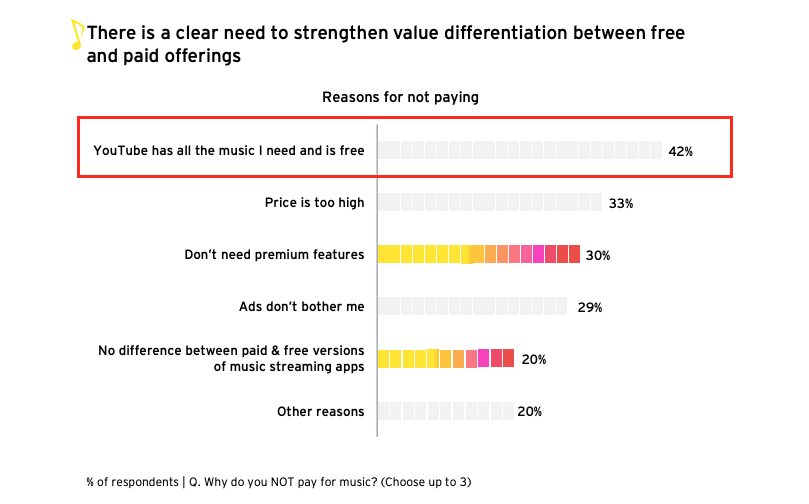
Source: IMI/E&Y report. Respondents surveyed in March/April 2026.
With Universal looking to accelerate its subscription revenues, stimulation of this metric in India – and other populous, low-revenue territories – could prove crucial.
On last week’s earnings call, UMG’s EVP/Chief Digital Officer, Michael Nash, pointed to a lesson outside of music, in sports.
Jio’s move to put Indian Premier League (IPL) cricket broadcasts behind a paywall in the country, he said, had been a key factor in driving its JioHotstar platform beyond 200 million subscribers.
Meanwhile, Grainge noted that UMG had already seen success with putting premium releases behind DSP paywalls in China. And he suggested that, following India, other markets could be next.
“China has shown what’s possible when healthier music ecosystems take hold,” said Grainge. “We want India to follow a similar path and believe many other high-potential markets will do too.”
2) Downtown’s economics are now visible – and analysts are wrestling with Virgin’s success
This was the first full quarter in which Downtown sat inside UMG, giving us a clear picture of the now-subsidiary’s performance.
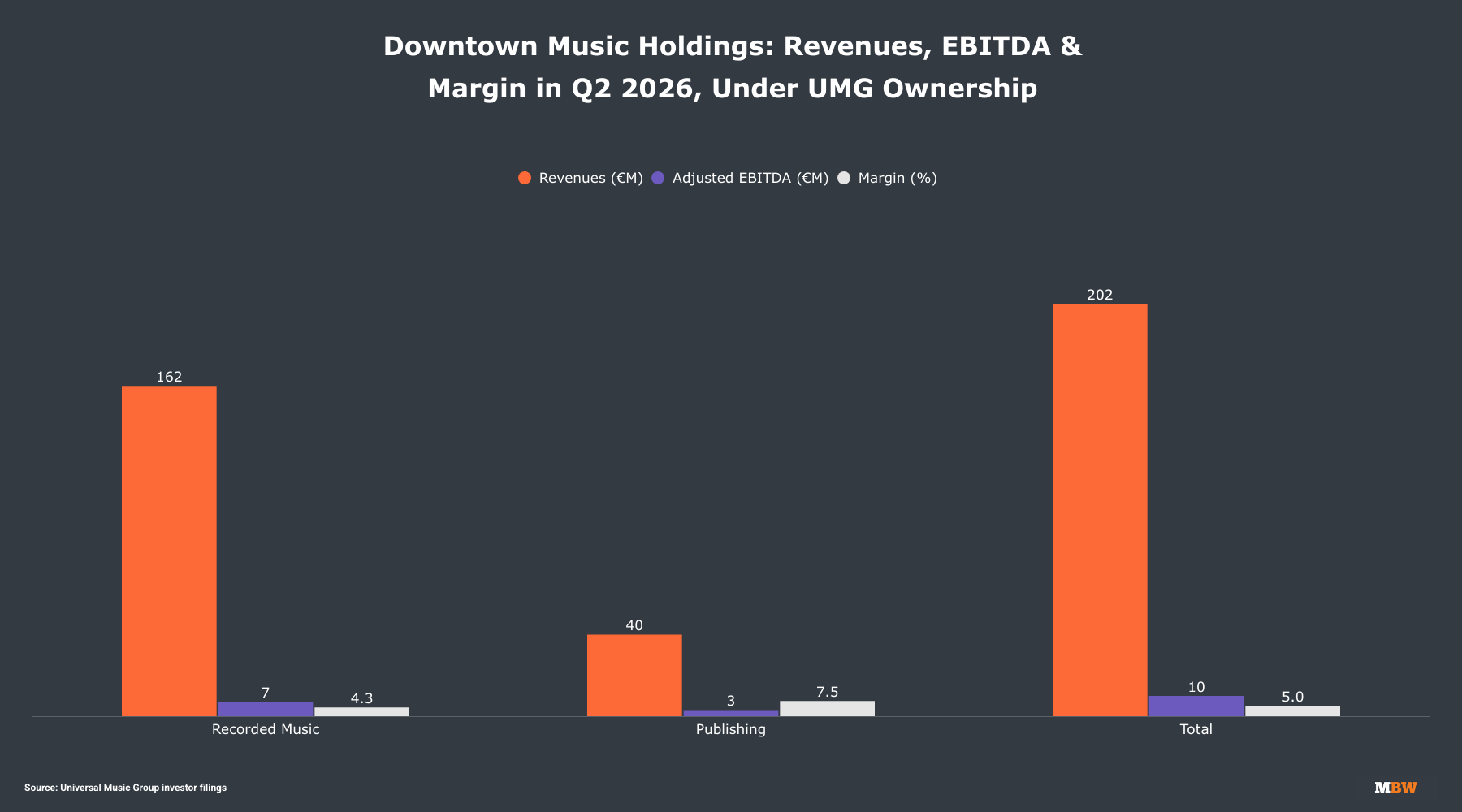
Downtown contributed EUR €202 million of revenue in the quarter, €162 million in recorded music and €40 million in publishing. It also delivered €10 million of adjusted EBITDA – a margin of 5.0%.
CFO Matt Ellis confirmed this figure was no surprise internally: “[Downtown was] right at around 5% for the quarter, which was in line with the number that we reported that they produced in 2025 prior to closing the transaction.”
Downtown wasn’t actually a major consideration in the analyst disappointment that greeted UMG’s reduced recorded music margins.
One figure that did perturb analysts was this: Excluding Downtown, UMG’s recorded music adjusted EBITDA margin dropped by 1.8 percentage points YoY to 24.9%.
A significant factor in this drop, said Ellis, was “repertoire mix.” That’s CFO-speak for the lower-margin end of UMG’s repertoire (artist and label services) growing faster than the higher-margin end (frontline label deals).
Ellis explicitly named the root cause for this in Q2 – “healthy growth in Virgin Music.”
“It’s quite the paradox: When Virgin Music Group performs exceptionally, it’ll leave certain UMG investors feeling grumpy – especially short-termists fixated on margin today vs. strength and scale tomorrow.”
We know from UMG’s previous reporting that Virgin’s official adjusted EBITDA margin in 2025 was 4.1%. As such, the faster Virgin grows vs. UMG’s frontline labels, the greater the headwind to the company’s overall margin.
It’s quite the paradox: When Virgin Music Group performs exceptionally, it’ll leave certain UMG investors feeling grumpy – especially short-termists fixated on margin today vs. strength and scale tomorrow.
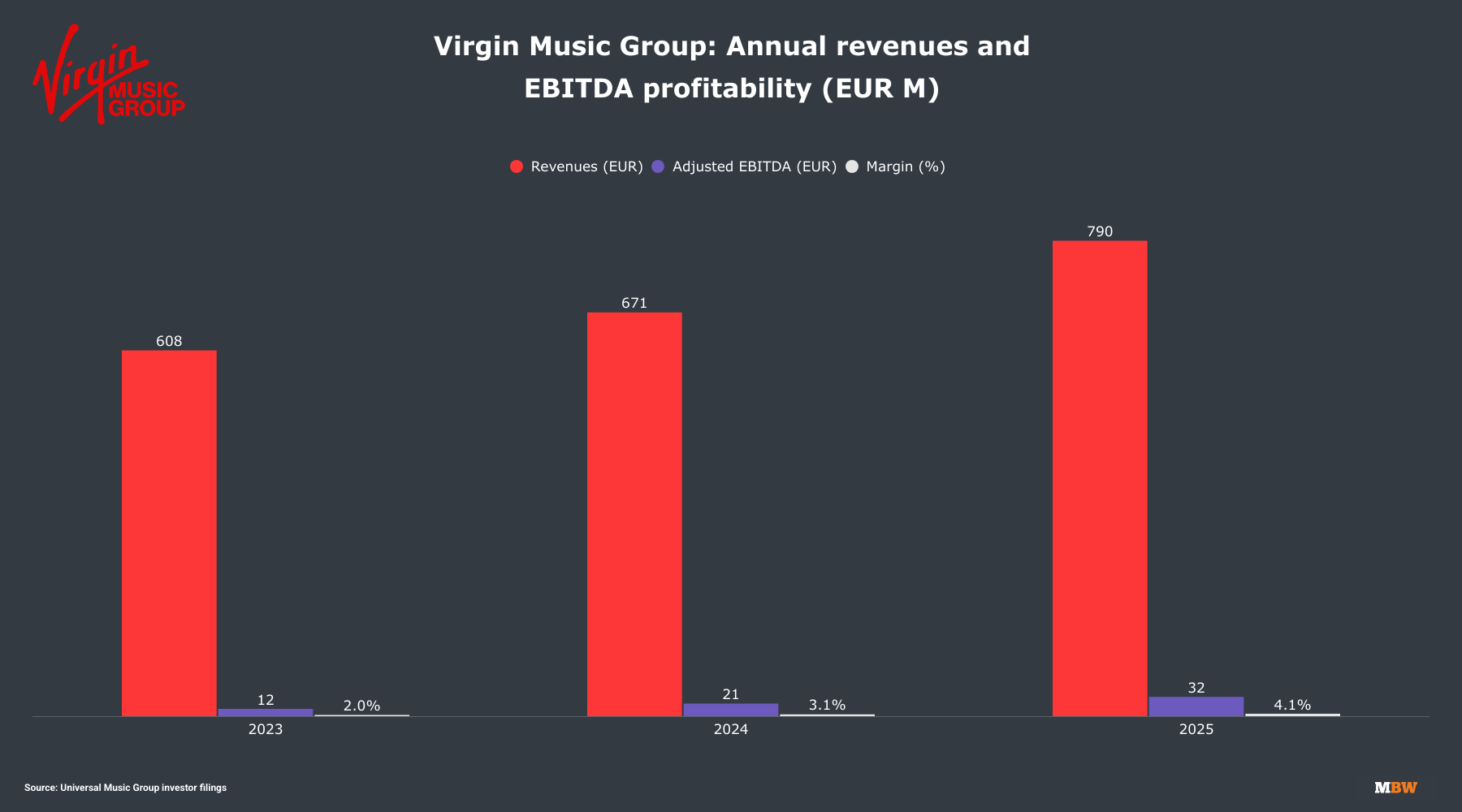
UMG has invested heavily into Virgin Music Group (VMG) – and bought a ~5%-margin business in Downtown – because the independent distribution/services segment is continually nibbling into the market share of traditional labels.
UMG’s options: (a) participate in this shift and accept the blended margin, or (b) protect a higher margin at all costs – watching helplessly as the indie segment slowly erodes Universal’s market power.
It would be tough for any shareholder to argue that UMG made the wrong strategic choice.
Regardless, Ellis suggested there may be some margin improvement coming: recently combining Downtown with VMG, he said, “gives us belief that there’s opportunity to see that margin perform as we complete the integration.”
Grainge said: “Downtown’s contribution to our revenue this quarter is just the beginning, and we expect it to create increasing strategic and financial value with opportunities for greater efficiencies moving forward.”
Grainge also framed Downtown and Virgin as vital talent pipelines for UMG, creating new – potentially lucrative – relationships with industry entrepreneurs and indie music-makers.
Elsewhere on the Q2 call, Ellis noted a loss-making quarter for UMG’s merch division – another drag on group margin – while flagging a new reality for Universal Music Publishing Group (UMPG).
He said: “We expect [UMG’s] music publishing to be a mid-single-digit growth business rather than high single digit for the immediate future.”
Ellis cited factors including a slowdown in publishing revenues from radio and linear TV performance that he pointedly called “secular” – i.e. a trend, not a dip.
3) Apple Music was absent from the Streaming 2.0 roll-call
Grainge read out a list of partners who’ve completed ‘Streaming 2.0’ agreements with UMG. It’s worth reproducing in full.
“We now have Streaming 2.0 agreements with almost all of our major streaming partners, including subscription services Spotify, YouTube, Amazon, and Deezer,” he said. “This quarter, we announced a new, strengthened deal with TikTok. And today, I’m happy to share we have completed our agreement with Pandora, a top 10 partner.”
Six named partners. Apple Music is not among them.
It wasn’t on a list of ‘Streaming 2.0 Partners’ in Universal’s investor presentation, either. (Although that presentation did, in small type, note that this wasn’t an exhaustive list.)
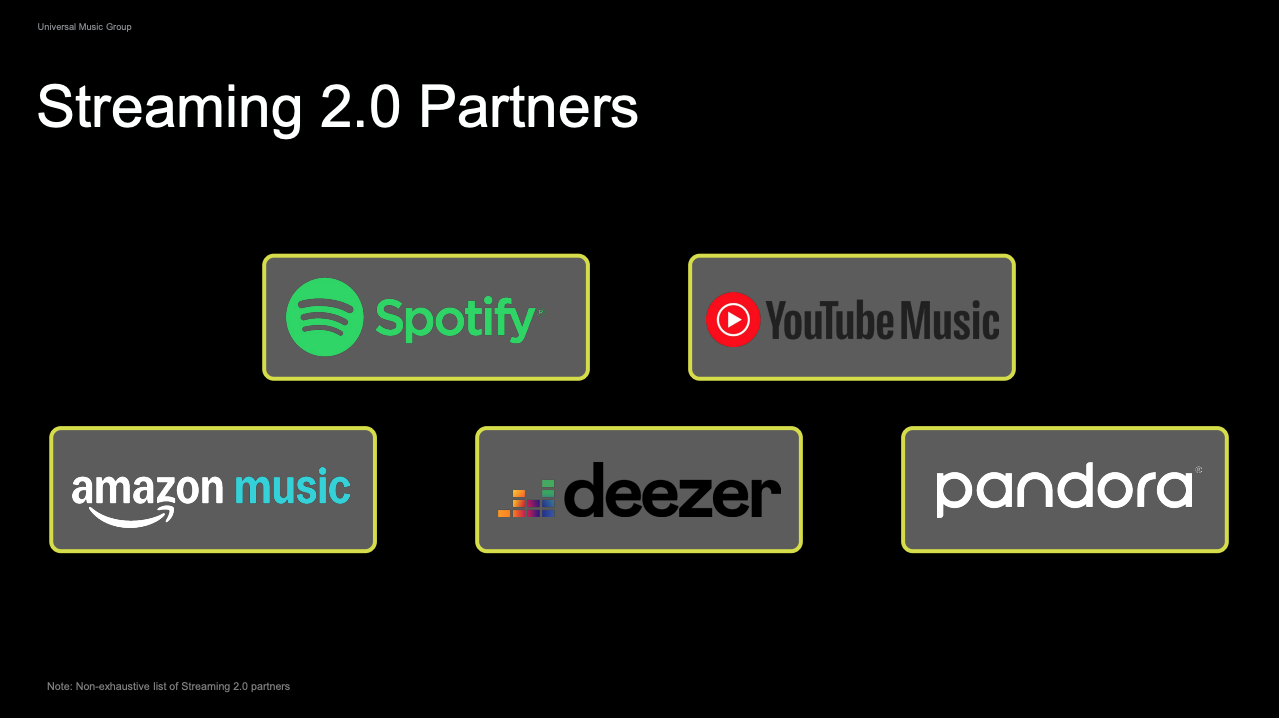
Fact is, UMG has never announced a Streaming 2.0 agreement with Apple, in contrast to the announcements it has made for Amazon Music, Spotify, YouTube, and now Pandora.
Interestingly, Grainge tied the UMG Streaming 2.0 partner list directly to AI. “I’m pleased that all these partners share our commitment to protecting human artistry,” he said.
“Music platforms should reward creativity and guard against illegally trained AI models pumping [out] AI slop or fraud designed to divert royalties from artists, songwriters, labels and music publishers.”
He added: “Fans don’t want AI slop. There’s no justifiable reason that this content should be algorithmically served to audiences on streaming platforms or siphoning money from human artists.”
Crucially, Grainge confirmed, “Our 2.0 agreements have built-in protections against royalty dilution.”
In March, Apple Music introduced Transparency Tags, a metadata disclosure system for AI-made music.
This places the obligation for disclosure on the supply chain rather than the platform. Where a tag is omitted, no AI use is assumed.
Is UMG looking for Apple to take a more active role in the reduction of AI slop – or, at the very least, sign off on royalty protections for human artists?
Who knows. The omission of any fruit iconography in the above slide likely tells its own story.
Worth remembering: In July, Apple Music raised its US Individual plan from USD $10.99 to $11.99, and its Family plan from $16.99 to $19.99.
The firm publicly blamed “rising licensing costs” for the move – effectively throwing shade at greedy-guts rightsholders.
When Spotify raised its US Premium Individual plan to $12.99 in February, it offered users a contrasting justification: a need “to continue offering the best possible experience” and to “benefit artists.”Music Business Worldwide



