






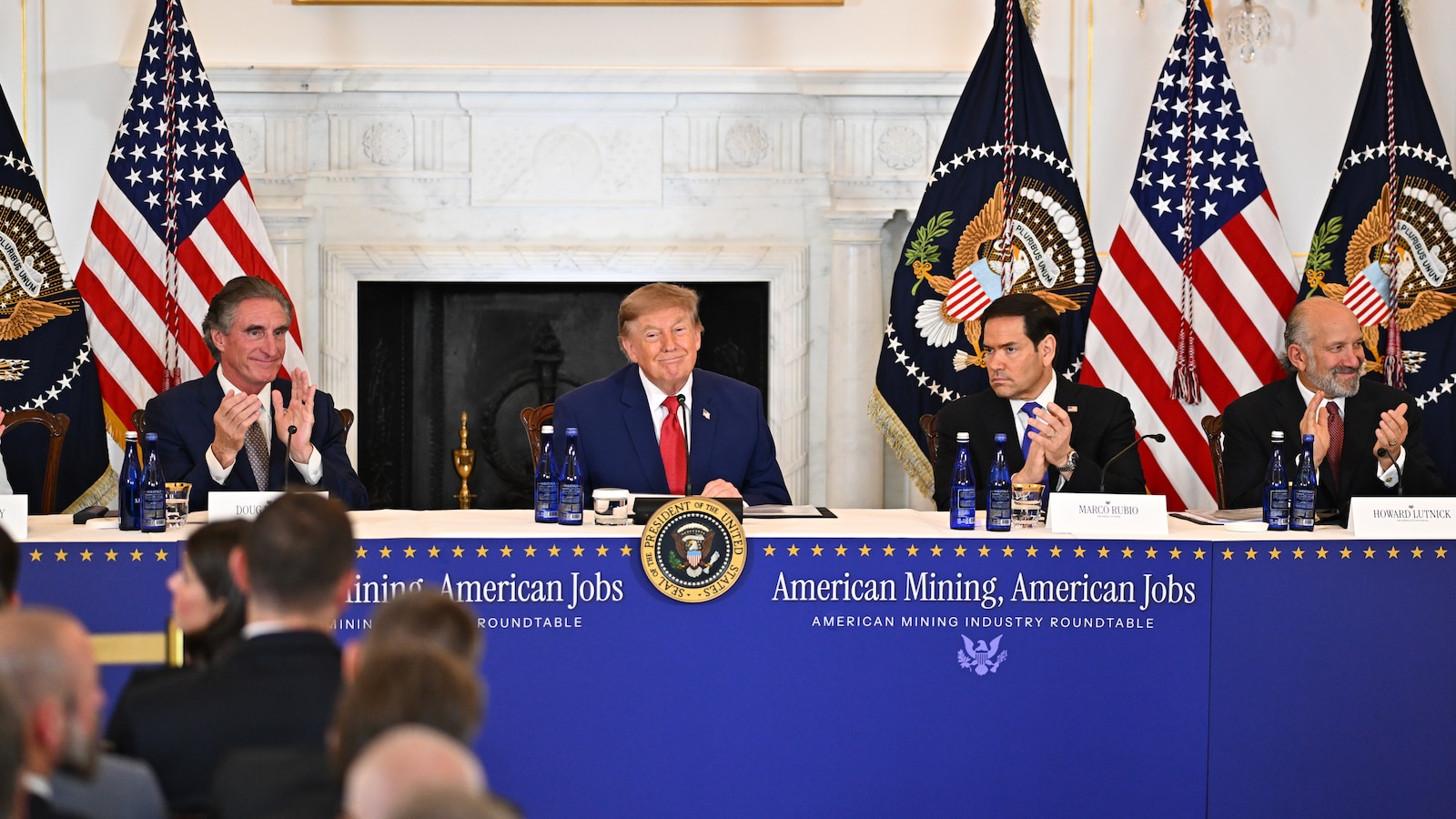












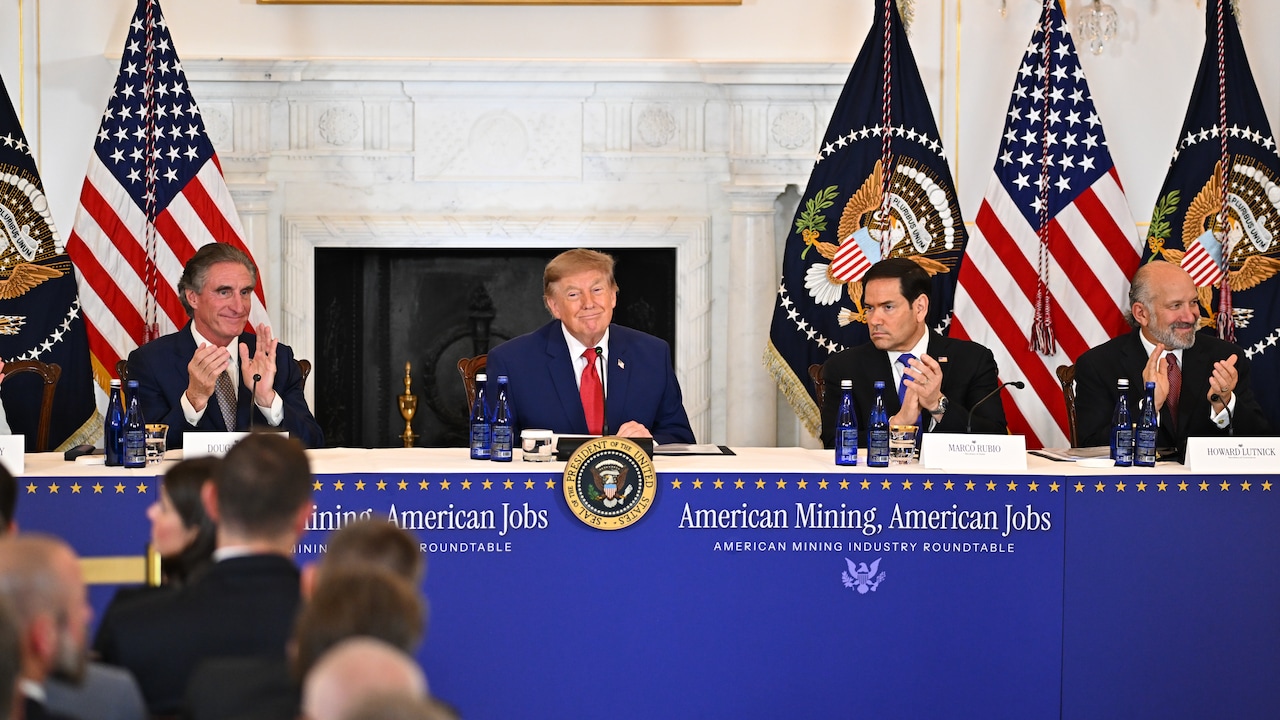
President Donald Trump touted $3 billion in US investments in critical minerals mining at a meeting Friday with top industry executives aimed at weaning the US off supply chains dominated by China.
Trump said the projects would “create thousands of jobs and promote our economic stability and security,” at an event at the State Department. “We’re putting our miners back to work, and we’re reclaiming America’s rightful place as the minerals superpower of the world,” he added.
Trump said the investments included a $1.4 billion loan agreement with Sila Nanotechnologies Inc. from the Defense Department’s Office of Strategic Capital to expand production of silicon battery anodes and lithium-ion battery cells. Other investments include $400 million to Sunrise Energy Metals Ltd. by the Pentagon to expand production in Australia of scandium, which is critical to aerospace and defense industries, and $150 million with Niron Magnetics Inc., a Minnesota magnet-making firm.
The Export-Import Bank is also working to provide more than $1 billion in financing for Ivanhoe Electric Inc.’s Santa Cruz copper project in Arizona — as part of a previously announced agreement — along with a $25 million investment to launch a graphite mine in Alabama.
The president also hailed plans to spend over $180 million to bolster educational programs for the industry, saying it would “train the next generation of American miners.”
Trump said his efforts would ensure the US “is never again reliant on hostile foreign nations for the resources our country needs to dominate in the future.”
The president was joined by executives from prominent companies, including Rio Tinto Group, BHP Group, MP Materials Corp., USA Rare Earth Inc., Energy Fuels Inc., US Antimony Corp. and The Metals Company.
The event showcased administration efforts to spur US critical minerals development and processing before a planned visit by Chinese President Xi Jinping to Washington in September. Trump said that under his administration domestic mines were reopening at a fast pace, including what he said was the first American rare-earths mine in more than 70 years and the construction of the first new aluminum smelter since 1980.
Despite a trade truce that eased export controls over critical minerals and magnets essential to a host of cutting edge industries, rare earths remain a source of tension between the world’s two largest economies. The US has sought to partner with domestic companies to build out a mine-to-magnet supply chain independent of China.
Ramón Barúa, the chief executive officer of Aclara Resources Inc. and a participant in the meeting, called the event a signal that the administration is prepared to go “all out supporting mining initiatives.”
The federal government has already pledged more than $10 billion of investments in a bid to jump-start nascent US markets for rare earths and permanent magnets. The Pentagon kicked off the spending spree more than a year ago, announcing it would take a $400 million preferred equity stake in MP Materials — the sole domestic rare earths producer — and the US has since announced other projects the government is championing.
While the scale of the US critical minerals build-out is enormous, there have been serious challenges and slow progress in developing the domestic industry.
The funding for schools comes as the US mining sector faces an aging workforce and a limited pipeline of engineers, geologists, metallurgists and other workers with specialized skills. Mining schools have seen enrollment and interest in the industry decline over decades, leaving companies competing for a relatively small pool of talent just as the US seeks to rapidly expand domestic production of critical minerals.
The workforce challenge is particularly acute because bringing new mines online can take years, meaning companies need to develop the talent pipeline well before projects begin producing.
The administration has also pushed to fund mining projects in Africa and South America in an effort to loosen Beijing’s grip on critical minerals. On Friday, the US International Development Finance Corp. said it would match a $4.8 million investment in Harena Rare Earths Plc to develop a rare-earth mine in Madagascar, which would supply materials including magnet metals for US manufacturing.
“We’ve been sleepwalking through many administrations,” said mining billionaire Robert Friedland, whose firms, Ivanhoe Electric and Sunrise Energy Metals, Trump highlighted for funding on Friday. “This is critical to our national security.”
(This story has not been edited by NDTV staff and is auto-generated from a syndicated feed.)
Essential Business Intelligence,
Sharp Market Insights,
Practical Personal Finance Advice, Daily Fuel, Gold and Silver Prices and Latest Stories — On NDTV Profit.



