


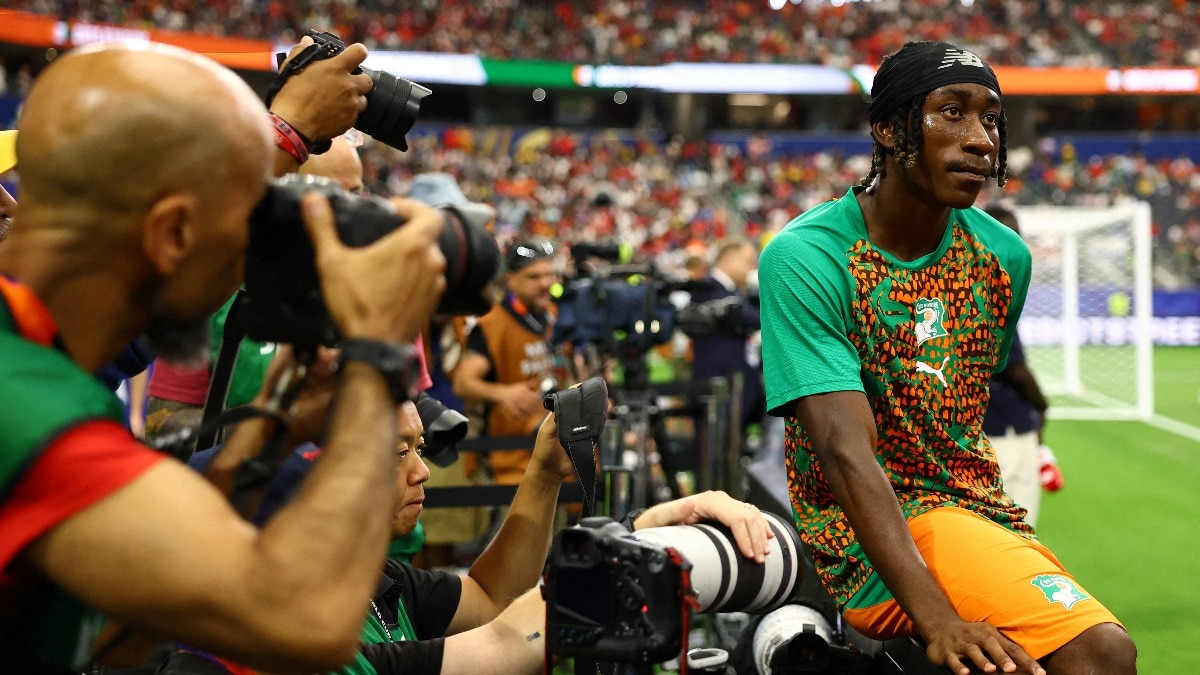
Real Madrid’s signing of Yan Diomande has naturally been viewed through the lens of the club’s evolving transfer strategy. At 19, the Ivorian winger fits the profile that has increasingly defined Madrid’s recruitment in recent years – young, high-ceiling talent capable of developing into one of football’s next global stars.
Yet beyond the excitement surrounding his arrival lies a little-noticed statistic. With his move to the Santiago Bernabu now complete, Diomande has become Real Madrid’s first permanent men’s first-team signing of an African international since Mahamadou Diarra arrived from Lyon in 2006.
In the two decades since, Madrid have rebuilt multiple squads, won six Champions League titles and signed some of the biggest names in world football, yet no African international had joined the first team on a permanent transfer.
The definition is important. Emmanuel Adebayor and Michael Essien both represented Real Madrid on loan. Achraf Hakimi graduated from the club’s academy, while Brahim Diaz joined from Manchester City as a Spain youth international before later switching allegiance to Morocco.
Under those parameters, Diarra remained the club’s last African international to arrive as a permanent first-team signing until Diomande’s arrival.
That raises an intriguing question: why did Europe’s most successful club go nearly two decades without making a permanent transfer for an African international?
A TREND HIDDEN IN PLAIN SIGHT
The answer is unlikely to lie in a shortage of talent.
Since Diarra arrived in Madrid, Africa has produced some of the defining footballers of the modern era.
Didier Drogba became a Chelsea legend, Samuel Eto’o conquered Europe with Barcelona and Inter Milan, Yaya Toure transformed Manchester City’s midfield, while Mohamed Salah, Sadio Mane, and Riyad Mahrez established themselves among the world’s elite.
Most followed a familiar pathway, developing through clubs in France, Belgium, Portugal or the Netherlands before reaching football’s biggest stages.
Despite that wealth of talent, Real Madrid never made a permanent move for any of them.
The pattern is easy to miss because it unfolds over years rather than transfer windows. In fact, the question first occurred to me almost by accident.
During the 2017-18 season, Karim Benzema was enduring one of the leanest scoring campaigns of his Real Madrid career, while Pierre-Emerick Aubameyang was scoring freely for Borussia Dortmund. Watching a match with a senior colleague, I wondered aloud whether Aubameyang would be the ideal striker for Madrid.
His response was immediate.
“It’s just not Florentino Perez’s market. Real Madrid don’t really sign African internationals.”
At the time, it felt like an offhand remark rather than a researched conclusion.
Years later, looking back at Madrid’s transfer history, it became clear that the observation pointed towards a genuine recruitment pattern rather than a coincidence.
THE FLORENTINO BLUEPRINT
The pattern says less about African football than it does about Real Madrid’s transfer identity.
Unlike many European giants, Madrid have rarely tried to recruit from every possible market. Their transfer policy has instead reflected distinct institutional philosophies. Florentino Perez’s first presidency was defined by the Galacticos era, where the objective extended beyond sporting success to assembling football’s biggest stars.
Since returning in 2009, however, that philosophy has evolved into identifying players capable of becoming the next generation of elite footballers.
Vinicius Junior, Rodrygo, Endrick, Jude Bellingham, Aurelien Tchouameni and Arda Guler all arrived before reaching their peak years.
Rather than paying premium prices for finished products, Madrid increasingly sought to secure future superstars before the rest of Europe.
As Steven G Mandis argues in The Real Madrid Way, recruitment at the club is shaped by a long-term institutional vision rather than isolated market opportunities.
Age profile, developmental potential and long-term value increasingly became central to Madrid’s planning.
That strategy naturally strengthened the club’s links with Brazil. Vinicius, Rodrygo and Endrick were all recruited before establishing themselves in European football, allowing Madrid to develop them internally rather than competing later in inflated transfer markets.
African football, however, has traditionally produced elite players through a different route.
WHEN GREAT PLAYERS ARRIVE AT WRONG TIME
Many of Africa’s biggest stars first established themselves in Europe’s secondary markets before reaching the very top. Drogba blossomed at Marseille, Essien at Lyon, Salah progressed through Basel, Fiorentina and Roma before exploding at Liverpool, while Mane’s development took him through Metz, Salzburg and Southampton.
By the time they became genuine world stars, Real Madrid often had little reason to enter the race.
Drogba’s peak years coincided with Madrid possessing Raul, Ruud van Nistelrooy and later Karim Benzema. Salah and Mane emerged while Cristiano Ronaldo dominated the left wing before Vincius Junior inherited that role.
Midfielders such as Essien and Toure reached their prime during an era when Madrid built one of football’s greatest midfields around Luka Modric, Toni Kroos and Casemiro.
This does not suggest those African stars lacked the quality to play for Real Madrid. Many undoubtedly did.
Recruitment at the highest level, however, is shaped as much by timing and squad composition as by individual ability.
Clubs rarely sign players simply because they are among the world’s best; they sign those who fit an existing sporting plan.
Viewed through that lens, Madrid’s transfer history appears less like a conscious avoidance of African footballers and more like the consequence of a recruitment strategy that consistently intersected with other markets.
A NEW CHAPTER?
Far from representing a break from Madrid’s modern transfer strategy, the Ivorian actually embodies it.
Like Vincius, Rodrygo and Endrick before him, Diomande has been signed not because he is already among football’s established superstars, but because Madrid believe he can become one.
His signing has also highlighted an overlooked aspect of Real Madrid’s recent history.
Over two decades, the club repeatedly turned to Brazil for wonderkids, Europe for elite prospects and established stars for immediate success, while Africa – despite producing generations of world-class footballers – remained largely absent from that recruitment map.
Diomande’s arrival does more than end a statistical anomaly stretching back to Mahamadou Diarra’s move in 2006.
It may also signal the beginning of a subtle shift in one of football’s most recognisable transfer blueprints, suggesting that even Real Madrid’s recruitment philosophy continues to evolve.
– Ends



