


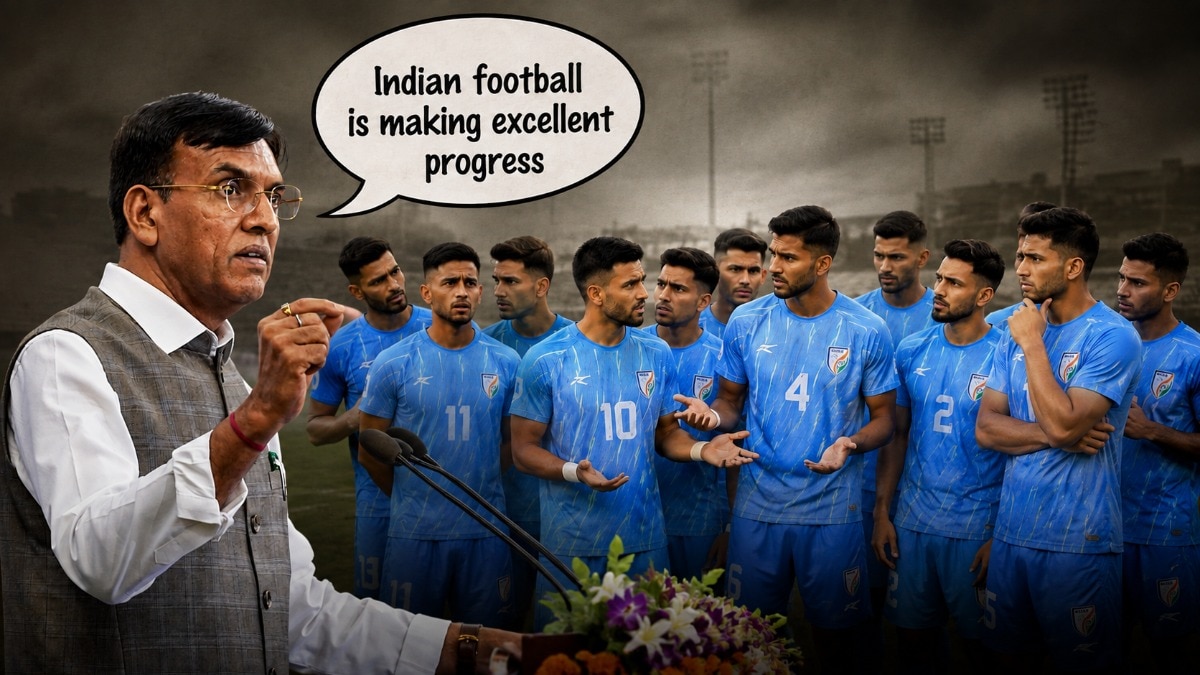
“Football is making excellent progress.”
If you are an Indian football fan reading that line, there is a fair chance you are wondering whether you have just walked into some elaborate ragebait. It is, in fact, a comment made by Sports Minister Mansukh Mandaviya while speaking about Indian football on the sidelines of the 85th edition of Fit India Sundays on Cycle.
And yes, he was talking about the same Indian football ecosystem currently trying to make sense of club exits, financial uncertainty, a changing ISL structure and a national-team setup that has had its own share of confusion.
The Indian Super League will return, as Mandaviya said, but the bigger picture around Indian football remains far more difficult than that one fact suggests.
After the uncertainty around the competition last season, having a league back on the calendar matters for clubs, players and supporters. But the return of the competition cannot by itself be treated as proof that Indian football is in good health, or making “excellent progress”
That is certainly setting the bar at a historic low.
While the ISL is finding a way back, clubs are struggling to make the numbers work, investors are stepping away and the commercial structure of the league is still being rebuilt.
The latest blow came when Tata Steel decided to withdraw Jamshedpur FC from the ISL for the 2026-27 season. That decision led to appeals from the club’s players, former India captain Sunil Chhetri and AIFF president Kalyan Chaubey, all asking the Tata Group to reconsider.
There is certainly a football ecosystem beyond the ISL, but the country’s top division is currently dealing with questions that go well beyond how many clubs are being formed.
THE ISL PROBLEMS ARE GETTING HARD TO IGNORE
The trouble with the ISL has been building for some time.
The commercial agreement between the All India Football Federation (AIFF) and Football Sports Development Limited (FSDL), which had been central to the league’s operation, expired before the previous season. The uncertainty around the commercial structure contributed to a drastically shortened 2025-26 campaign.
The season, which was initially expected to begin in September, eventually ran from February 14 to May 21 and was played in a single-leg format.
That meant fewer matches and fewer opportunities to generate revenue for clubs that were already carrying substantial operating costs.
Industry estimates suggest ISL clubs are losing around Rs 25-30 crore per season, while broadcast revenues have fallen sharply. The reported per-match valuation dropped from around Rs 1.68 crore in 2024-25 to Rs 9.5 lakh last season.
And the problems are not limited to Jamshedpur.
- Mumbai City FC saw City Football Group divest its stake.
- Kerala Blasters are facing financial uncertainty and are understood to be discussing a complete stake sale.
- Hyderabad FC were acquired by the BC Jindal Group after struggling to sustain their losses and were subsequently rebranded as Sporting Club Delhi.
- Diamond Harbour FC, newly promoted to the ISL, are also facing questions over their future.
The new club-led commercial model is meant to give teams greater control over their own revenues, sponsorships and broadcasting arrangements. That could eventually prove to be a positive change.
But asking financially stretched clubs to become their own commercial engines does not magically make the underlying problem disappear.
A NATIONAL TEAM FULL OF MESS
The uncertainty is not restricted to the club game. India’s national-team setup has also offered some uncomfortable examples of how decisions are being handled.
The Ranjit Bajaj-Bibiano Fernandes episode is a good example. Bajaj was approved as manager of the India U-15 men’s team after Fernandes was appointed head coach, but objected to the arrangement because he felt their footballing philosophies were too different.
He initially turned down the role and later said he was ready to take it if Fernandes was not part of the setup. What made the episode more concerning was the communication around the appointments, with Bajaj saying he had not been informed beforehand and did not receive timely confirmation even after reports about the decision emerged.
This is a team preparing for India’s first appearance at the inaugural FIFA U-15 World Cup and Festival. Time spent debating the structure of the coaching setup is time not spent scouting, building combinations and preparing the players.
Then there is the national-team calendar itself.
The proposed Brazil friendly in October has drawn criticism from former India captain Bhaichung Bhutia because of its potential clash with India’s participation in the FIFA ASEAN Cup. If the fixtures overlap, India could find itself having to choose between a high-profile friendly and a competitive international tournament.
These are not signs of a football system that has everything under control.
SO, WHERE IS THE EXCELLENT PROGRESS?
Mandaviya’s latest comment only widens the gap between how the Sports Ministry sees Indian football and how fans experience it.
For supporters already frustrated by the mess around the sport, “excellent progress” feels like an added insult to the injuries.
Earlier, during a crucial ISL press conference, he struggled to pronounce Mohun Bagan and East Bengal, calling them “Mohun Began” and “East Began” before seeking help.
It quickly became a meme, but for football fans, the moment went deeper than that. These are not just two ISL clubs. They are century-old institutions that are central to India’s football history, particularly in Kolkata.
Now comes the “excellent progress” comment.
Mandaviya spoke at length about India’s preparations for the Commonwealth Games and Asian Games, including facilities being developed to help athletes perform well. But when the conversation turned to Indian football, his answer was limited to the ISL returning and new clubs being formed.
There was no mention of Jamshedpur FC’s withdrawal, the financial strain on ISL clubs, the collapse in broadcast revenues, the commercial uncertainty or even the Ranjit Bajaj-Bibiano Fernandes mess. Either these are being consciously overlooked, or the people overseeing Indian sport simply aren’t aware of how bad things have become.
The ISL returning is good news. New clubs are good news too. But neither explains how Indian football, at this moment, can be described as making “excellent progress”.
Maybe the Sports Ministry sees a bigger picture.
If it does, Indian football fans deserve to know what that picture looks like.
– Ends



