


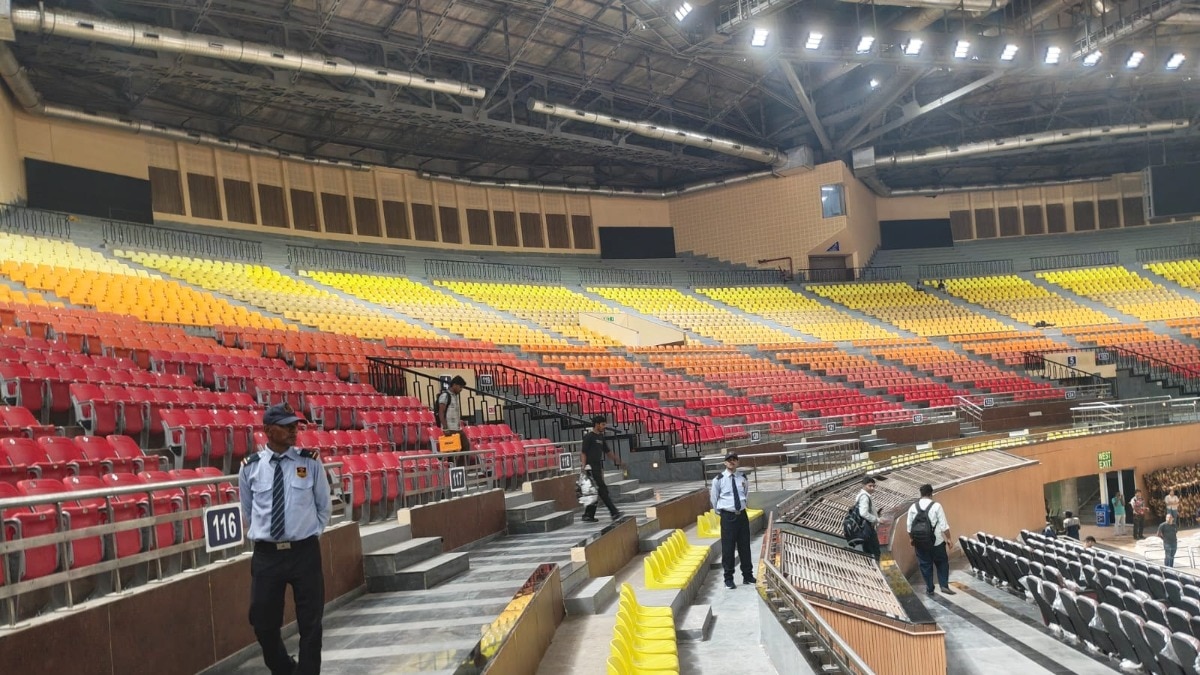
When the Sports Authority of India and the Badminton Association of India sat down to plan for the BWF World Championships, returning to India after 17 years, the brief went well beyond new flooring and fresh paint. It extended to keeping the building’s uninvited guests out altogether.
Vents have been sealed. Wooden doors have been replaced with a double-door entry system, an automatic outer door added ahead of the regular ones. A tip from the Railway Ministry led organisers to a non-toxic gel, ordinarily used to protect railway wiring, now applied around the stadium’s ducting. Portable machines that mimic the presence of predatory birds have been installed as a final layer of defence, aimed specifically at keeping pigeons from hovering over the courts.
It is a lesson learnt the hard way. At the India Open in January, pigeons twice halted a second-round match between HS Prannoy and Loh Kean Yew, and the complaints that followed, over hygiene, over conditions, over Delhi’s smog, left the BAI on the back foot. The preparations now under way at the Indira Gandhi Indoor Stadium are, in part, a reponse and wider plans to ensure the IGI Stadium hosts a world-class event,.
But of everything on show when BAI and SAI walked reporters through the venue, nothing drew quite as much attention as a man from Delhi named Jabbar.
Jabbar is a professional monkey whisperer, a trade passed down from his grandfather to his father to him. He has spent years chasing monkeys away from major auditoriums across the capital, and he is now part of a four-man team engaged to do the same around the World Championships venue.
The method, he explained, is not chemical or mechanical but vocal. His team replicates the warning call of a langur, the primate that has traditionally kept monkeys off Delhi’s streets and rooftops, and lets the sound do the work.
“When we shout like that, the monkeys run away. This method is effective,” Jabbar said. “We also ensure the safety of the monkeys. We are careful that our voice doesn’t force them to cross roads when vehicles are moving. Earlier, langurs used to beat the monkeys away.”
The team is paid Rs 25,000 a month through a tender, work that Jabbar says is neither glamorous nor guaranteed.
“We don’t get work on a consistent basis. But, in Delhi, around major venues, in north block and south block of the IGI Stadium,” he said, describing a trade that has quietly expanded even as it remains unrecognised. “A lot of them are doing it. They are learning from us.”
It is, by his own account, a dying inheritance. His son is in the second standard. “I learnt it from my father. But I don’t want my children doing it,” Jabbar said, a line that lands harder for how matter-of-factly he says it.
Around him, the more conventional signs of a stadium overhaul continue. Sixteen entrances across the first and second floors have been fitted with glass doors and an automatic double-entry system, part of the roughly Rs 20 crore being spent to transform the venue. Somewhere in that spend sits a four-man team with no engineering background and no title beyond the one they gave themselves, tasked with making sure Delhi’s monkeys stay away from a World Championship the city fought hard to bring back.
– Ends



