


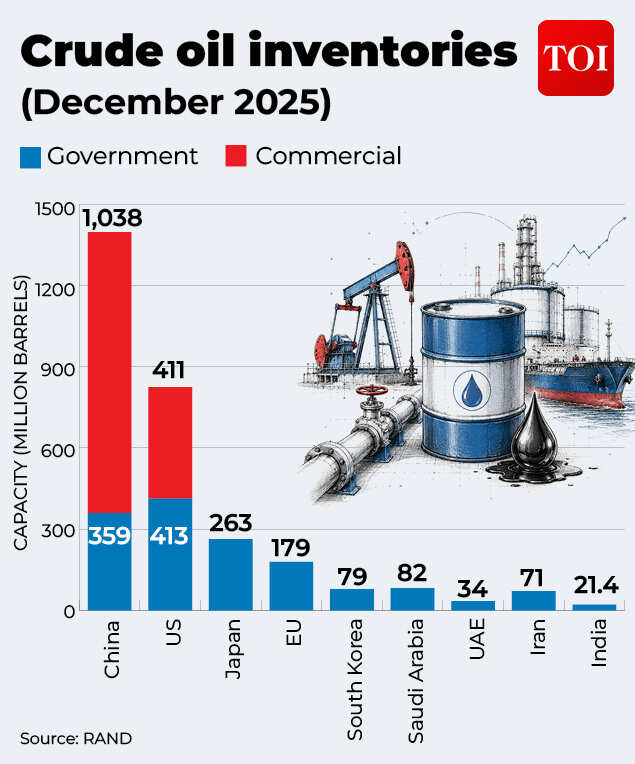
For half a century, the global oil market has revolved around two centres of power. The Gulf, led by Saudi Arabia, controlled spare production capacity. The US supplied military protection and financial muscle to Gulf oil. Together, Washington and the Gulf states could influence how much oil reached the market, in which currency it was traded and, ultimately, what consumers paid.That architecture is no longer as secure as it once appeared. A third centre of power is emerging: Not primarily as an oil producer, but as the world’s biggest buyer and stockholder.China has accumulated as much as 1.4 billion barrels in strategic and enterprise-controlled inventories, according to a new RAND study. That is more than three times the roughly 413 million barrels held in the US government’s Strategic Petroleum Reserve. Beijing’s stocks are estimated to cover 110-140 days of net imports.
World Crude Oil Inventories
China therefore possesses something no other major oil importer has had at this scale: the ability to alternate between being an enormous buyer, an absent buyer and a potentially enormous seller. In an increasingly fragmented market, those shifts can determine the direction of prices almost as powerfully as production decisions in Riyadh or Washington.
The new ‘swing producer’
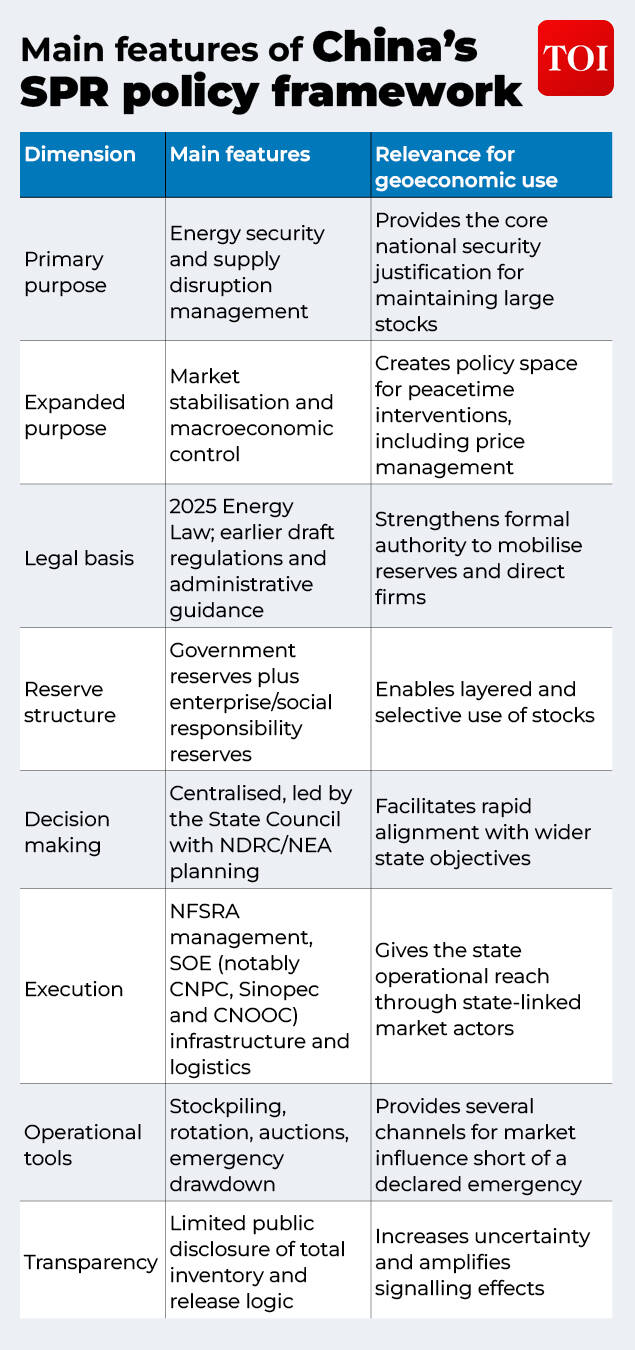
Saudi Arabia has traditionally been called the world’s “swing producer” because it can raise or reduce output relatively quickly. China is now capable of doing the same.China plays a significant role in global crude trade, accounting for around 20% of global crude, with volumes touching 12 million barrels per day. That is more than two times what India imports.Also Read | 100% tariffs: Why India may ignore Trump threat and continue buying Russian crude oilA decision to add or withdraw even one million barrels a day is significant in a market where relatively small mismatches between supply and demand can produce disproportionate price movements. Beijing does not need to release its entire reserve. Simply changing the speed at which it buys oil can alter traders’ expectations.This is what we saw since the start of the Middle East crisis. China consciously chose to reduce its oil imports, helping ease supply constraints on global crude demand. Analysts widely see China’s decision as a big factor that kept oil prices from spiraling out of control. China drew down part of its strategic oil reserve and tightened export controls rather than letting domestic and global prices spiral.Not only that, but unlike the IEA’s transparent 400-million-barrel coordinated release, China’s reserve management is largely opaque, commercially driven and rarely disclosed, giving Beijing greater flexibility and growing influence over global oil market dynamics, points out Praveen Rai, Director, Grant Thornton Bharat.According to Manas Majumdar, Partner and Leader – Oil & Gas, Fuels and Resources, PwC India, this translates into significant leverage which he calls price-making power or ‘prime purchasing power’, as different from OPEC’s pricing power which comes from its supply hold.
Main features of China’s SPR policy framework
And this position has evolved over the last decade where China used to consume around 11 million bpd and imported around 6 million bpd, to now imports doubling to almost 12 million bpd (of total 17 million bpd consumption). This has transitioned China from a simple consumer to a key market maker, in effect China now acts as a global swing buyer.“China’s massive strategic oil reserves help it act as a global swing buyer. During price dips, China aggressively stockpiles excess supply (e.g. it added 1.1 million bpd to reserves last year alone). This reserve in effect puts a structural floor for global prices,” Manas Majumdar tells TOI.“During price rallies, it can draw down reserves to suppress import demand, directly muting global price spikes, which is what has happened in the current Hormuz crisis,” he adds.
Buying sanctioned barrels, banking leverage
China has built much of its inventory by exploiting divisions in the international system. It has bought discounted oil from Russia and acquired barrels linked to Iran and Venezuela, frequently through intermediaries or altered trading routes.The RAND report estimates that around 22% of China’s reported crude imports in 2025 involved sanctioned oil, including Iranian and Venezuelan barrels that may have been rerouted through countries such as Malaysia. The Middle East accounted for about 41% of Chinese imports, while Russia supplied around 18%.This diversified buying strategy reduces the ability of Washington to dictate flows through sanctions. It also gives Beijing negotiating leverage over exporters. When China is one of the few buyers capable of absorbing large quantities of restricted crude, it can demand discounts, favourable payment arrangements and greater use of the yuan.Over time, China could go further. It could supply refined products or reserve oil to countries facing shortages, offer preferential prices to strategic partners or support oil transactions denominated in yuan. RAND describes such “strategic energy diplomacy” as plausible, particularly in Asia and the Global South.That would not immediately replace the dollar-based oil system. China’s capital controls and limited financial openness remain major obstacles to a genuine petroyuan. But each reserve-backed transaction could incrementally reduce US influence over energy trade.
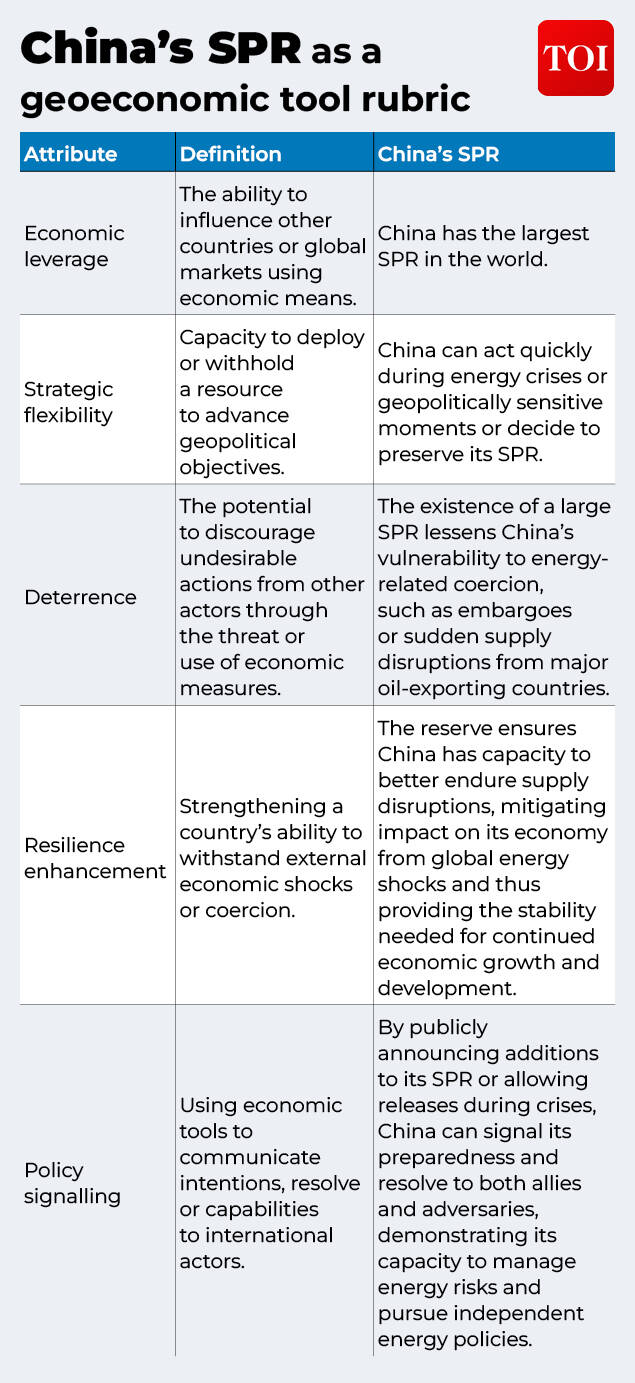
China’s SPR as a geo-economic tool rubric
Why India should worry
India would be affected even when Chinese action was not directed at it.India is one of the world’s largest crude importers and depends on overseas supplies for roughly nine-tenths of its requirements. Yet the RAND comparison places India’s strategic inventory at only about 21.4 million barrels, which is just a fraction of China’s stockpile.The immediate risk is price volatility. If China begins filling its reserves aggressively during a period of weak prices, it could lift crude costs just when Indian refiners expect relief. Conversely, a Chinese drawdown could depress prices, but the benefits might not be evenly distributed if Beijing simultaneously directs discounted barrels or refined fuels towards preferred partners.Higher crude prices feed into India through several channels: the import bill rises, the current-account deficit comes under pressure, the rupee weakens and the cost of transport, aviation, fertilisers and petrochemicals increases. The government then faces an unpleasant choice between passing prices on to consumers, cutting fuel taxes or asking state-owned retailers to absorb losses.“Every $10/barrel surge in crude inflates India’s annual import bill by $13–15 billion, so if China resorts to crisis buying, then it could quickly become India’s inflation tax,” says Manas Majumdar.There is also a strategic disadvantage. China can use low-price periods to accumulate security; India largely uses them to reduce its import bill. When the next crisis arrives, China possesses both physical stocks and negotiating leverage, while India remains more dependent on uninterrupted shipping and the goodwill of suppliers.China’s ability to buy sanctioned Russian and Iranian crude also creates competition for India. If Beijing increases purchases, the discounts available to Indian refiners could narrow. If it reduces purchases suddenly, prices for those grades may fall, but Indian companies could face intensified Western scrutiny for absorbing the surplus.
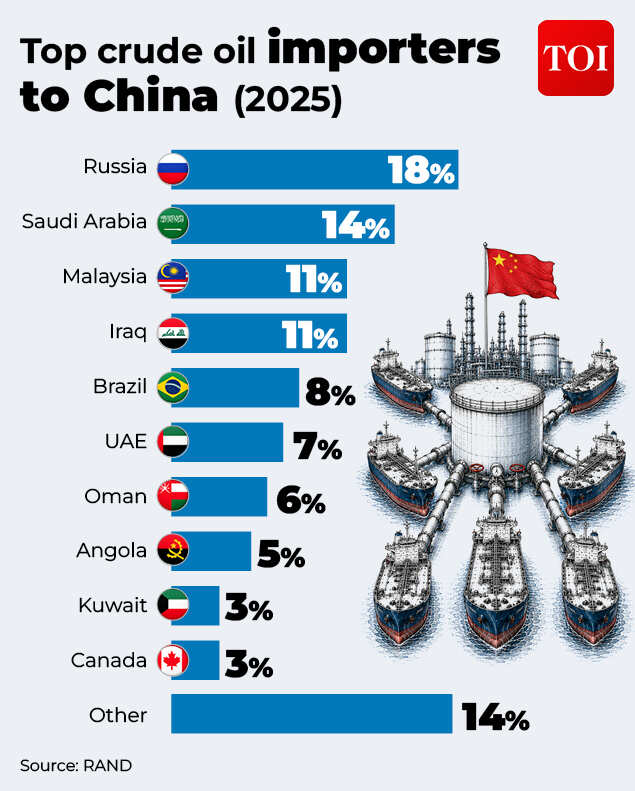
Top crude oil importers to China (2025)
India needs a buyer’s strategy
India cannot match China barrel for barrel. But it can reduce the imbalance.India’s strategy for energy security i.e., building up strategic reserves, accelerating its energy transition, expanding nuclear power capacity and pushing E&P initiatives is the right one, says Rajnish Gupta, Partner, Tax and Economic Policy Group, EY India.“Expanding strategic reserves provides immediate resilience; accelerating energy transition and usage of domestic resources reduces import dependence over the long run; and E&P initiatives can help increase domestic output. This is the most direct way to minimise the impact of price shocks,” he tells TOI.First, New Delhi needs to expand strategic storage and treat cheap oil as an opportunity to purchase insurance, not merely to improve the fiscal arithmetic for one quarter. It should also integrate government reserves more effectively with the inventories of public and private refiners.Second, India needs supply agreements that guarantee access during emergencies, including arrangements with Gulf producers, Russia, the US, Brazil and emerging suppliers. Strategic storage partnerships in which producing countries hold crude in India could enlarge the buffer without requiring the government to finance every barrel.Third, policymakers must track Chinese refinery runs, tanker movements, storage construction and import patterns as closely as they monitor Opec+ meetings. The most consequential oil-market signal may no longer come from a Saudi minister’s statement or a US sanctions announcement. It may come from an unexplained rise in tankers heading towards Chinese ports.PwC’s Manas Majumdar says India’s energy security plans don’t need a rethink as much as they need recommitment. The steps India has taken around supply source diversification, strategic reserve expansion and broader energy substitution are sound – they just need to be accelerated, he says.Praveen Rai of Grant Thornton Bharat says India should continue to strengthen its energy security strategy as China’s influence in global oil markets grows, although the focus should remain on building overall resilience.“As global oil markets become increasingly influenced by Asian demand growth and geopolitical uncertainties, India will also need to reduce the oil intensity of its economy through greater energy efficiency and transport electrification. A diversified and resilient energy portfolio will be critical to reducing exposure to supply disruptions, price volatility, and external market shocks,” he tells TOI.China cannot unilaterally set the world oil price. Producers still control supply, the Gulf still holds vital spare capacity, and the US remains the largest oil producer and the dominant financial power. But Beijing increasingly controls the marginal barrel of demand — whether it is purchased, stored, released or withheld.That is enough to move markets. The next oil order may not be dictated solely by those who pump the crude, but by the country with the deepest tanks and the greatest freedom to decide when to fill them. For India, preparing for that shift is no longer optional.



