




A Parliamentary panel has called for the early rollout of a calibrated Merchant Discount Rate (MDR) on high-value digital transactions. According to the panel the framework is essential to make the payments ecosystem financially viable and reduce the government’s subsidy burden.Earlier this week, Parliament cleared amendments to the Payment and Settlement Systems Act, 2007, through a Bill that empowers the government to allow banks and other payment service providers to levy charges on transactions carried out through the Unified Payments Interface (UPI) and other electronic payment modes notified by the Centre.The amendments remove the existing legal restriction that barred banks and payment service providers from imposing a Merchant Discount Rate (MDR) on notified digital payment modes.Also Read | What is MDR that is being proposed for UPI transactions, who pays the final cost? ExplainedThe government’s objective is to introduce a nominal charge on selected digital payment transactions involving consumers and small businesses, while creating a sustainable revenue framework for banks, payment service providers (PSPs) and payment infrastructure companies that support the country’s digital payments ecosystem.The legislation proposes amendments to Section 10A of the Payment and Settlement Systems Act, 2007, which currently prohibits banks and payment system providers from levying charges on electronic payments. It also modifies the linkage with Section 269SU of the Income Tax Act, under which businesses with an annual turnover exceeding Rs 50 crore are required to accept payments through specified electronic modes, including RuPay debit cards and BHIM-UPI QR codes.
Need for MDR
In its report tabled in Parliament on Wednesday, the Standing Committee on Finance also urged the Department of Financial Services under the Ministry of Finance to put an assessment of the long-term financial viability of defined-benefit and incentive-based schemes.Commenting on the incentive programme for promoting RuPay Debit Cards and low-value BHIM-UPI transactions, the Committee noted that the budgetary allocation of Rs 2,000 crore to compensate for losses arising from the zero-MDR regime unnecessarily increases the Department’s Demand for Grants while meeting only around 10 per cent of the industry’s actual operating costs.
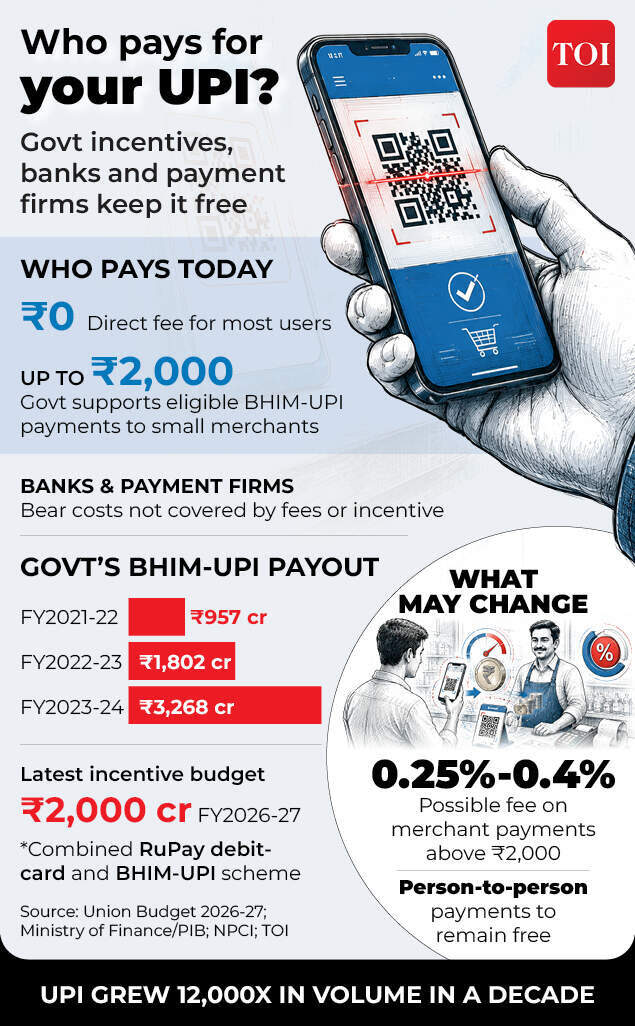
Who pays for your UPI?
In view of this, the Committee had earlier advised the Department to examine a self-sustaining, tiered revenue model that could ensure the long-term viability of the payments ecosystem without placing a recurring burden on the exchequer.The report said that, acting on the Committee’s earlier recommendation highlighting the need for a sustainable revenue framework, legislative provisions enabling a tiered MDR structure had subsequently been introduced.Even so, the Committee, chaired by senior BJP leader Bhartruhari Mahtab, expressed concern over the wide gap between the Rs 2,000 crore budgetary support and the industry’s estimated operational expenditure of Rs 20,700 crore.The report added that although the necessary legal provisions are now in place to introduce a calibrated MDR on high-value transactions, any delay in notifying and implementing the framework would leave payment service providers reliant on inadequate government support, potentially affecting investments in cybersecurity, fraud prevention and payment network infrastructure.“The Committee, therefore, reiterates the recommendation to expedite the implementation of a self-reliant, tiered revenue framework for higher-value merchant transactions while safeguarding small merchants and P2P transfers, thereby transitioning the digital payments ecosystem to a self-sustaining model,” the report said.



 on high-value digital transactions. According to t.)