







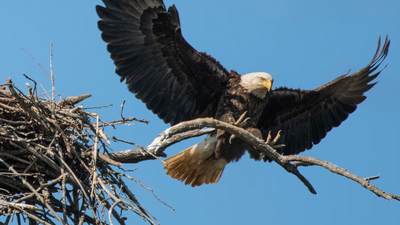
A Washington man is facing federal charges after allegedly shooting and killing a bald eagle that was found near chickens on his property in Clark County. The case began on February 5, 2026, when wildlife officers responded to a report of a dead bald eagle in the Hockinson area of Brush Prairie. A witness had reportedly heard a sound resembling a gunshot or firecracker earlier that morning. Officers found the bird with a head wound and sent it for examination. X-rays reportedly revealed two shotgun pellets lodged in the eagle’s head, while a veterinary examination identified the injuries as fatal. Months after the investigation began, federal prosecutors charged 66-year-old Benjamin G. Allen in connection with the eagle’s death. The allegations remain unproven in court.
Washington man accused of shooting bald eagle
The investigation began on February 5, 2026, when Washington Department of Fish and Wildlife Police received a report about a dead bald eagle at a residence in the Hockinson area of Brush Prairie in Clark County. According to the federal case, the person who reported the incident had heard what sounded like a loud firecracker or gunshot earlier that morning. Wildlife officers arrived at the property and found the adult bald eagle on the ground with an apparent wound to its head. The bird was taken to a local humane society for X-rays, which reportedly showed two pellets lodged in its head. Investigators secured the evidence and referred the case to the US Fish and Wildlife Service for further investigation.The federal case alleges that the eagle was shot and killed with a shotgun on February 5. Following the initial investigation, the bird underwent a veterinary examination. According to the case details, the examination found two shotgun pellets in the eagle’s brain and determined that the wounds were responsible for its death. US Fish and Wildlife Service agents subsequently interviewed Allen as part of their investigation into the bird’s death. The evidence described by prosecutors forms part of the allegations against him. However, the findings do not by themselves establish guilt, which must ultimately be determined through the federal court process.
The bald eagle is federally protected
Bald eagles are protected under US federal law even though they are no longer listed as endangered or threatened under the Endangered Species Act. The species was removed from the federal endangered and threatened species list in 2007 after a major recovery in population numbers. However, bald eagles continue to receive protection under the Bald and Golden Eagle Protection Act and the Migratory Bird Treaty Act. The Eagle Act prohibits unauthorised actions including shooting, wounding, killing, capturing or disturbing bald and golden eagles. The US Fish and Wildlife Service continues to enforce these protections across the country.
How the chickens factor into the case
The case has attracted attention partly because Allen reportedly kept chickens near the area where the bald eagle was found. However, the federal allegations do not establish that the eagle was attacking the chickens when it was allegedly shot. They also do not establish that protecting the chickens was the motive for the alleged shooting. Bald eagles are predators and can prey on smaller animals, including poultry, but the presence of chickens near a property does not by itself provide legal permission to kill a protected eagle. Any claim that the eagle was attacking Allen’s chickens should therefore be treated cautiously unless supported by evidence presented in court.
Federal law and wildlife conflicts
The US Fish and Wildlife Service recognises that bald eagles can come into conflict with human activities and property interests. Federal regulations provide limited mechanisms for dealing with certain eagle-related conflicts through authorisation and permits. These rules are designed to balance conservation with legitimate concerns involving agriculture, property and other activities. However, such provisions do not amount to a general right for landowners to shoot an eagle they believe poses a threat to livestock. The circumstances in which an eagle can legally be taken are governed by federal regulations, and unauthorised killing can result in prosecution.
Federal charges against Benjamin G. Allen
The US Attorney’s Office for the Western District of Washington charged 66-year-old Benjamin G. Allen of Brush Prairie by criminal information on August 4, according to the case details. He is accused of violating the Bald and Golden Eagle Protection Act and unlawfully killing a migratory bird. Prosecutors allege that Allen used a shotgun to kill the bald eagle on February 5. He has been summoned to appear in US District Court in Tacoma on September 8. The charges are allegations rather than findings of guilt, and Allen is presumed innocent unless prosecutors prove the case beyond a reasonable doubt.
What penalties could the charges carry
The potential penalties depend on the specific offences and provisions involved in the federal case. Under the Bald and Golden Eagle Protection Act, an unauthorised killing can result in criminal penalties. The US Fish and Wildlife Service states that a first violation can carry a fine of up to $100,000 for an individual, imprisonment of up to one year, or both. More serious penalties can apply to subsequent violations. The separate migratory-bird offence can also carry penalties under federal law. The actual consequences, if Allen is convicted, would depend on the charges proven and the court’s sentencing decision.
Bald eagle’s remarkable conservation recovery
The case comes against the backdrop of one of America’s most notable wildlife conservation successes. Bald eagle populations declined dramatically during the 20th century because of factors including habitat destruction, hunting and the widespread use of DDT. The pesticide interfered with reproduction and contributed to severe population declines. After conservation measures were introduced and DDT use was restricted, bald eagle numbers began to recover. The species was removed from the federal endangered and threatened species list in 2007. Its recovery, however, did not end federal protection. Bald eagles remain protected under separate wildlife laws.
Why the case is significant
The case highlights the distinction between a species being endangered and a species being legally protected. Bald eagles are no longer classified as endangered under the Endangered Species Act, but federal law still prohibits unauthorised killing and other forms of harm. It also illustrates the legal complications that can arise when protected wildlife comes into contact with livestock or domestic animals. Property owners may have legitimate concerns about predators, but federal wildlife protections can restrict how those conflicts are handled. In this case, prosecutors will have to establish whether Allen unlawfully killed the eagle and whether the evidence supports the federal charges.The case will now proceed through the federal court system, with Allen scheduled to appear in court in September. Prosecutors will have to prove the allegations against him beyond a reasonable doubt if the case goes to trial. Evidence described in the case includes the dead bald eagle, the reported gunshot, X-rays showing two shotgun pellets and the subsequent veterinary examination. Until the court reaches a decision, the allegations remain unproven. The case nevertheless underscores that killing a bald eagle without federal authorisation can carry serious legal consequences, despite the species’ removal from the endangered species list nearly two decades ago.


