





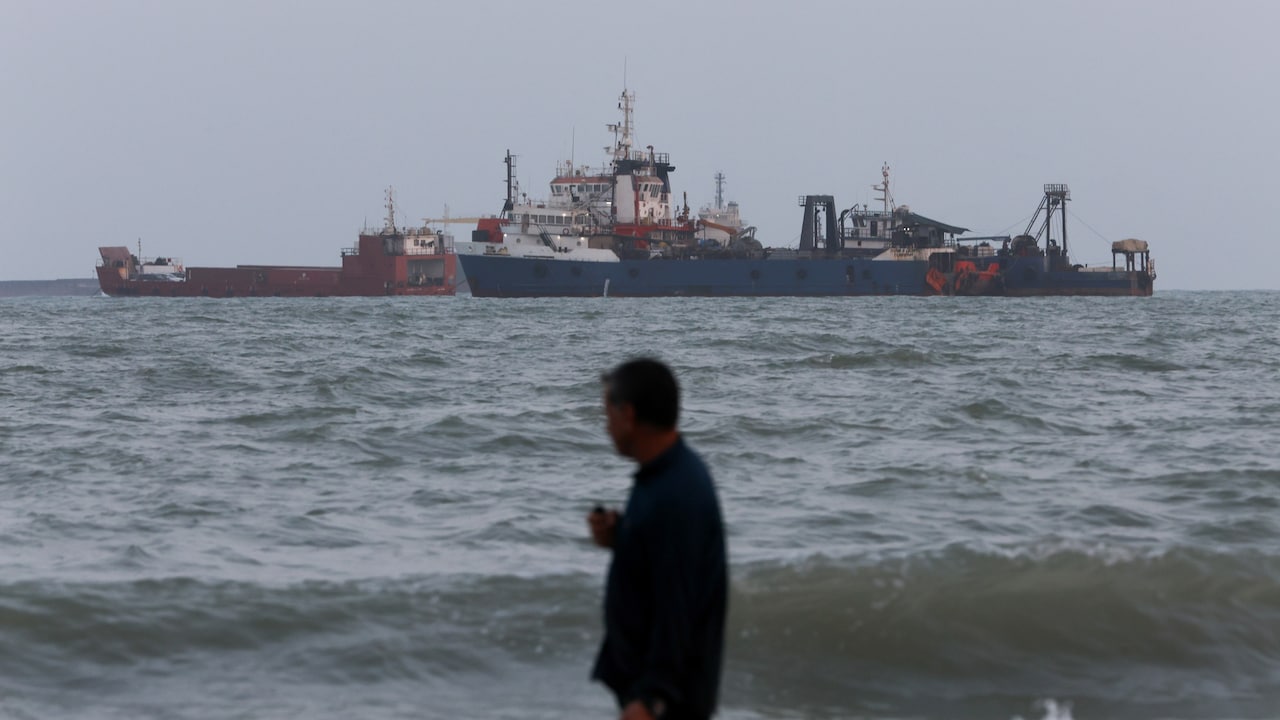
More ships have come under attack in the Strait of Hormuz as talks to end the war in the Middle East remain stalled and the US readies new economic measures to force Iran to capitulate.
The UK Maritime Trade Operations on Saturday said it had been notified of a projectile striking the hull of a bulk carrier. Two Abu Dhabi National Oil Co. vessels were struck while transiting Hormuz on Thursday and another was hit on Friday evening, according to reports from the United Arab Emirates’ state-run WAM news agency. There were no reports of injuries.
The waterway, through which a fifth of the world’s oil and gas transited before the war, has emerged as a key sticking point in negotiations to bring a lasting end to almost six months of fighting. The US is adamant free passage along the route linking the Persian Gulf to the Gulf of Oman and the Arabian Sea should be restored, but Iran insists it will retain control.
The price of Brent crude, the global benchmark, rose almost 6% this week as hopes faded of a quick resolution to a deadlock that’s disrupted the flow of oil and other key commodities to global markets. There had been some 65 confirmed incidents involving vessels in Hormuz and the broader Middle East during the conflict and 17 seafarers had died as of Aug. 11, according to the International Maritime Organization.
President Donald Trump has struggled to find an off-ramp to the war, which began when the US and Israel launched air strikes against the Islamic Republic on Feb. 28 and has claimed thousands of lives — most of them in Iran. He told Fox News on Friday that the US plans to hit Iran’s economy hard and he didn’t care if the conflict ends before the November US midterm elections, which will hinge on voter perceptions of the economy.
In a speech on Long Island Friday, Trump said a US blockade of Iranian ports was a “wall of steel” that enabled Washington to effectively govern Hormuz. “Pretty soon I’ll be declaring the Hormuz strait a territory of the United States,” he said with a chuckle.
Iran and Oman have been locked in lengthy negotiations about establishing a shipping route through the waterway, but the US isn’t party to those discussions.
Iranian Foreign Minister Abbas Araghchi said technical talks with Oman are ongoing and may be concluded soon, but an agreement wouldn’t translate into the strait’s reopening.
That “is a separate issue. It depends on fulfilling other conditions that the US must abide by for it to take place,” he said on his Telegram channel on Saturday. While Iran is in contact with mediators from Qatar and Pakistan, who are passing messages between Tehran and Washington, “this does not constitute negotiation. We have not yet made a decision to resume negotiations with the US,” he added.
Trump’s push for renewed economic pressure on Iran comes as the US faces a shortfall of key munitions and mounting domestic opposition to an expanded military campaign.
US Treasury Secretary Scott Bessent said in a Newsmax interview Thursday that there would be “more announcements coming next week” on new economic measures aimed at Iran that “have never been seen in the history of economic isolation on a country,” without specifying them.
Iran’s economy has already taken a major hit, with much of its industrial capacity damaged and crude exports severely curtailed by the US blockade, but waves of sanctions have failed to force it to bend on its nuclear program or relinquish control over the strait.
It’s unclear exactly what meaningful additional measures the US could implement without resorting to secondary sanctions on buyers of Iranian oil, such as China. That would likely spark retaliatory action from Beijing and spark more global energy price uncertainty.
Iran, for its part, has reorganized its military to be more aggressive abroad as talks on ending the war remain mired in stalemate, a sign that Tehran is preparing for the possibility of a protracted era of regional conflict.
Volatility in the Middle East extends beyond the US-Iran conflict. Israel continues to clash with Hezbollah in southern Lebanon and Hamas operatives in Gaza, while the Houthis have attacked ships in the Red Sea. All three groups are backed by Iran.
Lebanese Prime Minister Nawaf Salam said the Israeli military staged a series of attacks on his country on Saturday, including intensive airstrikes and shelling, that claimed the lives of at least nine people and injured 11. The situation was “of utmost gravity” and undermines efforts for stabilization, he said in a post on X.
The Israel Defense Forces earlier said it had hit Hezbollah infrastructure in the Nabatieh and Ansar areas in southern Lebanon in response to action by the militia, and it would continue operations to counter threats against its soldiers and nationals.
“Responsibility for dealing with any military structures, if they exist on Lebanese territory, lies exclusively with the Lebanese state,” Salam said, adding that those who had been killed couldn’t be considered military targets.
The latest upsurge in violence threatens to derail a US-brokered ceasefire between the Israeli and Lebanese governments that provides for Hezbollah’s disarmament. It also envisions the IDF eventually withdrawing from territory it has occupied and that the Lebanese army will step in to maintain security.
(This story has not been edited by NDTV staff and is auto-generated from a syndicated feed.)
Essential Business Intelligence,
Sharp Market Insights,
Practical Personal Finance Advice, Daily Fuel, Gold and Silver Prices and Latest Stories — On NDTV Profit.


