


India’s economic prowess has overshadowed Pakistan’s for years, and perhaps that is why we hardly talk about the two together in the context of global trade. There’s one industry where Pakistan is giving India tough competition: textiles. Both the nations are competing for the same customers and, most importantly, it’s the market China has vacated. We are talking about bedsheets and towels specifically.
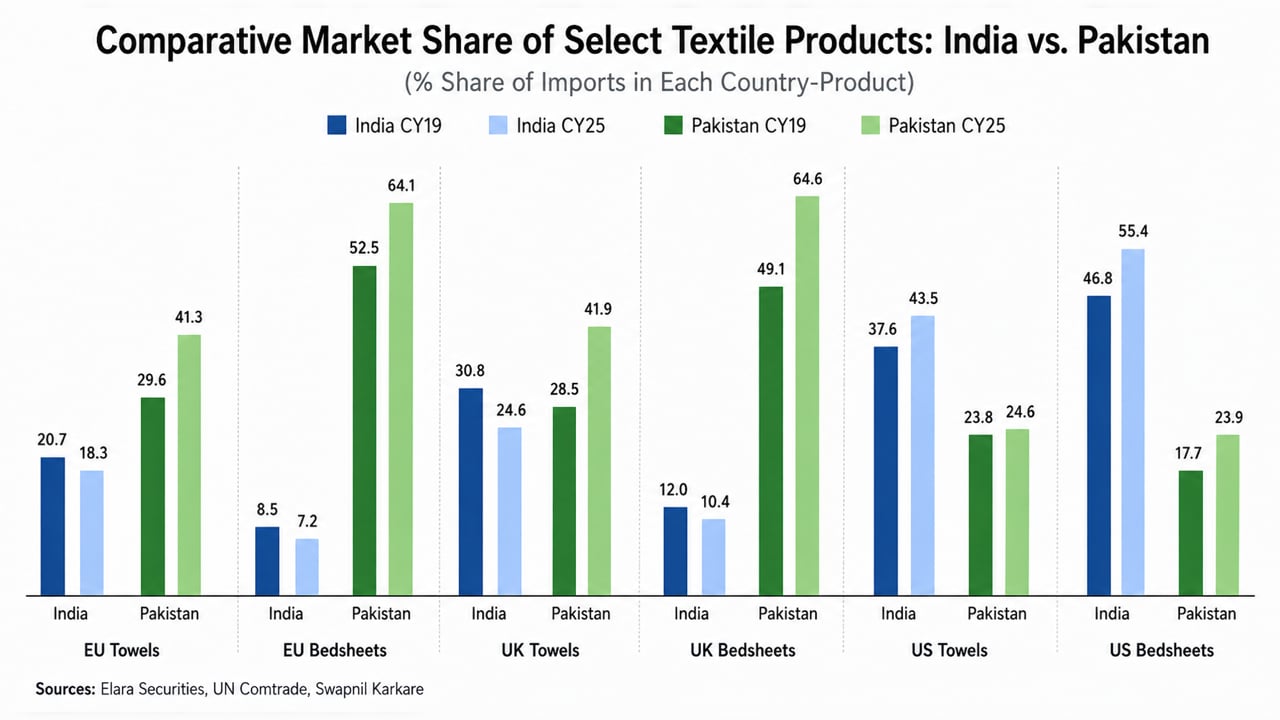
The latest data from UN Comtrade, compiled by Elara Securities, reveals an unusual split. India has strengthened its position in the US market, while Pakistan in Europe and the UK. The competition is not about quality alone. There are multiple factors in play, right from tariffs to manufacturing scale.
India Lags in Europe
Both India and Pakistan benefited from China’s retreat from the US market, but India is a clear winner. India’s share of US cotton-bedsheet imports rose from 47% in 2019 to 55% in 2025. Pakistan gained too, from 18% to 24%. China, meanwhile, fell from 23% to just 8%. In terry towels, India’s share rose from 38% to 44%, while Pakistan’s moved only marginally, remaining around 24%.
But India’s experience in the European markets was different. The European Union (EU) is the world’s largest regional home-textile market, yet India’s share has been falling. Pakistan’s share in EU terry towels rose from 30% in 2019 to 41% in 2025, while India’s fell from 21% to 18%. In bedsheets, Pakistan’s share increased from 53% to 64%, while India’s declined from around 9% to 7%. The trend continues in the UK-Pakistan gained market share while India lost.
Trade Policy Matters, But Also The Quality
This is where trade policy becomes central.
Pakistan has benefited from preferential access to the European market under the EU’s Generalised System of Preferences (GSP+) regime. GSP+ is a special trade incentive that cuts import duties to zero on two-thirds of tariff lines for vulnerable developing countries, including Pakistan, Kyrgyzstan, Sri Lanka, the Philippines, Uzbekistan, and Mongolia. On the other hand, Indian exporters face tariffs of roughly 10-12% on these textile products. This is a primary reason behind Pakistan’s gain and India’s loss in the region.
The US had a similar programme that included both India and Pakistan. In 2019, it removed India from the list of beneficiary countries. In 2020, GSP expired and hasn’t been renewed. Also, most textile products were not part of GSP in the US. That means neither Pakistan nor India benefited from these incentives in the US markets.
ALSO READ: Tukaram Mundhe Is Not The Problem. Our Love For Heroes Is | The Reason Why
Pakistan’s Asset May Become a Liability
But the GSP+ is both an advantage as well as a vulnerability for Pakistan. Since 2014, it has enjoyed all the benefits of GSP+ and inadvertently over-relied on it. The Pakistan Business Council (PBC) highlights that around 86% of Pakistan’s EU exports use these incentives, with a 95% utilisation rate. That’s a lot.
This raises an important question about its strength without these incentives. And it looks like we may be able to see it sooner. In December 2027, the current scheme expires, with a couple of years more support in transition. Also, the EU has scrapped the automatic extension. That means Pakistan must submit an action plan to qualify for the next scheme.
According to the PBC, the uncertainty of this scheme has created a cliff-edge scenario. If it fails to renew, all textile exports to the EU will carry tariffs of around 9-12%. If it renews, it continues to operate as before, but the scheme itself involves conditions, compliance requirements and periodic reviews.
India’s Long-Term Advantage
India, on the other hand, has already negotiated a free trade agreement (FTA). Under the agreement, 90.7% of India’s exports to the EU by trade value would become duty-free. However, the agreement hasn’t been implemented yet. The UK agreement, on the contrary, is in force from 15 July 2026 onwards.
Yes, a trade deal doesn’t automatically transfer orders. Europe-Pakistan quality standards and supplier relationships are already strong, which may still benefit Pakistan. But those are short-to-medium term benefits.
India’s large-scale, integrated production and skilled workforce allow it to make higher-value products that many quality-conscious Western buyers are willing to pay for. Its experience in the US shows that when tariff disadvantages are reduced, it can improve its market share significantly. Therefore, these deals give India a longer-term advantage over Pakistan, which has not signed any such deals.
They could provide much-needed oxygen to a textile industry that has been hit by multiple shocks, including Covid and growing competition from Bangladesh and Vietnam in recent years. They could therefore do more than open markets. They could incentivise more investment, formalisation and moving further up the value chain.
Disclaimer: The views expressed in this article are solely those of the author and do not necessarily reflect the opinion of NDTV Profit or its affiliates. Readers are advised to conduct their own research or consult a qualified professional before making any investment or business decisions. NDTV Profit does not guarantee the accuracy, completeness, or reliability of the information presented in this article.
ALSO READ: Let’s Dump The Idea Of A BRICS Currency | The Reason Why
Essential Business Intelligence,
Sharp Market Insights,
Practical Personal Finance Advice, Daily Fuel, Gold and Silver Prices and Latest Stories — On NDTV Profit.


