


Bhopal:
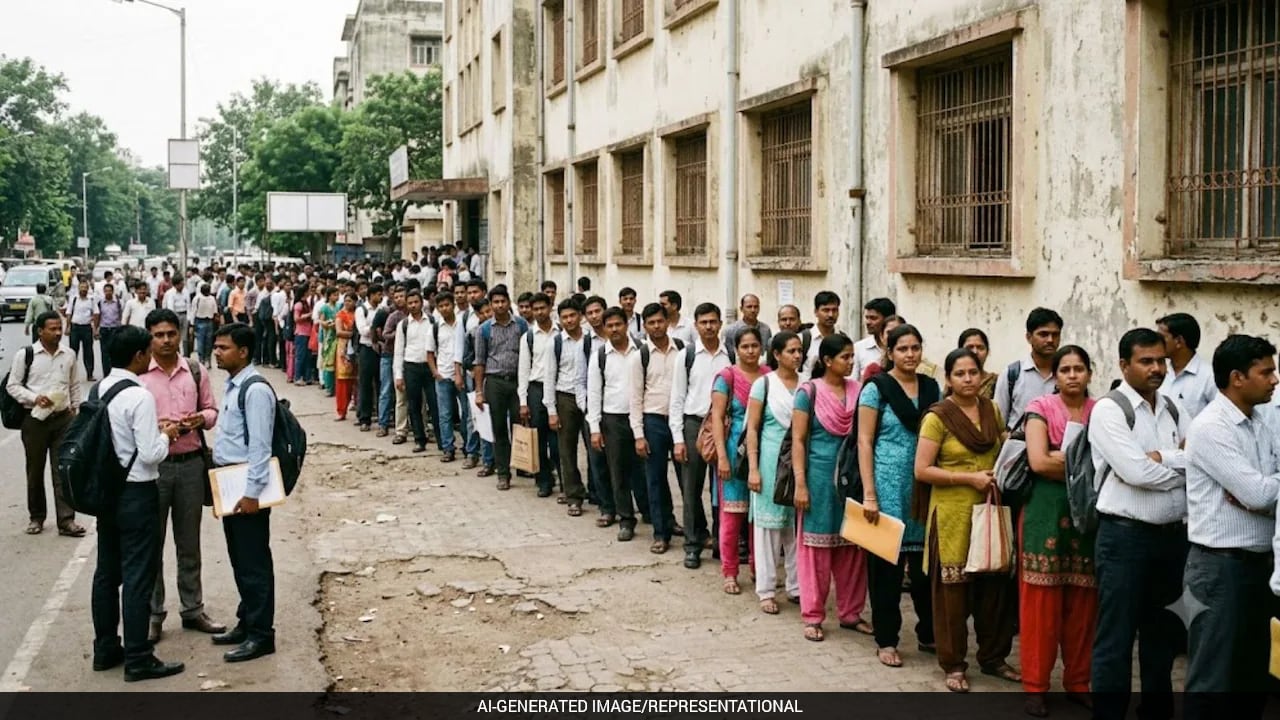
At a time when unemployment and the scramble for government jobs remain major concerns for millions of young Indians, an RTI response has revealed a striking contrast: more than 8.23 lakh sanctioned posts lying vacant across central government civilian establishments. And the figure does not include vacancies in public sector banks or public sector undertakings (PSUs). The workforce stretches from the massive Railways, Defence and Home establishments right up to the President’s Secretariat and the Prime Minister’s Office.
Against an overall sanctioned strength of 39,23,212 posts, only 30,99,556 employees were in position as on March 1, 2024. That leaves a gap of 8,23,656 posts or roughly 21 per cent of the entire sanctioned civilian workforce covered by the statement. Put simply, more than one in every five posts that the government itself had sanctioned was without an employee in position, as per the RTI application filed by Neemuch-based activist Chandra Shekhar Gaur.
“These figures are worrying at a time of rising unemployment. Government jobs are the right of the youth. The government should begin the process of filling these vacant posts on the highest priority and in mission mode. This will provide employment to young people and also improve departmental efficiency,” Gaur said.
And the empty chairs reach the very top of India’s administrative structure. According to the RTI data, the President’s Secretariat had 803 sanctioned posts but only 516 people in position, leaving 287 posts vacant or 35.74 per cent of its sanctioned strength. The Prime Minister’s Office had 441 sanctioned posts against only 315 employees in position, leaving 126 vacant or 28.57 per cent. In other words, more than a third of sanctioned posts in the President’s Secretariat and more than a quarter in the PMO were unoccupied according to the government’s own manpower statement.
In its August 19 response, the Department of Expenditure’s Pay Research Unit said the latest available group-wise and status-wise estimated strength of regular central government civilian employees was as on March 1, 2024. The response provided ministry and department-wise sanctioned strength and the number of persons actually in position, exposing the enormous gap between the size of the administrative machinery sanctioned on paper and the workforce occupying those posts.
The biggest hole is visible in one of the country’s most important establishments. The Defence Ministry’s civilian establishment had 5,56,248 sanctioned posts but only 3,14,005 employees in position, leaving an extraordinary 2,42,243 posts vacant. That works out to around 43.5 per cent of its sanctioned civilian strength. These figures relate specifically to civilian defence employees and should not be confused with workforce vacancies in the army, navy or the air force.
The railways, India’s gigantic transport network and one of the country’s biggest employers, presents an equally striking picture. Against 14,79,701 sanctioned posts, only 12,39,576 people were in position, leaving 2,40,125 posts vacant. Railways alone accounted for almost 30 per cent of the total vacancies reflected in the RTI data.
Put defence civilian establishments and railways together and the magnitude becomes even more dramatic: more than 4.82 lakh sanctioned posts were vacant in these two establishments alone, accounting for well over half of the total 8.23 lakh vacancies. The workforce gap runs equally deep through the machinery responsible for internal security. The Ministry of Home Affairs had 11,18,233 sanctioned posts but 10,07,348 people in position, leaving 1,10,885 posts vacant. While the percentage gap is lower than in several smaller departments, the sheer number means more than one lakh sanctioned positions were unoccupied in an establishment connected with some of the country’s most critical security and administrative responsibilities.
These three giant establishments, defence civilians, railways and home affairs, together account for approximately 5.93 lakh vacancies or nearly three-fourths of the total gap revealed in the government figures. The Department of Posts had 2,53,124 sanctioned positions but only 1,91,578 employees in position, leaving 61,546 posts vacant. The Department of Revenue, crucial to the government’s taxation and revenue administration, had 1,79,374 sanctioned posts against only 1,09,712 persons in position, leaving a huge 69,662-post gap, equivalent to nearly 39 per cent of its sanctioned strength.
Agriculture presents another significant manpower shortage. The Department of Agriculture and Farmers’ Welfare had 5,420 sanctioned posts but only 3,565 employees in position, leaving 1,855 vacant posts, or roughly 34 per cent of its sanctioned strength. The situation is even more severe proportionately in the Department of Animal Husbandry and Dairying. Against 2,393 sanctioned posts, only 1,015 employees were in position, leaving 1,378 vacant. That means nearly 58 per cent of sanctioned posts were unoccupied. The Department of Fisheries had 664 sanctioned posts and 464 persons in position, leaving another 200 vacancies.
The figures for the country’s environmental administration are similarly striking. The Ministry of Environment, Forest and Climate Change had 5,127 sanctioned posts against only 3,170 persons in position, leaving 1,957 vacancies, or approximately 38 per cent of sanctioned strength.
The Ministry of Labour and Employment had an even larger proportional deficit. Against 6,302 sanctioned positions, only 3,684 people were in position, leaving 2,618 posts vacant, more than 41 per cent of sanctioned strength. Education too is operating with substantial gaps. The Department of Higher Education had 1,414 sanctioned positions but only 892 employees in position, leaving 522 posts vacant, or nearly 37 per cent. The Department of School Education and Literacy had 365 sanctioned posts against 278 people in position, leaving 87 vacancies.
The numbers extend to the health administration. The Department of Health and Family Welfare had 27,427 sanctioned positions against 25,845 persons in position, leaving 1,582 vacant posts. The Department of Health Research had just 28 persons in position against 62 sanctioned positions, meaning 34 of its 62 sanctioned posts, or more than half, were vacant. AYUSH had 432 sanctioned positions against 199 employees, leaving 233 vacancies, also more than half its sanctioned strength.
The government’s scientific and strategic establishments have sizable gaps as well. The Department of Atomic Energy had 37,250 sanctioned positions but only 27,016 people in position, leaving 10,234 vacancies. The Department of Space had 19,200 sanctioned posts against 15,074 employees, leaving 4,126 vacant posts. The Ministry of Electronics and Information Technology had 6,527 sanctioned positions against 4,846 employees, leaving 1,681 posts vacant.
The vacancies also reach ministries tasked with building India’s cities and managing its water resources. Housing and Urban Affairs had 19,151 sanctioned positions against 14,559 employees, leaving 4,592 vacant posts. Water resources, river development and Ganga rejuvenation had 11,433 sanctioned posts against 8,242 employees, leaving 3,191 vacancies.
Even departments dealing with industry, information and the legal system show significant shortages. The Department for Promotion of Industry and Internal Trade had 3,807 sanctioned posts against 2,454 employees, leaving 1,353 vacant. The Ministry of Information and Broadcasting had 4,940 sanctioned posts but only 3,103 employees in position, leaving 1,837 vacancies, around 37 per cent of its sanctioned workforce. The Ministry of Law and Justice had 3,478 sanctioned positions against 2,211 people in position, leaving 1,267 posts vacant.


