


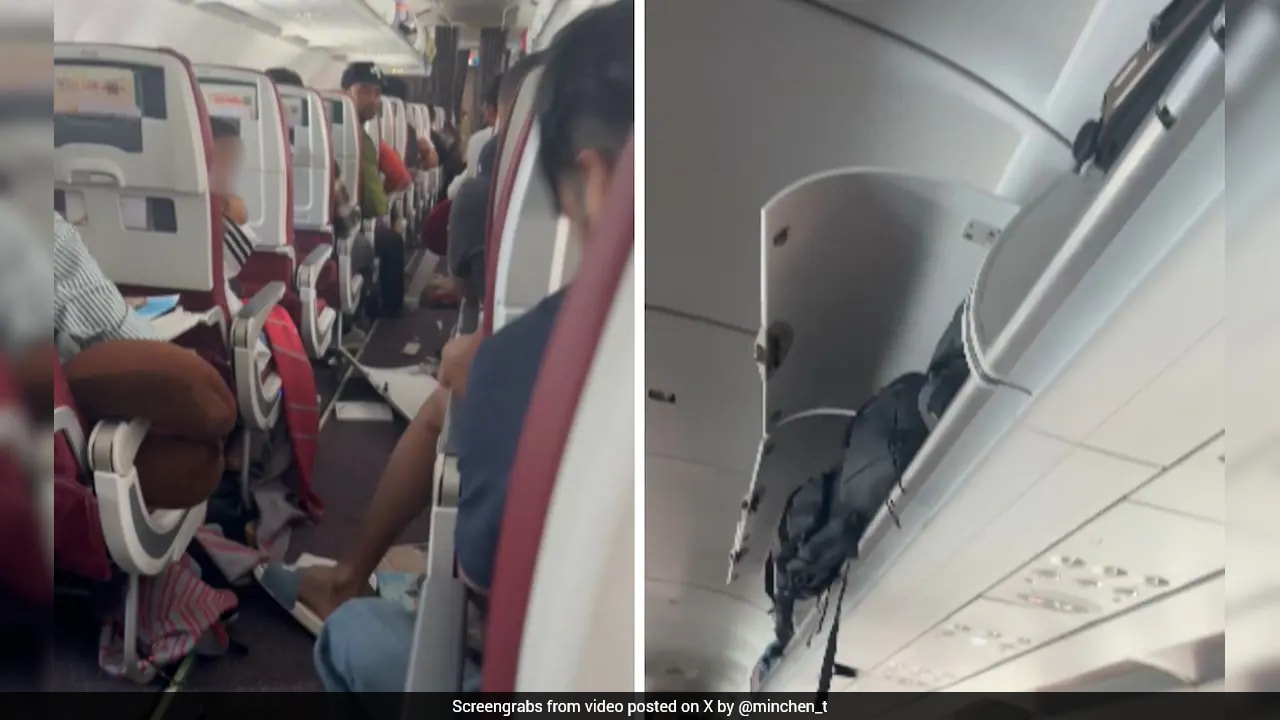
New Delhi:
The pilot-in-command of flight AI2379 from Phuket to Delhi, which dropped 300 feet over Odisha on August 4, injuring several passengers, has been sacked by Air India after he tested positive for a psychoactive substance.
In a statement, the Tata-owned carrier said it has a zero-tolerance approach to safety violations and regulatory requirements.
“The Pilot-in-Command of the Phuket-Delhi flight tested positive for a psychoactive substance. In line with Air India’s zero-tolerance approach to violations of safety, fitness or regulatory requirements, the pilot’s employment has been terminated with immediate effect,” it said in the statement on X.
The Aircraft Accident Investigation Bureau, in its preliminary probe report, noted that the Air India Airbus A320 carrying 145 people suffered near-simultaneous loss of all three hydraulic systems while cruising at 36,000 feet.
This resulted in what it described as an autopilot disconnect, which triggered a brief stall warning. Soon, the plane lost altitude, leaving 24 passengers injured.
Also read: Air India Phuket Flight Pilot Tested Positive For Psychoactive Substance: Probe Report
The initial probe report noted that the pilot tested positive for the psychoactive substance. However, it did not state that the pilot-in-command’s drug abuse contributed to the hydraulic failure or the altitude loss.
The aviation probe body recommended action against the pilot for violations in the preliminary probe.
“Detailed investigation regarding technical and other aspects is underway. In this case, it has been observed that the PIC was found non-negative for psychoactive substances in the confirmatory test. The confirmation of use of psychoactive substances is a serious concern, and AAIB recommends appropriate actions by DGCA on priority,” said the preliminary report by the Aircraft Accident Investigation Bureau (AAIB).
The report said the pilot and his co-pilot were subjected to a drug-detection test after the plane landed. The flight captain was found positive, whereas the co-pilot tested negative.
After the plane landed safely in Delhi, the crew said that the aircraft had encountered turbulence. After an AAIB team arrived at the airport to assess the situation and collect evidence, the incident was classified as an accident.
“We acknowledge the release of the preliminary report by the Aircraft Accident Investigation Bureau (AAIB) and continue to extend our full cooperation to the investigation, including providing access to all relevant operational, maintenance and technical records.
Safety remains…— Air India Newsroom (@AirIndia_News) September 4, 2026
The report further noted that at the time of the incident, the co-pilot was flying the plane and tried to bring the situation under control.
“Subsequently, the PIC (the pilot in charge) took over the controls. Meanwhile, the aircraft encountered an altitude upset. Initially, it gained 372 ft and fell by 292 ft from its assigned FL360 during the event,” it said.
Soon, flight controls recovered, the report said, adding that the aircraft started operating normally.
The AAIB report also stressed that a pre-flight inspection had been carried out by the maintenance personnel and no discrepancies had been recorded.
Acknowledging the report, Air India reiterated its adherence to a “safety-first” approach.
“We acknowledge the release of the preliminary report by the Aircraft Accident Investigation Bureau (AAIB) and continue to extend our full cooperation to the investigation, including providing access to all relevant operational, maintenance and technical records. Safety remains Air India’s highest priority. Our pilots undergo rigorous training, regular proficiency checks, medical examinations and other regulatory assessments in accordance with applicable national and international requirements. Following the incident, Air India has started voluntary testing of 100% of its pilots as a further step to reinforce its safety-first approach,” it said in a statement earlier today, adding that it would take appropriate action wherever warranted.


