


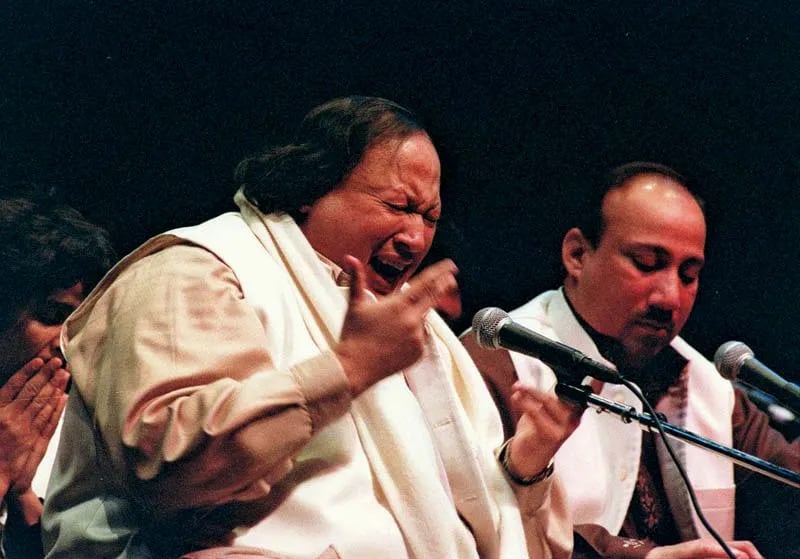
Shahenshah-e-Qawwali is a moniker very befittingly used to crown the legend that was Ustaad Nusrat Fateh Ali Khan. In a world of rampant remixes and incoherent lyrics, there shines a jewel like him till today, whose incredible vocal prowess and innovative spirit took the centuries-old traditional form of Sufi music – Qawwali – to the farthest corners of the world, from small villages in Pakistan to massive Western music festivals and international stages.
Nusrat Fateh Ali Khan’s timeless pieces have inspired generations upon generations, and to this day his songs seem to circle back into our orbit as they are recreated or sampled in iconic films. Or should we say, his creations make the scene all the more memorable.
And this is precisely what we want to address – the undying love of Bollywood for the legend that is Nusrat Fateh Ali Khan.
The Recent Magic Of A Nusrat Fateh Ali Khan Song
The most recent magic was cast when his song Saanson Ki Mala added a certain fervour to the very volatile Mirzapur: The Film. At the crux of it, the film is about “lub hi toh hai“. You’ll know when you watch it – no spoilers here. Nusrat Fateh Ali Khan’s original vocals were blended effortlessly with new renditions by singers Madhur Sharma and Vaibhav Pani.
The song played a key role in a mid-credit sequence featuring Beena Tripathi (Rasika Dugal) and a page from her past.
This might also remind readers that the composition was heard before in famous ’90s films such as Jeet (1996) and Koyla (1997), starring Madhuri Dixit and Shah Rukh Khan.
Another recent example is Jaan Se Guzarte Hain in Aditya Dhar’s Dhurandhar 2, another Nusrat Fateh Ali Khan qawwali adapted from the classic 1977 track Dil Pe Zakhm Khaate Hai. The new version was reimagined by Shashwat Sachdev, with vocals by Khan Saab and Shashwat Sachdev.
And how it fit like a glove in the intense plot cooked by Aditya Dhar for one of the most sensational blockbusters of all time in Hindi cinema. Speaking of love, betrayal, and undeterred emotional resilience, Nusrat Fateh Ali Khan’s qawwali amped up the tension that was Dhurandhar’s core theme.
And The Many More Times Nusrat Fateh Ali Khan Kept Coming Back
The recent additions only made us take a trip down memory lane and recall some of his lasting gems that found a place in the music collections and Spotify lists of generations past and present.
One of his absolutely unmissable classics was Mere Rashke Qamar, composed and sung by Nusrat with lyrics by Fana Bulandshahri. This ghazal-qawwali, to date, is a concert favourite. It just hits different. Such was its popularity that it was reimagined by Tanishk Bagchi and voiced by Rahat Fateh Ali Khan for the 2017 movie Baadshaho.
The very identity of Sufi music is emboldened by the hint of romanticism that so many poets of eons have sworn by. And Nusrat Fateh Ali Khan kept it intact in one of his most romantic ghazal compositions to date – Ye Jo Halka Halka Suroor Hai. Since then, it has been adapted in several Bollywood medleys, one being the 2016 single Halka Halka and then loosely incorporated in the 2018 film Fanney Khan, where its intoxicating beats stayed.
Other songs that deserve a mention include Tere Bin Nahi Lagda from Ranveer Singh and Sara Ali Khan’s Simmba. The Sufi ballad was incorporated into Tere Bin for the film, re-sung by his nephew Rahat Fateh Ali Khan alongside Asees Kaur.
The emotional depth of Sanu Ek Pal Chain Na Aave ricocheted in the reimagined modern track in the 2018 film Raid, where Rahat Fateh Ali Khan’s vocals found a new home for Nusrat Fateh Ali Khan’s creation. Another song from the same film was Nit Khair Manga – a prayer song turned into a softer acoustic Bollywood style and re-rendered by Rahat Fateh Ali Khan.
Kinna Sohna Tenu Rab Ne Banaya, composed and performed by the Ustaad, was adapted in Aamir Khan and Karisma Kapoor’s Raja Hindustani (1996) and Marjaavaan (2019).
Mera Piya Ghar Aaya, written by 8th-century Punjabi Sufi poet Baba Bulleh Shah, was popularised by Nusrat Fateh Ali Khan. It was recreated in the 1995 film Yaarana, where a commercial jazz touch was added by Anu Malik and sung by Kavita Krishnamurthy. This became an iconic dance track for Madhuri Dixit.
As it comes gliding, there was and always has been a Nusrat Fateh Ali Khan rendition for all generations. Every age group finds one qawwali by the Ustaad, infused with modern beat and tempo to croon to – and it never disappoints.
He died at just 48 due to sucdden cardiac arrest linked to kidney and liver failure. But his music lives on.
On many days, a Nusrat Fateh Ali Khan soulful helping is all it takes to let music do what it does best – heal.
ALSO READ | What Mirzapur The Movie Gets Right That Bollywood’s Superstar Films Often Get Wrong


