


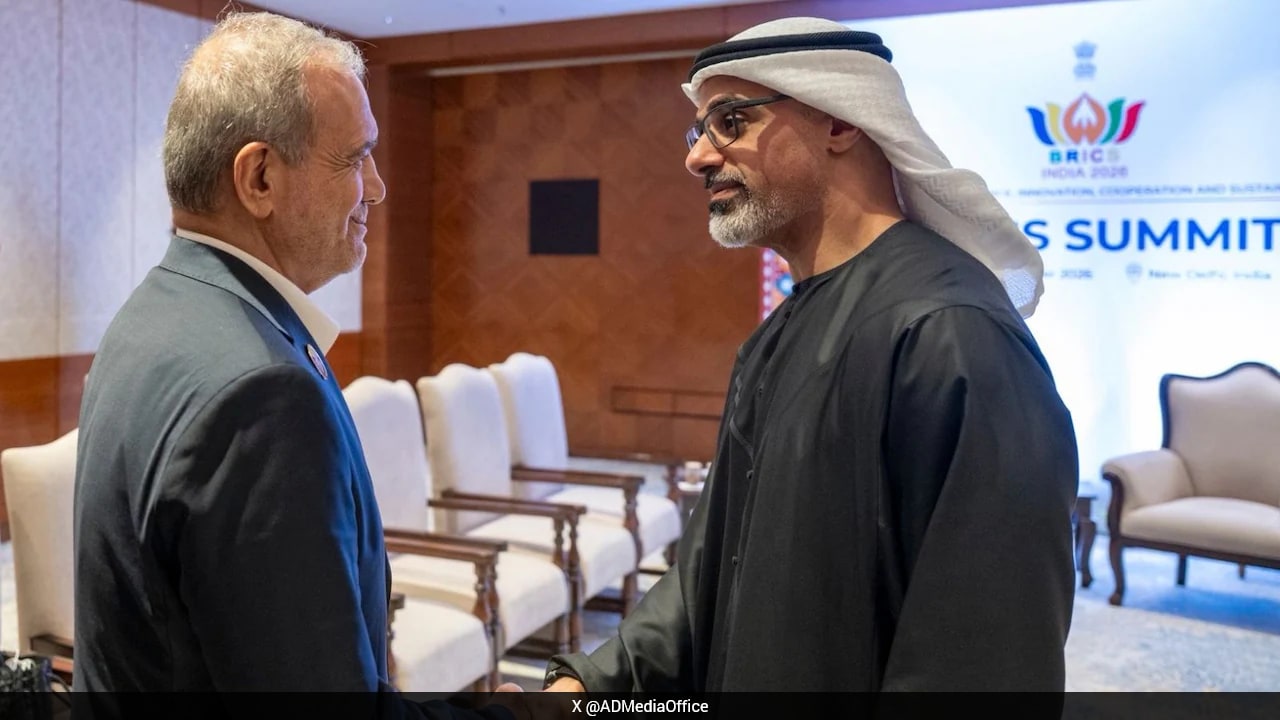
In a big sign of diplomatic progress between Tehran and Abu Dhabi who are divided by the war in the Middle East, the Iranian President on Sunday said that the countries want to “turn the page” on the conflict.
“We had a constructive exchange with the crown prince of Abu Dhabi,” Masoud Pezeshkian said a day after a meeting with Sheikh Khaled Bin Mohamed Bin Zayed Al Nahyan in India, on the sidelines of the BRICS summit.
“It was agreed that we would turn the page, look to the future and build it together”, he added.
Meanwhile, US President Donald Trump on Sunday said that he ‘does not care’ if Gulf countries meet with Iran to speak about the future of the Strait of Hormuz and said that it was “up to them” if they meet senior Iranian officials for talks.
The talks between the Gulf states and Iran in Oman on Monday will aim to strengthen cooperation on security in the Middle East. The meeting comes in the backdrop of a clash between the US and Iran over the blockaded Strait of Hormuz, through which one-fifth of world oil supplies previously flowed.
Last month, the UAE had announced that it was suspending trade and financial exchanges with Iran.
The meeting between the leaders on Saturday was the highest-level contact between Iran and UAE since the region was plunged into chaos following joint US-Israeli aggression against Tehran and the subsequent retaliatory strikes by the Islamic Republic on US bases in Gulf States, including the UAE.
Friendly Countries Should Not Allow “Enemy” Attacks From Soil: Pezeshkian
During the meeting, Pezeshkian said that Iran has “no problem” with the UAE or other regional countries but objected the presence of US military bases in Gulf countries. He also accused the US of using these bases to attack Iran during the war.
“We have no problems with the UAE. We have no problem with any of the regional countries. We have a problem with the American bases located in these countries and from which they are attacking our country,” Pezeshkian said.
“The UAE, the Emiratis and other countries of the region are our brothers. We have been living together for a long time and we have had trade. We have supported each other,” he said.
He said that friendly countries should not allow “enemies” to use their soil to attack other neighbouring countries, the Iranian leader said.
The 11-member grouping eventually adopted the New Delhi Declaration 2026, expressing serious concern over the escalation in the Middle East and calling for maximum restraint, dialogue and diplomacy. It also called for the protection of civilians and civilian infrastructure and stressed the importance of maintaining global trade, supply chains and energy flows.


