


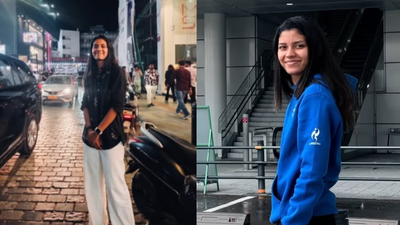
India’s Quimcy Joaquim Dsouza suffered a 1-2 defeat to Indonesia’s Ima Sumaya in the women’s singles Teqball semifinal at the Asian Games 2026 on Saturday. However, her medal hopes remain alive, with the 24-year-old set to compete for bronze against Japan’s Yuina Sakamoto on Sunday.A victory would make Quimcy the first Indian to win a Teqball medal at the Asian Games, where the sport is making its debut at the Aichi-Nagoya edition. The Indian’s journey to the last four has already been a breakthrough, marking an important chapter in her rise as one of the country’s leading Teqball players.
From middle-distance running to football and Teqball
Hailing from Mumbai, Quimcy began her sporting journey as a middle-distance runner at the age of 13 as reported by The Indian Express. Her passion for football soon took over, and she went on to represent Maharashtra in age-group football.Although her football career did not progress as she had hoped, her love for the game remained. After completing a degree in Sports Management, she joined sports goods retailer Decathlon and discovered Teqball after watching Brazilian football legend Ronaldinho play the sport in Instagram videos.Quimcy took up the sport and gradually established herself as a leading figure in India’s Teqball community.
Seven-time national champion and international trailblazer
Quimcy became the first Indian woman Teqer to represent the country at the international level. She also founded the Teqball Club of Bengaluru to help promote the sport at the grassroots level.A seven-time national champion, she has emerged as one of the trailblazers of Indian Teqball. Earlier in 2026, she finished ninth at the Teqball World Championships in Romania, further strengthening her credentials on the international stage. Her performances at the Asian Games have now given her an opportunity to add a historic medal to her achievements.
Quimcy Dsouza ’s Asian Games 2026 campaign
Quimcy made an impressive start to her Asian Games debut, topping Group A with two wins to secure direct qualification for the women’s singles semifinals.She opened her campaign with a 2-1 comeback victory over top-seeded Japan’s Yuina Sakamoto. After losing the first set 10-12, Quimcy fought back to win the second 12-11 before clinching the decider 13-11. She then defeated Cambodia’s Koemyean DY 12-9, 12-7 in straight sets to finish at the top of her group and book a place in the last four.
Quimcy falls short in semifinal against Indonesia
Quimcy started her semifinal against Indonesia’s Ima Sumaya on a strong note, winning the opening set 12-7. Sumaya responded in the second, recovering from an early deficit to take it 12-9 and force a decider.The Indian raced to a 3-0 lead in the third set and extended it to 4-1. However, Sumaya mounted a comeback, took control of the decider and won it 12-7 to secure her place in the final. The defeat ended Quimcy’s hopes of reaching the gold-medal match, but she will have another opportunity to finish her debut Asian Games campaign on the podium.
Bronze medal match offers chance to make history
Quimcy will face Japan’s Yuina Sakamoto in Sunday’s bronze-medal match. The Indian had defeated Sakamoto in the group stage, but will need to reproduce that performance to secure a place on the podium.A win would earn India its first-ever Teqball medal at the Asian Games. Quimcy has also competed in mixed doubles alongside Mohamed Anas Imran Beg. The Indian pair defeated the Philippines’ Jhoana Abulencia and Prince Agustin in their Group A opener.Teqball, invented in Hungary, combines elements of football and table tennis and is played on a curved table. The sport is making its Asian Games debut at Aichi-Nagoya 2026, with five medal events: men’s and women’s singles, men’s and women’s doubles, and mixed doubles.


