


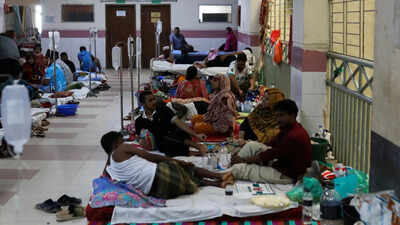
A sharp rise in dengue cases is putting hospitals in Dhaka under severe pressure. Over 747 new patients were admitted across Bangladesh in the 24 hours to 8am on Friday. The surge prompted some hospitals to treat patients on floors and verandas after beds filled up.According to a report by Dhaka Tribune, at Mugda General Hospital in Dhaka, 145 dengue patients were receiving treatment in a ward with a capacity of just 38 beds on Thursday. Doctors and nurses said the overcrowding was making it harder to monitor patients, administer medicines and provide emergency care.The directorate general of health services (DGHS) said no dengue deaths were reported during the latest 24-hour period. However, 79 dengue deaths have been recorded in the first 18 days of September alone.Since January 1, 59,147 people have been hospitalised with dengue across Bangladesh, with 176 deaths reported. A total of 54,838 patients have been discharged after treatment.
Patients treated on floors, verandas
At Mugda General Hospital, every designated bed in the dengue ward was occupied. Additional patients were being treated on the floor and veranda, while some beds were being shared by more than one patient.Afrin Akter, from Narayanganj, was among those being treated on the floor. She was vomiting intermittently and appeared too weak to speak properly as a nurse administered saline.Her mother said Afrin had suffered from fever and body aches for several days. After medicines failed to improve her condition, the family tried to get her admitted to several hospitals but could not find a vacant bed.They eventually reached Mugda General Hospital, where Afrin was admitted despite the lack of a bed.Nasima, sub-in-charge of the hospital, said patients were arriving every day from Dhaka and districts outside the capital.“Due to the bed shortage, patients are being admitted to the floor and veranda out of necessity,” she said.She said 145 patients were currently being treated in the ward against its capacity of 38 beds. Many patients, she added, arrive in critical condition, while early treatment can improve the chances of recovery.Dr Nurul Islam, deputy director of Mugda General Hospital, said the increase in dengue cases had pushed up patient pressure.“At present, services are being continued with the existing doctors and nurses, but additional beds and manpower are needed to handle the situation,” he said.“All the patients who are coming here are being admitted and provided treatment. Instructions have been given to every ward to provide proper treatment.”
Dengue spreads beyond Dhaka
The latest DGHS figures show that the pressure is not limited to the capital.Of the 747 patients admitted nationwide in the latest 24-hour period, 216 were admitted outside Dhaka’s city corporations but within Dhaka division. Another 61 were admitted in Dhaka North City and 40 in Dhaka South.Chittagong division recorded 180 admissions, while 92 patients were admitted in Mymensingh, 81 in Khulna, 52 in Rangpur and 25 in Barisal.August was the worst month for dengue this year, with 20,536 infections and 43 deaths reported.
October could bring further rise
Entomologist professor Kabirul Bashar said forecast models indicate that the dengue situation could worsen further in October.Although Aedes mosquitoes become less visible as winter approaches, he said they should not be neglected.Referring to Bangladesh as a “country of mosquitoes,” Bashar said dengue cases were rising compared with previous years and warned that the situation could become more severe in the coming days.He called for greater public awareness about Aedes mosquito behaviour and stronger mosquito-control measures.DGHS director general professor Dr Prabhat Chandra Biswas said patients would be referred to private hospitals if government facilities exceeded their capacity.He said hospitals had been instructed to increase their bed capacity and that treatment facilities were also being strengthened at district and upazila levels in dengue-prone areas.Public health expert Dr Mushtak Hossain said treating patients alone would not be enough to control the outbreak.“The long-term effective solution is to destroy the breeding grounds of Aedes mosquitoes,” he said.He called for regular mosquito control, greater public awareness and early detection and treatment at the local level, along with adequate facilities in Dhaka and across districts and upazilas.


