


Did you know that US President Donald Trump has carried out more securities trades than all members of Congress combined since his return to the White House in January 2025? Interestingly, he supports legislation that would prohibit lawmakers from buying and selling stocks without imposing the same restriction on the president.A majority of Americans support prohibiting lawmakers from trading stocks. President Donald Trump himself backed a ban that would restrict members of Congress but leave him outside its scope.A Bloomberg review of financial disclosures found that Trump or his money managers made nearly 28,700 trades during the 17 months from his second inauguration through the end of June, 2026. In comparison, lawmakers on Capitol Hill reported roughly 22,200 transactions over the same period.The sharp increase in presidential trading has renewed concerns about possible conflicts of interest. The debate has largely focused on whether elected officials could use non-public information when trading, but Kedric Payne of the Campaign Legal Center said that is not the only concern.“Even if they’re not trading the stock on non-public information, they still create the appearance of a conflict of interest because they can still influence the value of the stock through their official duties,” he said.
Republicans’ stance
Republicans are also seeking to turn opposition to congressional stock trading into a campaign issue ahead of this fall’s closely watched midterm elections.“The American people deserve to know that those they elect to public office actually serve the American people and not their own wallets,” Representative Anna Paulina Luna said during a speech at a two-day Republican convention in Dallas last week.
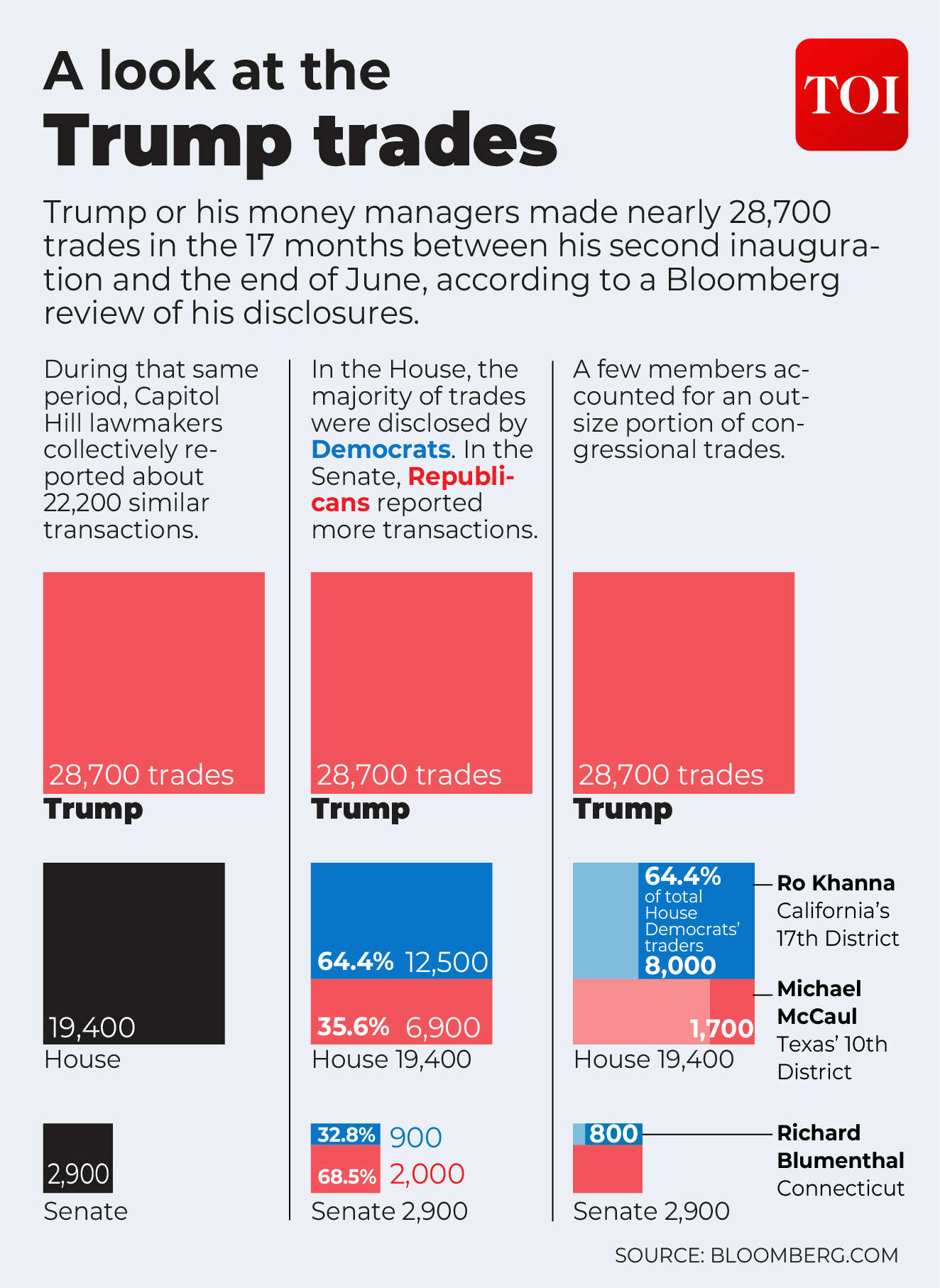
Trump trades and the break-up of other lawmakers’ trades
The stock-trading prohibition approved by House Republicans in July applies only to members of Congress, their spouses and dependent children. The president is not covered by the measure. This leaves Trump able to continue trading securities despite having access to a broad range of US intelligence and the ability to affect entire sectors through executive orders or statements on social media.Trump has endorsed the House legislation. In his State of the Union address earlier this year, he urged Congress to approve the measure “without delay” so that lawmakers “cannot corruptly profit from using insider information.”Restrictions on stock trading by lawmakers have attracted support across the political spectrum. An Economist/YouGov poll conducted in May found that three-quarters of US citizens believed members of Congress and other elected officials should not be permitted to trade stocks. A slightly smaller share supported a complete ban.
Trump’s investments
The White House did not comment on whether Trump supports extending a stock-trading ban to the president. White House spokesman Davis Ingle, however, said Trump’s investments are managed independently by third-party financial institutions through computer-based model portfolios that track indexes such as the Schwab 1000.“Neither President Trump nor any member of his family has any ability to direct, influence, or provide input regarding how the portfolio is invested or when investments are bought or sold,” he said.Trump has previously criticised lawmakers who have sought to extend restrictions on stock trading to the presidency. Last year, after Senator Josh Hawley introduced legislation that would have applied a congressional stock-trading ban to the president and vice president, Trump attacked the Republican senator.The Missouri senator was a “pawn” who was “playing right into the dirty hands of the Democrats,” Trump said on the social media platform he owns.“I don’t think real Republicans want to see their President, who has had unprecedented success, TARGETED, because of the ‘whims’ of a second-tier Senator named Josh Hawley!” Trump said.
Trump’s stand
Trump has also called for an investigation into stock trading involving former House speaker Nancy Pelosi and her husband, whose technology-heavy portfolio has frequently outperformed the broader market. The family’s investment choices have become the basis for trading apps and an exchange-traded fund, while also inspiring Hawley’s legislation, which was initially titled the Preventing Elected Leaders from Owning Securities and Investments Act, or PELOSI Act.Trump is the only US president this century to have disclosed active trading in individual stocks, averaging about 80 trades on each market day. His financial disclosures during his first term were dominated by relatively illiquid real estate assets and other privately held businesses. His portfolio now includes thousands of positions across stocks, bonds and cryptocurrencies.During the first quarter of this year, Trump purchased as much as $1.38 million worth of shares in DoorDash Inc.In April, the food delivery company delivered a McDonald’s order to Trump at the White House. The event became a social-media moment that promoted tax breaks for tipped workers while also providing a lobbying coup for DoorDash. CNN reported that Trump has also promoted companies including Nvidia Corp., Tesla Inc. and 19 other firms within a week of acquiring stakes in them.
‘Everybody’s profiting’
Trump has rejected the suggestion that his trading creates a conflict of interest. “You know why I’m profiting?” he told reporters in July. “Because the stock market’s going up. Everybody’s profiting.”Even a stock-trading prohibition covering members of Congress appears to face significant hurdles. The House measure approved in July was attached to legislation on voter identification that was regarded as a poison pill by Senate Democrats.Hawley was the only Republican on the committee to support his own bill. Other Republicans described the proposal as a “publicity show” and “legislative demagoguery.”The most significant overhaul of congressional financial ethics rules in recent years came with the Stop Trading on Congressional Knowledge Act of 2012, commonly known as the STOCK Act. However, enforcement has remained limited, with penalties beginning at only $200.Applying a stock-trading ban to the president could prove even harder.“The way we’ve handled this in the past is through ethics norms, ethics traditions, public and political pressure,” Payne said. While ethics committees or the Department of Justice could enforce a ban applicable to Congress, “it’s questionable how the DOJ would be able to effectively enforce it against the president.”


