



Want to bookmark your favourite articles and stories to read or reference later? Start your Independent Membership today.
Already a member?
Log in
Blue Nun is back. Considering the German Liebfraumilch has sold more than a billion bottles since its creation in 1921, you may wonder if it ever actually went away, but it most has definitely been relaunched. And if there was ever a wine brand that needed a refresh, this was surely it.
Like many, I have a history with Blue Nun. It was the brand that got me “into wine” in the first place. Nicely sweet, lower in alcohol, it was a first-time drink of wine kind of wine. “Blue Nun, Have Fun”, apparently. Its halcyon days were in the 1970s and Eighties, it captured the mood of a new generation of wind-down wine drinkers. Until then, wine had largely been reserved for a certain sort of serious person, with serious tastes, but cultural shifts produced a new, enthusiastic generation of wine drinkers looking for something lighter in feeling as well as flavour.
Blue Nun was the drink of choice for Alan Partridge and teenagers like me who had no idea what they were doing. Gradually, we began leaning towards drier styles from further afield, looking to Australia, New Zealand, South America and South Africa for more contemporary wines.
So why go back now? Is the re-release of Blue Nun just another example of a brand jumping on the nostalgic bandwagon that has probably served its time?
The pitch is essentially: same nostalgic blue bottle and it tastes exactly like I remember it. While the producers boast a more contemporary taste, describing it as a fresh, easy-drinking and fruit-forward, with apple, peach and citrus notes and moderate sweetness, there’s not a huge amount on the nose beyond aromas of the seedless grapes you’d serve at a children’s party. I akso can’t say it improves much on the palate. It’s medium-sweet, akin to a commercial cider, and very light, with just the subtlest flavoursof peach. I can see why my teenage self loved it, but if I’m looking for a low-alcohol, slightly sweet wine, give me a Moscato d’Asti any day.
But the lower alcohol, might mean it hits the sweet spot with a new generation looking to drink no-lo drinks. The new Authentic White is 10 per cent ABV, while the new Riesling is 9%. And there is less emphasis on the old Liebfraumilch image: the main wine is now called Blue Nun Authentic White, rather than Liebfraumilch.
The other wine that was the butt of all the bad wine jokes of course is English wine. In the 1970s–90s, English wine was widely regarded as poor: thin, acidic, often made from obscure hybrid grapes and sometimes semi-sweet. Alongside, Blue Nun, wine writers regularly treated it as a punchline, and this is where things get a little more interesting.
While English wine also harks back to bottles synonymous with dodgy hairstyles and terrible lipstick – there is a new generation that has proved that a quiet revolution has taken place in the English countryside.
English and Welsh wines, for decades regarded as little more than an eccentric hobby, were becoming rather impressive. The reputation had been for wines of palate-stripping acidity and little else. For me, that changed when a friend poured me a glass of Nyetimber Classic Cuvée 2009 in December 2013.
Was this sparkling wine really English? It was rich and creamy thanks to the Chardonnay, but had the structure and steely precision to give it real finesse. There’s nothing nostalgic about this memory. It was the beginning of my realisation that England was emerging as one of the most exciting wine regions in the world.
Southern England shares the same chalk geology found in Champagne, with a seam running through Hampshire, Sussex and Kent and resurfacing across the Channel in France. Historically, however, Britain sat at the absolute margins of viable wine production. Despite that shared geology, we lacked the climatic consistency to make much beyond searingly acidic wines.
That has changed. Warmer conditions and longer growing seasons have increased the potential for world-class sparkling wine – a style that, conveniently, relies on grapes retaining plenty of acidity. Convinced of England’s potential, Nyetimber pioneered the exclusive planting of the traditional Champagne varieties Chardonnay, Pinot Noir and Pinot Meunier in 1988. Since then, the number of vineyards and producers has surged, creating an energetic industry making both sparkling and still wines.
Galia Pike, who owns and runs Westwell with her husband Adrian, a small family vineyard and winery beneath the Pilgrims’ Way on Kent’s North Downs, tells me: “English wine has finally found its own distinct identity. Sparkling wine has done an exceptional job of establishing England as a serious wine-producing region, but now there’s so much world-class still wine being made, too.”
That is what makes English and Welsh wine exciting now. Producers are willing to take risks, experiment and work out what suits their particular patch of land, rather than simply trying to imitate somewhere else. Where else in the wine-producing world has quite this sense of possibility?
Sadly, my conclusion is that Blue Nun really isn’t that fun. I’m not convinced we need to resurrect every bottle simply because it reminds us of another era. Ironic consumption aside, that chapter of our drinking history can probably stay in the past. There’s something far more vibrant on our doorstep now. English wine may not be the cheapest bottle on the shelf, but it could well be one of the most interesting you’ve drunk in a while.
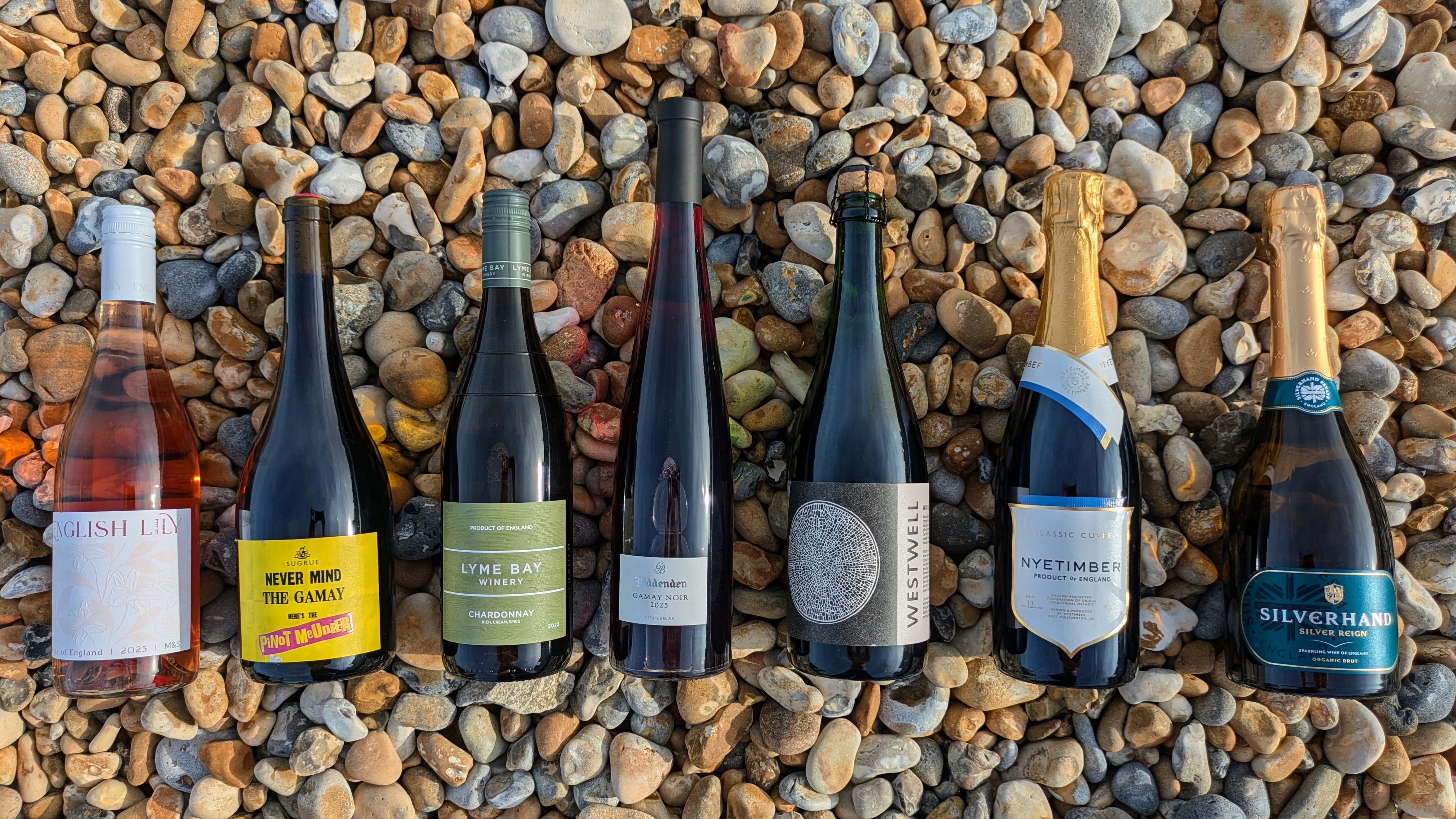
English Lily Rosé, Surrey, 2025
M&S (in-store) and Ocado, £12, 11% ABV
An uncomplicated and approachable rosé that’s full of delicate notes of fresh raspberries, strawberries and light floral aromas. Made by the highly respected Denbies Estate in Surrey, it’s as pretty-as-a-picture English pink.
Never Mind the Gamay, Sugrue, Sussex, 2025
Sugrue, £29, 12.5% ABV
Dermot Sugrue is one of my favourite producers, and is globally respected as being one of the world’s best winemakers. We don’t describe wines as delicious enough, but this really is. It’s a barrage of bright red fruits and an undertone of wild rosemary and thyme, all delivered with a mouthful of lipsmackingly bright acidity, leaving you joyously excited for the next glass.
Lyme Bay Estate Chardonnay (made with Essex fruit), Devon, 2022
Ocado, £28.25, 13% ABV
Made with Chardonnay grapes sourced from the Crouch Valley in Essex, one of the warmest and driest parts of the UK, this is a great example of the richer styles of white wines that England is now capable of producing. While distinctly English, it is comparable to wines from Burgundy: think licks of vanilla-laced lemon cream, notes of toasted almonds and slices of fresh green apples and golden pears. It’s a medium-bodied wine that has an elegantly long finish.
Gamay Noir, Biddenden, Kent, 2025
Biddenden, £22.50, 12% ABV
A dazzlingly joyous light-bodied wine that’s brimming with Kentish cherry, ripe fruit and a zing of redcurrants. Its vibrant acidity keeps everything fresh, but never tart. A fun and uplifting wine to share with friends.
Westwell Wicken Foy, Kent, NV
The Wine Society, £29, 12% ABV
I think this might be one of the best traditionally made English sparkling wines that I’ve tried for under £30. This is a classic blend of Chardonnay, Pinot Noir and Pinot Meunier that also incorporates some older reserve wines dating back to 2013 and 2014. The resulting wine is an effervescent joy, with notes of russet apples, butter-melting sourdough toast and a hint of toasted hazelnuts and lemon zest. A wine of immense quality for the price.
Nyetimber Classic Cuvée NV
Sainsbury’s, £30 (with Nectar until 13/10/26; usual price £43), 12% ABV
Consistently regarded as one of England’s best sparkling wines, this is the benchmark for quality. This refined, elegant sparkling combines an ever-so-appealing note of freshly baked brioche, swirls of fresh cream and apricots, and an invigorating citrus edge. It feels as memorable drinking now, as it did the first time I tasted one of their wines 13 years ago.
Silver Reign Brut Organic, Silverhand Estate, Kent, NV
Sainsbury’s, £17.50, 12% ABV
Made using the same method as Prosecco, but a world away from most Proseccos, this is a great example of the other side of English sparkling wine. With aromas of autumnal orchard fruit and white peaches, this is a lively bubbly with an appealing lightly toasted finish. I had thought it would fall short due its production method, but it delivers a characterful glass of sparkling wine.


