


New Delhi:
Russian Ambassador Denis Alipov has claimed that a senior US official publicly acknowledged that Washington would not allow India to develop into another China — a competitor — describing the remark as a “Freudian slip”.
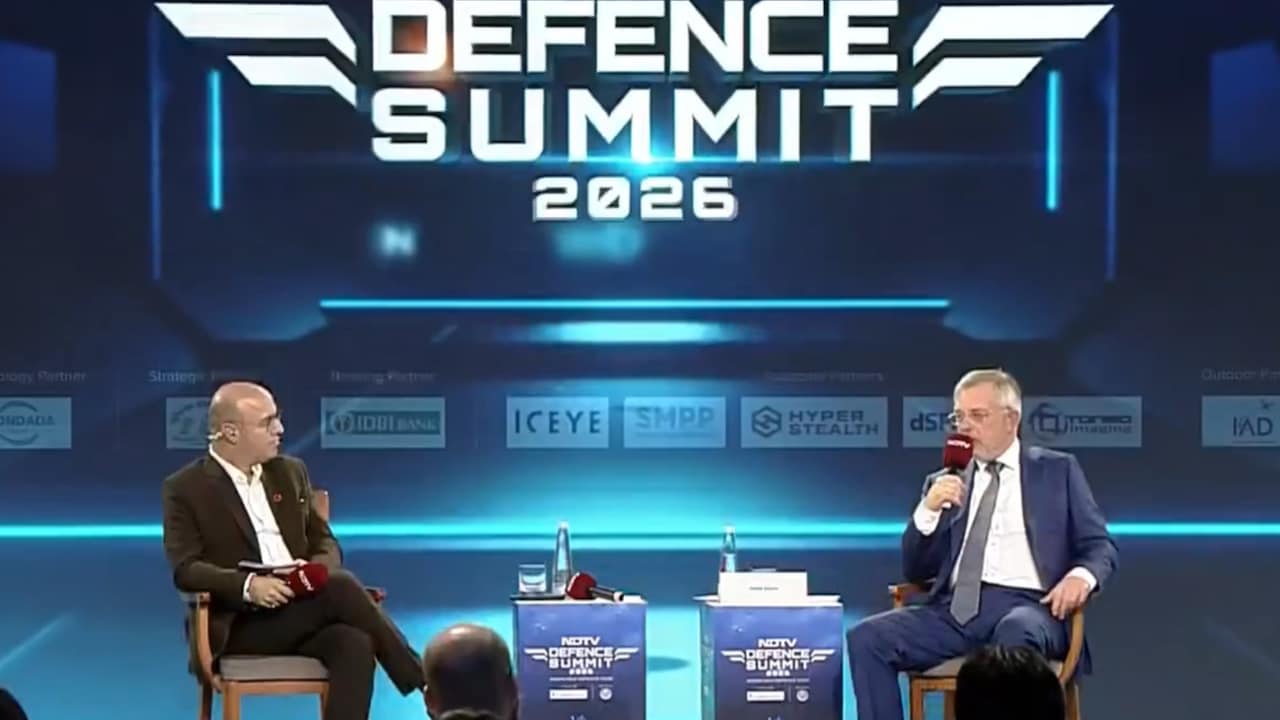
Speaking at the NDTV Defence Summit on Sunday, Alipov claimed the comment had been made during this year’s Raisina Dialogue in the national capital.
“I think this year at the Raisina Dialogue, one of the top US officials revealed and spoke publicly that the ‘US will never allow India to become the next China’ as a competitor. It was like a Freudian slip,” Alipov said. “So as India becomes stronger and stronger, and eventually a superpower — which is inevitable — the US would be doing everything possible to contain India. And so, we regard this measure, the Graham Act, as such.”
The Graham Act or the Lindsey O Graham Sanctioning Russia and Iran Act of 2026, is a recently introduced US law signed by Donald Trump which is designed to increase economic pressure on Russia and strengthen sanctions against Iran.
The ambassador’s comments came as India faces pressure from the US over its purchases of Russian crude. The Graham Act gives the US authority to impose tariffs of up to 100 per cent on countries buying Russian oil and gas.
“India is buying Russian oil not for the sake of Russia. India is buying Russian oil for the sake of its own economy and its own people. Because it is there at a competitive offer,” Alipov told NDTV.
“In response to this, I think India has shown strategic autonomy and strength. The US has articulated to pressure Russia with this act. It is by itself absurd. And the US, I would repeat that, very well knows that. And I think as India rises, this kind of pressure. Tactics will continue and will aggravate, will increase,” he added.
India-Russia Ties
India’s official diplomatic relations with the Soviet Union were established in April 1947 and continued with the Russian Federation following the dissolution of the Soviet Union in 1991. Alipov spoke about the two nations’ decades-old diplomatic relationship.
“Trust and respect are the very qualities that characterise our relationship. You don’t do business with untrustworthy partners. And it has been, as Minister S Jaishankar once pointed out, remarkably consistent. Since the times of the Soviet Union, since India’s independence — next year we are going to celebrate 80 years of our diplomatic relations,” he said.
Alipov said the relationship had survived major changes in global politics over the years because neither side had made its ties dependent on the immediate state of global affairs.
“Throughout all these decades, we have been friends who have been reliable partners to each other — not only Russia to India, but both ways. We have never conditioned our relations on any immediate global disposition, so we have never regarded our relationship as a zero-sum game,” he said. “I think this consistency, the assistance and help to each other throughout the years, has made a very solid foundation for our relations to go further with wide perspectives.”
Alipov said the latest meeting between Russian President Vladimir Putin and Prime Minister Narendra Modi had demonstrated that Moscow and New Delhi had a substantial agenda for the future. PM Modi and Putin met on September 11 on the sidelines of the BRICS leaders’ summit in New Delhi.
“I think the BRICS summit itself has testified and shown that not only Russia and India, but all member countries in BRICS aspire to a more prominent voice in global affairs — to be at the table of decision-making, to have a fair alternative platform for discussion which is open, which is inclusive,” he said. “And this is something we, together with India and with other partners, stand for.”


