


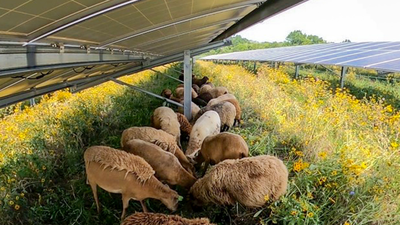
What started in 2018 as a small trial with just 30 sheep has grown into a commercial operation that now manages vegetation around thousands of solar panels across the American Northeast. Husband-and-wife farmers Lewis Fox and Niko Kochendoerfer founded Agrivoltaic Solutions LLC in Vermont. They developed a model that uses livestock instead of mechanical mowers to control grass and weeds around solar energy sites. According to a case study published by the American Solar Grazing Association, the couple’s business has grown from its first flock of 30 sheep to 500 sheep managing vegetation across 1,500 acres of solar sites. The operation shows how farming and renewable energy can work together. The model can provide steady income for regional livestock producers while lowering maintenance costs for energy companies.
Scaling up operations across state borders
Solar grazing uses sheep to eat grass, weeds, and brush growing around ground-mounted solar arrays. Heavy machinery can damage electrical cables or solar panels. Mechanical mowing equipment can also throw rocks into glass solar components. Sheep, by comparison, can move easily under low-clearance solar racks. They can keep plant growth under control without putting sensitive electrical wiring at risk. When Fox and Kochendoerfer started Agrivoltaic Solutions in 2018, solar grazing was still an untested way to maintain solar sites in the region. After showing that sheep could reliably keep vegetation within height limits set by utility operators, the business grew quickly. As detailed on the company’s official site, Agrivoltaic Solutions now manages contracted grazing operations in Vermont, New Hampshire, Maine, New York, Pennsylvania, and Illinois. Along with managing flocks directly, the company has created custom grazing plans for more than 30,000 acres of solar projects across the United States.
Financial stability through dual land use
For traditional livestock farmers, finding affordable pasture and keeping income steady can be ongoing challenges. Land rental costs, changing meat prices, and seasonal weather changes can all reduce the profits of family farms. Combining sheep farming with solar sites offers another option by turning maintenance budgets into farm income. Instead of farmers paying to rent land for grazing, solar developers pay farmers to maintain their sites. This shared-use model gives farmers access to stable, multi-year contracts. It also lets them grow their herds without having to buy more land. According to research noted by the American Solar Grazing Association, solar grazing keeps maintenance spending within local farming communities. Instead of sending that money to commercial landscaping or mowing companies, utility operators pay regional livestock producers directly for the work. This approach can help small farms build stronger businesses. It also means land used for renewable energy can continue to support local agriculture.
Collaborative networks and consulting expansion
As demand for solar maintenance grew beyond what their own 500 sheep could handle, Fox and Kochendoerfer expanded their business by bringing in other regional livestock producers. Through Agrivoltaic Solutions, the couple serves as a link between utility developers and independent local livestock owners. Under this system, nearby farms provide sheep and handle daily flock care. Agrivoltaic Solutions manages logistics, insurance requirements, site checks, and contracts with companies. This partner model allows smaller farms to take part in commercial solar contracts without taking on the administrative work or legal risks that can come with large utility sites. To help improve industry standards, the company also added professional consulting services to its grazing work. The firm works with solar developers, engineering companies, and land planners during the early stages of site development. The goal is to make sure new solar sites are designed with animal safety and handling in mind. Design details include setting panel wires at suitable heights, choosing seed mixes that work well for sheep during site restoration, installing suitable perimeter fencing, and providing reliable water for grazing animals. By including farming needs in renewable energy planning from the beginning, solar sites can be ready for livestock grazing as soon as construction is finished. This can create long-term partnerships between energy companies and rural farming communities.


