


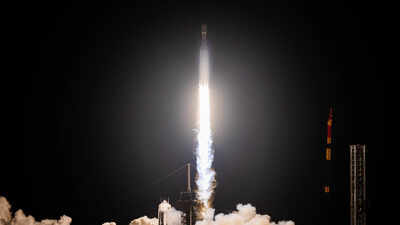
BENGALURU: Multiple Indian payloads, representing four space startups, reached orbit aboard SpaceX’s Falcon 9 rocket, which lifted off at 12:02 am IST on Friday (October 2) as part of the Transporter-18 rideshare mission.The mission carried satellites developed by Dhruva Space and TakeMe2Space, along with payloads from SatLeo Labs and EON Space Labs. The payloads will demonstrate technologies for thermal imaging, Earth observation and artificial intelligence (AI)-based data processing in orbit.Dhruva’s LEAP-2 satellite, its second commercial mission using the P-30 satellite platform, was successfully deployed into orbit at 1 am IST. It hosts two in-orbit demonstration payloads: a star tracker developed by France-based Sodern, part of ArianeGroup, and TAPAS-1, developed by SatLeo Labs.SatLeo describes TAPAS-1, or Thermal Access Platform for Analytics & Solutions, as India’s first dedicated commercial thermal payload. The CubeSat-category payload uses thermal infrared sensing to capture temperature information that conventional optical satellite imagery cannot directly provide. The mission will validate its thermal sensing technology, payload performance and data-processing capabilities in orbit.“Most satellites show us what the Earth looks like, TAPAS-1 will show us how it behaves by revealing temperature patterns that ordinary payloads cannot see,” said Shravan Bhati, co-founder and CEO, SatLeo Labs.Dhruva Space also undertook the end-to-end integration of LEAP-2 with the Falcon 9 launch vehicle. The company said this builds on its work on LEAP-1, through which it became the first Indian private company to undertake the launch vehicle integration of its satellite in-house.“This extends our role beyond satellite manufacturing into launch integration and end-to-end mission delivery, reinforcing its full-stack Space engineering approach. LEAP-2 will also be supported by our growing global ground infrastructure, including its owned and operated ground station in Luleå, Sweden; the first non-govt entity owned and operated ground station outside India, authorised by the GoI to provide Ground-Station-as-a-Service,” the firm added.TakeMe2Space’s 14-kg MOI-1A satellite is designed to allow customers to run AI models on Earth-observation data directly in orbit. It carries onboard computing capacity of 117 trillion operations per second (TOPS), 2 TB of storage and a nine-band multispectral imager. Processing imagery in space could reduce the need to transmit large volumes of raw data to Earth, with potential applications in agriculture, mining and supply-chain intelligence.MOI-1A follows TakeMe2Space’s 2024 MOI-TD technology demonstration, which validated onboard AI inference and data processing. The company said it had signed up 23 customers for its in-orbit inference services.MOI-1A also carried MIRA, a 502-g optical telescope developed by EON Space Labs. “A compact optical telescope engineered for space imaging. It delivers high-resolution Earth observation with exceptional stability and thermal robustness,” EON describes the payload.
Share your thoughts in the comments
Be respectful · TOI community guidelines
MIRA is a pathfinder for a planned small satellite constellation. Its flight comes after the loss of the PSLV-C62 mission on Jan 12, which had affected the company’s earlier launch plans.“Satellites collect vast amounts of data, but much of it still has to reach the ground before it can be turned into useful information. With MOI-1A, customers will be able to run their AI models directly in orbit and receive the insights they need, without downloading all the raw imagery. This mission is an important step towards making computing in space a service that businesses can use,” Ronak Kumar Samantray, founder and CEO, TakeMe2Space, said.


