


Jawaharlal Nehru University (JNU) has a direct connect to the 2026 Nobel Prize in Physiology and Medicine. Prof Suneel Kateriya of JNU is a direct research student of this year’s Nobel Laureate Dr Peter Hegemann. This one-on-one connect is truly a rarity and brings cheers and hope among the Indian scientific community.
The 2026 Nobel Prize in Physiology or Medicine has shone spotlight on one of the most transformative discoveries in modern biology, optogenetics. The prize has been awarded jointly to Karl Deisseroth of the United States and German scientists Peter Hegemann and Georg Nagel for discoveries concerning light-gated ion channels and optogenetics. Their work has enabled scientists to switch individual brain cells on and off using pulses of light, opening an entirely new window into understanding how the brain works.
But behind this Nobel-winning story lies a remarkable Indian connection. Incidentally India has not won a single Nobel Prize in science ever since Prof C V Raman was awarded the Nobel Prize in Physics in 1930. The drought continues and its hurts the Indian scientific community no end.
At the centre of that connection is Prof Suneel Kateriya of the School of Biotechnology at Jawaharlal Nehru University in New Delhi, who was a direct PhD student of Nobel laureate Peter Hegemann in Germany between 2000 and 2004. During his doctoral work, Prof Kateriya played a key role in identifying two DNA sequences in a tiny green alga that eventually led to the discovery of channelrhodopsins, the light sensitive proteins that became the foundation of optogenetics. This led to flood gates being opened for a new area of scientific application.
Read | Explained: How Is The Nobel Peace Prize Decided?
Those discoveries were reported in landmark scientific papers published in 2002 and 2003. Prof Kateriya is listed as an author on both papers that are among the foundational studies associated with the Nobel-winning work. According to Prof Kateriya, it was his initiative to identify the two novel genes from the algal genome that encoded the light sensing proteins that would later change neuroscience forever.
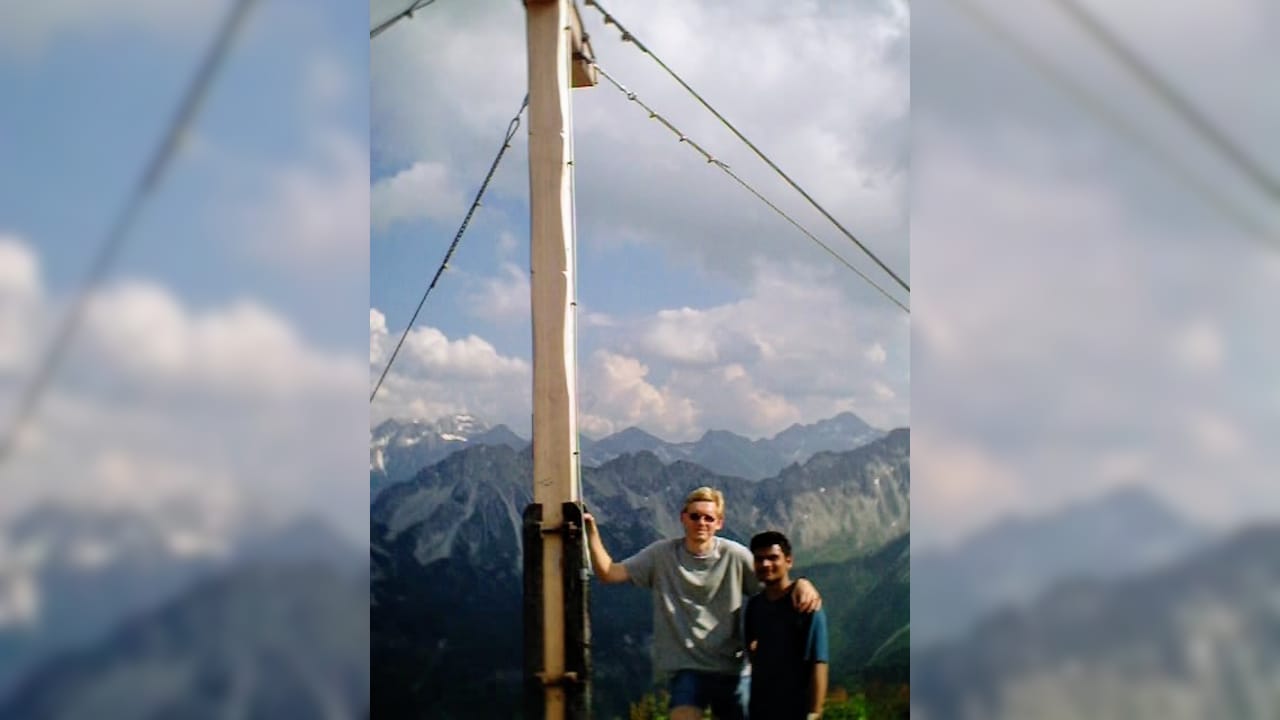
Dr Peter Hegemann and Dr Suneel Kateriya on a trekking trip
Photo Credit: Prof Suneel Kateriya
Speaking to NDTV, Prof Kateriya described the Nobel announcement as both a proud and emotional moment.
“I was a PhD student with Professor Peter Hegemann from 2000 to 2004. We were working on a very fundamental question, how this green alga swims in water and navigates towards sunlight. I was lucky enough to identify two DNA sequences and these DNA sequences were encoding a light sensitive protein,” he said.
The story began with a microscopic green alga called Chlamydomonas, a single celled organism commonly found in ponds and freshwater environments even in India. Scientists had long known that the alga could detect light and move towards favourable light conditions, a phenomenon known as phototaxis. What remained a mystery was how the organism actually sensed light and translated it into movement.
In Prof Hegemann’s laboratory, young doctoral student Suneel Kateriya joined an effort to solve this puzzle. Using computational biology and molecular biology tools, he identified two genes that encoded previously unknown light sensitive proteins.
When exposed to light, these proteins generated electrical activity inside cells.
“We were basically the first people to show that certain proteins can bring so much bioelectrical activity and this is important for biological function,” Prof Kateriya recalled.
The discovery was further developed through collaborative work involving Georg Nagel, who demonstrated that the proteins acted like microscopic gates. When illuminated by blue light, the channels opened and allowed charged particles to flow into the cell, triggering an electrical signal.
A few years later, Karl Deisseroth, a neuroscientist at Stanford University, used one of these proteins inside neurons. He showed that flashes of blue light could precisely activate brain cells. This became the birth of optogenetics, a technology that today is used across neuroscience laboratories worldwide.
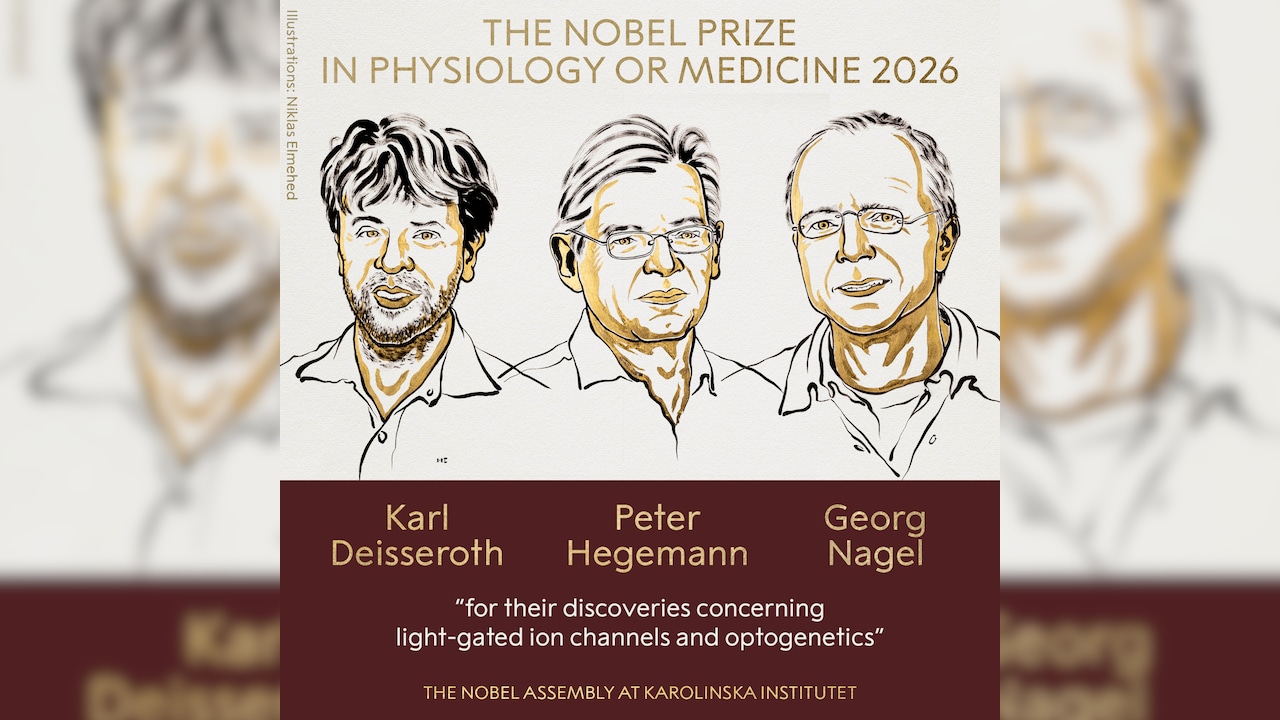
Optogenetics is now regarded as one of the most powerful tools in biology. By inserting light sensitive proteins into selected neurons, scientists can switch individual cells on or off with extraordinary precision. The technology allows researchers to study memory, emotions, behaviour, addiction, sleep and neurological disorders in ways that were previously impossible.
For Prof Kateriya, however, the Nobel story is also deeply personal because it is inseparable from his relationship with his mentor.
“Peter Hegemann is an awesome mentor and a very good teacher. He used to teach me for hours and hours. I was lucky to have Peter Hegemann as a mentor. He is the one who made me love science. Not only a scientist, he is a very good human being,” he told NDTV.
Read | Francis Halzen Wins Physics Nobel For Astrophysical Neutrinos’ Discovery
The admiration is evident even today. More than two decades after completing his doctorate, Prof Kateriya remains scientifically active with his former mentor. He says they recently communicated another joint research paper and have together published more than 25 scientific papers since he returned to India.
Although many observers may note that an Indian scientist contributed directly to the foundational discovery behind the Nobel-winning work, Prof Kateriya is careful not to seek personal recognition.
Asked whether he believed he too should have been recognised, he responded with characteristic humility.
“I won’t say that because I did contribute to the fundamental discovery. But whatever has been credited to my account, I am really content and satisfied. The Nobel Prize journey is not an individual journey. It is a major contribution from everybody.”
Instead, he credits his teacher and the larger scientific ecosystem that enabled the discovery.
Born in Kannauj in Uttar Pradesh, educated in the state school system and in Kanpur University, trained at Banaras Hindu University, JNU, Germany and later Columbia University, Prof Kateriya’s own journey reflects the importance of nurturing scientific talent through sustained investment in research.
Today, he leads his own laboratory at JNU, continues to work on optogenetics and is developing new light sensitive proteins that may have future applications in biology and medicine. His laboratory is also studying ciliopathies and exploring new optobiotechnology approaches using algae.
The Nobel Prize, he says, carries an important lesson for India.
“Basic science is very important. Once you have basic science it will bring new discoveries. These new discoveries will give innovation. As long as we excel in good academics and good fundamental science, possibilities are there.”
That message may be the most enduring takeaway from this year’s Nobel Prize. A curiosity driven question about how a tiny pond dwelling alga moves towards sunlight eventually transformed neuroscience and medicine. Along the way, a young Indian doctoral student played a significant role in discovering the genes that started the journey.
Today, as his mentor joins the ranks of Nobel laureates, a satisfied and contented Prof Suneel Kateriya stands as perhaps the closest Indian link to one of the biggest scientific prizes of the year, while continuing to insist that the real triumph belongs to good science, great mentorship and the pursuit of fundamental knowledge.


