


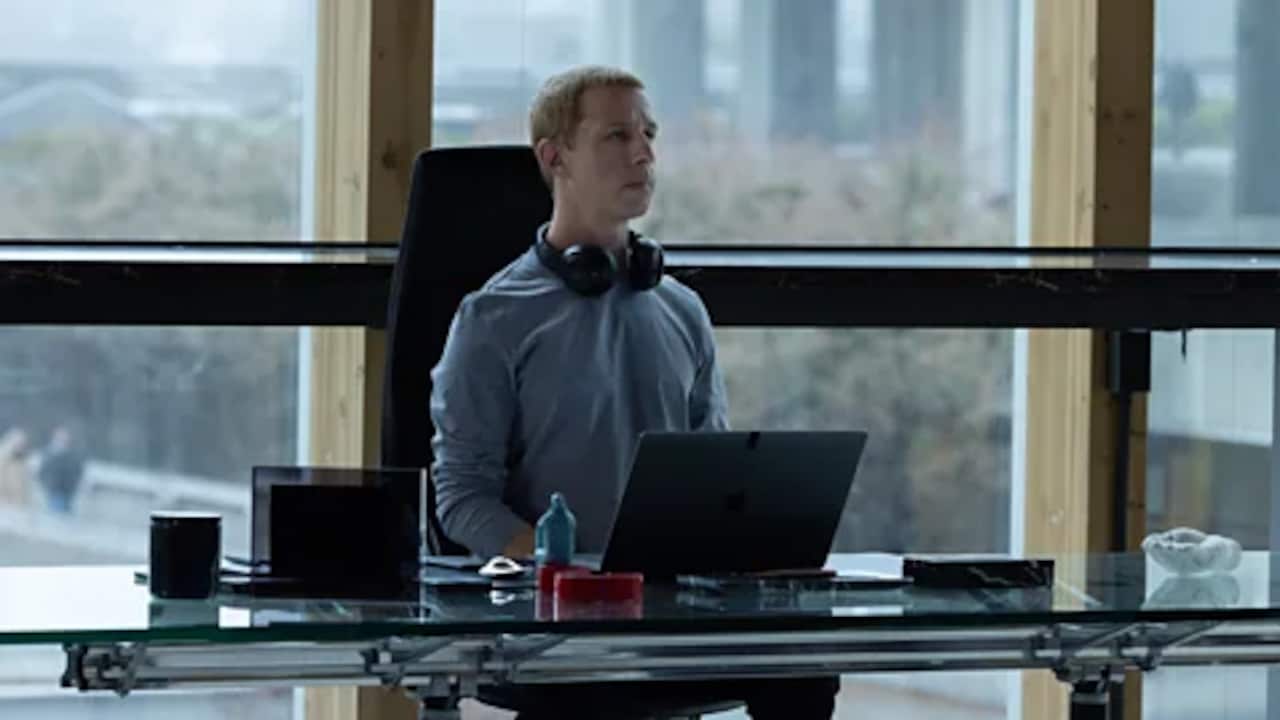
A crackling whistleblower drama that excoriates the algorithm-driven world of Facebook/Meta/Instagram for the way it imperils nations, societies, communities and individuals struggling with disaffection and disinformation, The Social Reckoning sees writer Aaron Sorkin return (this time with directorial responsibility added on) to the turf that he trod in The Social Network (2010).
He hits his target hard enough when the darts land right. When they don’t, this standalone follow-up, which rests to a great extent on the shoulders of Jeremy Strong stepping in for Jesse Eisenberg in the role of Mark Zuckerberg, is projected as a sort of cold-hearted corporate scalawag chasing revenues no matter what the price of the pursuit is.
The Social Reckoning represents a moment of reckoning for the writer-director. The question that has hung in the air ever since The Social Network garnered near-universal acclaim a decade and a half ago is, whose creative voice had a greater impact on how that film turned out: Sorkin’s or director David Fincher’s?
The sequel, made without Fincher’s participation, comes close to providing a definitive answer. It isn’t half the film that The Social Network was. Sorkin’s fourth outing as director has its share of moments but, in its totality, it falls shy of being a fitting companion piece.
Flitting between 2019 and 2021, The Social Reckoning is about a period in the story of Facebook that unfolded nearly two decades after the events that The Social Network covered. It is found wanting in several important respects, not the least of which is in its shying away from the grave dangers that the domination of minds by one tech conglomerate poses to democracy.
The film factors in the January 6 Capitol attack and the inciting White House posts that fuelled it but refrains from mentioning Trump or indicating the severe ill-effects of MAGA activities on American polity and society. It stays focused instead on the drama of a company dealing with allegations that it helped foment trouble by leading and manipulating the users of its social media platforms.
But that is not to say the script is totally amiss. Sorkin knows a thing or two about writing memorable scenes. There are far fewer of those here than we were treated to in The Social Network, but the zippy screenwriter in him (who was in full flow in The Trial of the Chicago 7) still peeps through often enough. He is, however, let down by Sorkin the director and pretty palpably at times.
When the film flags, the two principal actors, led by Mikey Madison as real-life Facebook whistleblower Frances Haugen and Jeremy Allen White as a Wall Street Journal investigative reporter who wrote a series of stories with the help of the former’s leaks, step in to enliven the proceedings, partially at any rate.
In putting a dramatic spin on the events that led to Facebook founder Mark Zuckerberg having to testify before a Congressional committee, Sorkin takes recourse to his trademark rat-a-tat dialogue and smart verbal punch-ups in order to lay out the details of a tale of profit-centric business strategies, manipulative algorithms and flagrant disregard for the dangerous repercussions of seeking to boost engagement at all costs.
Some of the writing is first-rate. The actors benefit from it. But some of it, especially when the polemical tends to tilt towards the pedantic, is pretty erratic, making The Social Reckoning one of the rare Sorkin films that might find itself shut out from the Oscar race.
The Social Reckoning follows two chronologically separated yet parallel narrative strands that feed into and flow out of each other. One centres on the conscientious data engineer with inside dope and a gutsy but tech-challenged newspaper correspondent deeply perturbed by the social media platform’s blatant algorithm shifts to fan misinformation, hate and radicalisation.
The other thread focuses on Zuckerberg’s preparations for the Congress hearing and the efforts of his team of media relations execs and image consultants to protect him from increasing negative public scrutiny. MZ is projected as the bad guy out to make a killing from sowing seeds of discontent and rage.
He isn’t the sprightly, fast-talking tech entrepreneur he was in The Social Network. Yes, he isn’t the protagonist here. His actions and utterances are repeatedly called into question. He stands his ground but does not make much headway as his techy, bad-tempered submissions fly in the face of reality.
A Sorkin film usually doesn’t, but The Social Reckoning wilts under the weight of its verbiage. The Social Network, too, was about people sitting in rooms and talking incessantly about tech and business matters that ranged from the inscrutable to the impenetrable. Yet, the film did not fail to suck the audience in. That is where The Social Reckoning falters.
Without actually hitting too many false notes, the film struggles to turn Facebook’s battle for credibility into a riveting affair. It stays trapped in the time frame of the plot – it includes the COVID-19 pandemic that threatens to delay, if not derail, Jeff Horwitz’s reporting – and does nothing at all to point towards the graver dangers that were to come in the years since the time the film is set in.
The Social Reckoning is well-crafted. It is also well-acted, with many of the supporting actors turning in high-quality performances. Leading the charge in this respect are Bill Burr as Charlie Garrigan, a former Facebook investor who vehemently holds up a mirror to Zuckerberg, and Wunmi Mosaku in the role of image consultant Raya Akinola, who works to get her boss out of a pickle.
Madison proves yet again her ability to inhabit complex characters and make them believable. White adopts unflashy means to bring alive a man doing the kind of real print journalism that is now all but dead. Strong hits it out of the park with his sharply-angled interpretation of MZ.
The steadfastly ponderous quality of the performance, reminiscent partly of Kendall Roy and partly of Roy Cohn, is absolutely apt, but the force it unleashes tends to seep into the rest of the film. It elevates the characterisation but does the film as a whole no favours.
The Social Reckoning is passable. It could have been, nay, should have been, much, much more.


