


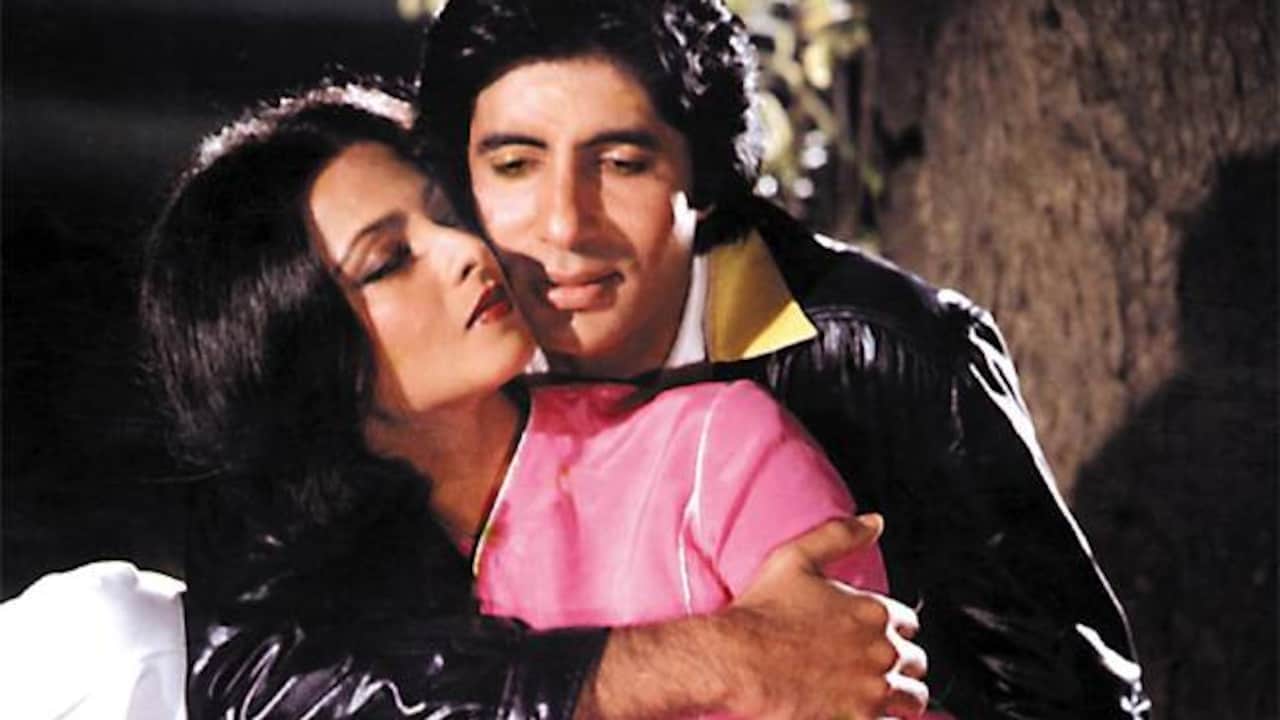
Rekha’s life and career are far greater than her famous association with a Bollywood superstar. We could easily skip the superstar chapter and focus entirely on Rekha’s cinematic journey.
If only Rekha hadn’t spent decades making sure we couldn’t.
Over the decades, Rekha has kept the door ajar, ensuring Amitabh Bachchan remains front and centre in her mythology. His influence and her experience with him are a natural part of her journey.
Advertisement – Scroll to continue
Having written a book on Rekha, I’m almost inevitably asked around their birthdays to revisit a legend that has somehow endured across the decades and still captures the imagination.
Instead of rumours, let’s trace the story through their own words-and the clues Rekha herself has been dropping all along.
When ‘Do Anjaane‘ met: “The fact that he was a married man doesn’t make any kind of difference”
Fifty years ago, Do Anjaane (1976) brought them together. The two stars were polar opposites on a call sheet. Amitabh was Bollywood’s unstoppable ‘Angry Young Man’ (Zanjeer, Deewar, Sholay), and famously disciplined. Rekha was mostly stuck in B-grade films and known for anything except being on time.
Advertisement – Scroll to continue
Everyone expected a clash on set. Instead, she was completely mesmerised.
As Rekha later famously confessed to Simi Garewal (Rendezvous with Simi Garewal, 2004), “Standing in front of Mr Amitabh Bachchan is not easy.” She was so nervous she kept blanking on her lines, until that deep baritone stepped in with a gentle warning: “Suniye…zara dialogue yaad kar lijiyega.”
Amitabh’s professionalism left her terrified and awestruck. In her own words, on Rendezvous with Simi Garewal, Rekha described Amitabh as “something I’d never seen before. I’ve never met anyone like him. How can so many good qualities be bestowed on one person? I’m not a fool; I’m intelligent, or so I’d like to believe. When I see a good thing, I can recognise it.”
His dedication won her over completely, launching an association the industry and the nation have never stopped talking about.
In her own words, on Rendezvous with Simi Garewal, Rekha described Amitabh as “something I’d never seen before. I’ve never met anyone like him. How can so many good qualities be bestowed on one person? I’m not a fool; I’m intelligent, or so I’d like to believe. When I see a good thing, I can recognise it.”
Amitabh’s dedication, sincerity and professionalism won Rekha over completely. The stage was set for a professional and personal association the industry would not stop talking about for decades.
Do Anjaane (1976) wasn’t a blockbuster, but it finally earned Rekha respect as an actress. And she gave all the credit to Amitabh. He became everything she admired. That he was married mattered little to her. As she famously put it later: “The fact that he was a married man doesn’t make any kind of a difference. A rose is a rose… I want to have the honour of being associated with this person, so what is stopping me? I’m not here to ‘break’ his home. I’m here to be one of the lesser mortals who can just have a whiff of him and feel happy.”
Amitabh himself hadn’t spoken about it then.
“When I Am In Love, I’m In It Completely”
Around this time, Rekha underwent a striking visual makeover. In the mid 1970s, when stories of Rekha’s alleged association with Amitabh started doing the rounds, film magazines’ coverage turned toxic. Amitabh, known for his close ties to the Gandhi family, was blamed by top-selling film magazines’ editors for trying to censor the press during the 1975 Emergency.
When the Emergency lifted, the magazines exacted their revenge by putting an informal “ban” on him. As Amitabh later recalled on his blog, Amitabh wrote on his blog, “…the entire press went against me, because they were informed by ‘sources’ that I… had brought on the idea of the Emergency and a ban on the press… Nothing could have been more ridiculous.”
Amitabh retaliated by shutting his doors to the media altogether, banning reporters from his sets.
As they began shooting together in films like Khoon Pasina, Alaap, and Immaan Dharam (all 1977), Rekha made sure their story stayed in the headlines. But given the “ban” on him, how did the media report on these sensational developments? Amitabh was referred in the media as the “Superstar” or “Lambuji” or just plain “he”. This actually suited Rekha just fine. She dropped clear hints about her growing feelings and how he inspired her growth, openly declaring: “When I am in love, I’m in it completely — every minute of every hour I’m thinking about HIM. Twenty-four hours it’s him, him, him in my thoughts. If he has promised to call at a particular time, and he doesn’t, I bring the roof down. After all, if he couldn’t make it, he shouldn’t have promised at all, should he?”
The Scandalous Statements
In 1978, Rekha starred in as many as fourteen films. Most vanished into cinematic oblivion, except Ghar, a breakout role where her sensitive portrayal of a traumatised survivor earned widespread critical acclaim.
Critics praised her effortless chemistry with Vinod Mehra, but Rekha explained her intensely romantic scenes were surprisingly easy: “I would just substitute Vinod Mehra for ‘him’.”
“He” would become a recurring figure in Rekha’s media interactions; she deliberately slipped in casual references to Amitabh at every opportunity and kept him in the audience’s imagination.
Amitabh Bachchan never responded to Rekha’s comments and always denied the alleged relationship about which so much was written for years.
By 1978, Rekha and Amitabh’s alleged affair dominated magazine covers. While cynics dismissed it as a clever publicity stunt to feed their on-screen chemistry, the public happily bought into every spiced-up detail.
Rekha, meanwhile, leaned straight into the role. In a sensational 1978 Stardust interview, “Girl Without a Conscience,” she called herself ‘the other woman’ for the first time and famously declared: “People say the wife is always one-up because she has the man. I say the ‘other woman’ is ten-up because the man wants her in spite of having a wife.”
Writer Khushwant Singh, known for his blunt wit, cut through the industry’s double standards: “Rekha is the victim of the masculine habit of calling any stylish woman a ‘nymphomaniac’… Still, the more scandalous her statements, the more I like her.”
And scandal she did create with her next move.
At Rishi Kapoor and Neetu Singh’s wedding (January 22, 1980), Rekha arrived in a stark white sari, with a bold crimson streak of sindoor glowing in her hair.
Years later, Jaya Bachchan addressed the storm with defiant composure: “Let the whole world say what they want. He has made a commitment to me… If he is doing something behind my back, it’s his problem. Not my problem. He has to live with it. And with his conscience!”
Without ever naming names, Amitabh eventually addressed the mounting tensions: “A divorce will never happen in our case… I made an absolutely first-class choice when I took Jaya as my wife.”
This is the closest that Amitabh ever came to even admitting all was not well at home.
The ‘Greatest Casting Coup’ In Bollywood
Most tabloid scandals flare up and burn out. The Amitabh-Rekha association might have suffered the same fate if Silsila hadn’t immortalised it.
The Yash Chopra film gave people visuals of an affair they had been imagining and talking about; it embedded the story in public memory. To date, most media reports and features on the fabled affair are accompanied by visuals picked out from the film.
Later Yash Chopra said, “I was always on tenterhooks and scared [during the making of ‘Silsila’] because it was real life coming into reel life. Jaya is his wife and Rekha is his girlfriend; the same story is going on. Anything could have happened because they are working together.”
Silsila, the ‘greatest casting coup’, forever chiselled the Amitabh-Rekha-Jaya triangle into the public conscience.
“I Love Him And He Loves Me, That’s It!”
When Amitabh nearly died on the sets of Coolie in 1982, the hospital’s VIP log read like a national guestbook, from Prime Minister Indira Gandhi down to Bollywood royalty.
Rekha was allegedly barred from entering the hospital, and she made sure everyone knew about. In a sensational interview to Filmfare, Rekha recalled, “Just imagine, I couldn’t communicate my feelings to that person. I couldn’t feel what he was going through. It was the worst kind of feeling. Even death won’t be so bad. I could accept death, not this feeling of sheer helplessness, absolute helplessness.”
She also talked about Amitabh’s outward denial of their relationship. She said, “He did it to protect his image, his family, his children. Why should the public know of my love for him or his love for me? I love him, and he loves me, that’s it!”
Muzaffar Ali, who directed Rekha in her career-defining Umrao Jaan, offered a rare window into her mindset: “Whenever referring to Amitabh, she always spoke using ‘inko, inhone’, like women do who consider themselves married. I think she considered herself married… Amitabh should have married her.”
Years later, Simi Garewal asked Amitabh on television about the persistent rumours:
Simi: One rumour that comes up like a virus every few years is your link-up with Rekha. Why does that happen? What generates it?
Amitabh: Ask the people who generate it.
Simi: Who generates it?
Amitabh: The media
Simi: Is it just the media you feel?
Amitabh: Well, if there is somebody else, then I must be made aware of it.
Simi: Do you ever meet each other?
Amitabh: She has been my co-star and colleague, and when we were working together, obviously we met each other. Socially, we have nothing in common. That’s about it.
He claimed they had no social contact at all.
The Silsila That Refuses To Fade
In 2012, the Congress nominated Rekha to the Rajya Sabha. As she took her oath in the Upper House, fellow MP Jaya Bachchan sat just rows away, while television cameras shamelessly zoomed in on Jaya’s face, fueling a fresh round of media friction.
Yet, after decades of speculation about their alleged affair, sensational quotes and icy denials, Rekha’s appearance in R. Balki’s Shamitabh in 2015 came as a genuine surprise. The film was co-produced by Amitabh Bachchan Corporation and had Bachchan and Dhanush as lead actors. Though they shared no screen time, the subtext did the heavy lifting: in a meta-cameo, Rekha hands a trophy to Dhanush (playing a mute actor using Amitabh’s voice), declaring him “blessed with God’s own voice.” The film then cuts to Amitabh’s face as the audience erupts in cheers, a wink to their history, and a scene clearly designed to cash in on the enduring fascination around the two stars.
That enduring fascination still sells.
Whether it is award shows, comedy nights or reality TV, Rekha continues to lean into the mythology-dropping inside jokes and crooning love songs without ever uttering a single name.
The silsila, it turns out, never really leaves the public imagination.


