

The 8th Pay Commission is scheduled to hold crucial stakeholder meetings in Mumbai this week, and what’s likely in focus is the demand raised by central government unions to revise the salaries and pensions using a fitment factor of 3.833.
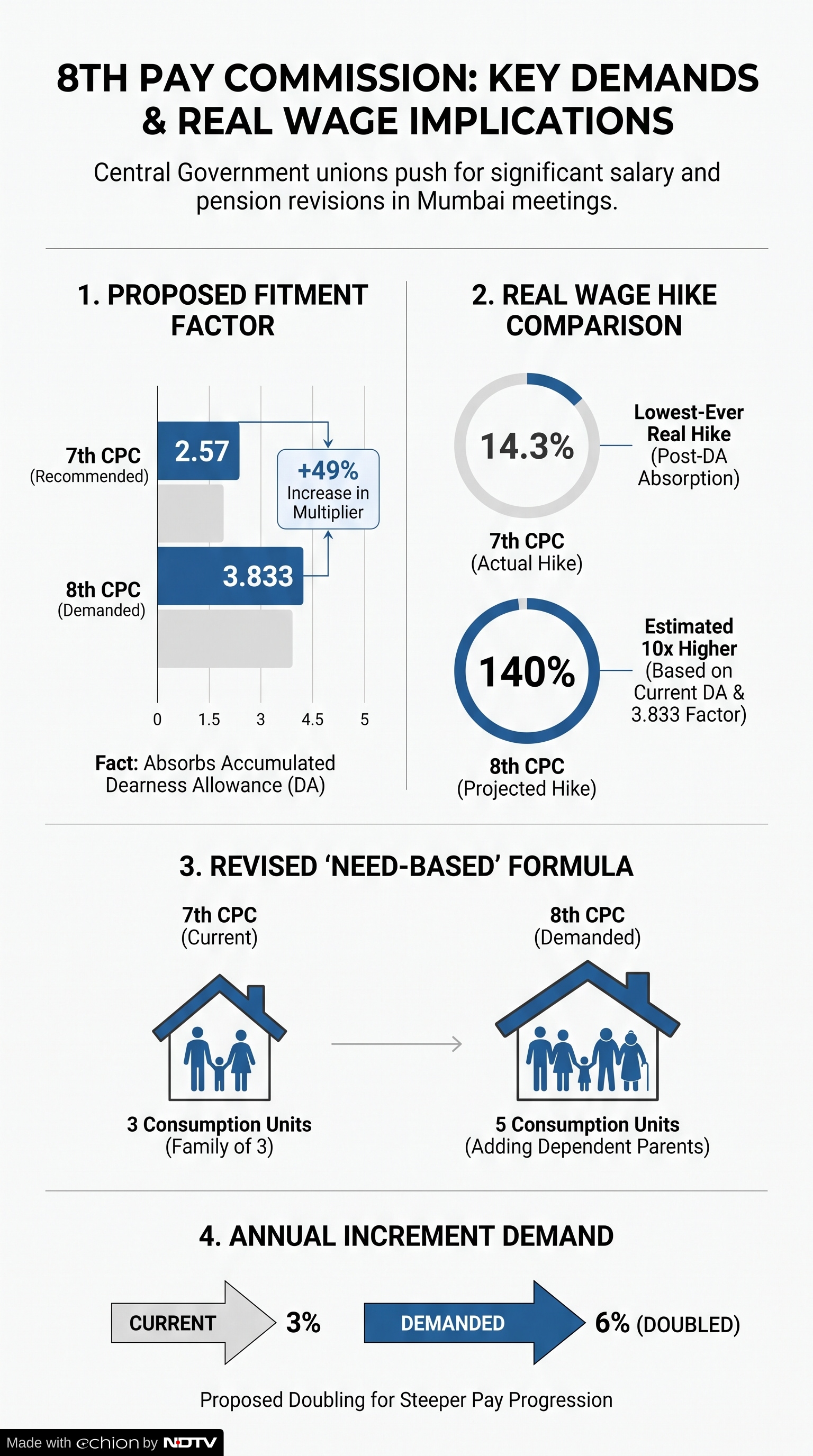
The multiplier, at the forefront, appears to be 49% higher than the fitment factor of 2.57 recommended by the 7th Pay Commission. However, such a comparison would understate the gap.
To fully comprehend, it should be taken into account that fitment factor works in two ways. Firstly, it absorbs the accumulated dearness allowance into basic pay, and any hike beyond that is seen as the real wage increase.
Also Read | Layoffs Are Rising In Tech, But These Skills Are Helping People Unlock Better Pay
The 7th Central Pay Commission (CPC) report clearly illustrates this. Of the 2.57-fitment factor, 2.25 was simply used to fold the then accumulated DA of 125%. The effective hike, however, came in much lower at 14.3%.
This was the lowest-ever real hike for pensioners and employees under the history of pay commissions. Previously, the 3rd CPC had delivered an effective hike of 20.6%, followed by 27.6% under 4th, 31% under 5th and a massive 54% under the 6th.
Applying The Same Test To 3.833
Currently, the DA stands at 60% of the basic wage, as per the last revision announced with effect from Jan. 1, 2026. To absorb the current accumulated DA, 1.6 out of the overall fitment factor would be utilised.
Now, if the demanded fitment factor of 3.833 is divided by 1.60, then the effective multiplier will be of about 2.4. This will result in a real wage hike of 140%, which is about 10 times higher than the 14.3% real hike rolled out a decade ago.
For a clearer understanding, consider the example of a Pay Band 1, Level 1 employee. The current basic pay sits at Rs 18,000, plus Rs 10,800 in the form of DA. If the demand raised by the Staff Side of National Council-Joint Consultative Machinery (NC-JCM) of 3.833 as the fitment factor is accepted, then the basic pay would rise to Rs 69,000.
However, it should be noted that the DA would be revised at least twice to thrice before the 8th Pay Commission is implemented. Likely before Diwali, the Union Cabinet is widely expected to raise DA by another 3%, with effect from July 2026. This would take the accumulated DA to 63% of the basic wage. To absorb this, 1.63 out of the final fitment factor would be utilised.
ALSO READ: DA Hike Before Diwali? Here’s How Much More Employees Could Get
Same Formula, Bigger Family
The core basis for the fitment factor demand centres around the Aykroyd nutrition formula, based on the “need-based minimum wage” framework of the 15th Indian Labour Conference. Using the same, the 7th Pay Commission rolled out Rs 18,000 as the minimum salary in 2016, against the demand for Rs 26,000.
This time, however, the unions have sought a tweak in the mechanism on counting the family members of earning individual. The 7th CPC costed food, clothing, housing and other needs for a family of three consumption units, whereas the current demand is that the needs of five consumption units—adding the aging parents of the earning individual—should be taken into consideration.
This argument is not new, as the 7th CPC report records that the NC-JCM Staff Side argued in 2015 that dependent parents should be counted as additional consumption units.
More Than The Headline Number
The memorandum submitted by the Staff Side of NC-JCM doesn’t solely rests on fitment factor. The employee forum has also demanded the doubling of annual increments from 3% at present to 6%, which would also sharply steepen the pay progression within each level over the next decade.
The unions have also sought higher house rent allowance (HRA), in view of the growing real estate prices. The 7th CPC had trimmed HRA from 30%, 20% and 10% to 24%, 16% and 8% for X, Y and Z-categorised cities, respectively, but embedded provisions for automatic revision once the DA amounts to half of the basic wage.
Accordingly, the HRA was raised to 27%, 18% and 9% for X, Y and Z cities, respectively, in 2024, when DA crossed 50%.
What Happens Next
The 8th CPC, headed by Justice (retired) Ranjana Desai, will meet employee and pensioner bodies in Mumbai on Oct. 22-23. The fresh consultations come after the latest round of talks in Bengaluru earlier this month.
The panel, notably, was officially constituted in November 2025, and was given 18 months by the Centre to submit its report. Going by that timeline, the deadline would lapse in May 2027.
Once the final recommendations are submitted, the same would be scrutinised by the government before issuing its nod. The wage and pension hike is expected to be implemented retrospectively from Jan. 1, 2026, but this wasn’t confirmed in the notification for pay commission’s setup issued by the government last year.
ALSO READ: DA Hikes So Far In 2026: What’s Changed For Government And Bank Employees? Check Full List
Essential Business Intelligence,
Sharp Market Insights,
Practical Personal Finance Advice, Daily Fuel, Gold and Silver Prices and Latest Stories — On NDTV Profit.