


Let’s be totally honest, when you hear that AI has cracked an 80-year-old math problem, your first instinct is probably to yawn and swipe away. It sounds like a headline strictly for coding nerds and academics.
But you might want to stop and look closer. What just happened in the labs of OpenAI isn’t just about geometry. It’s a massive, slightly unsettling glimpse into how the very fabric of human discovery may be changing right before our eyes.
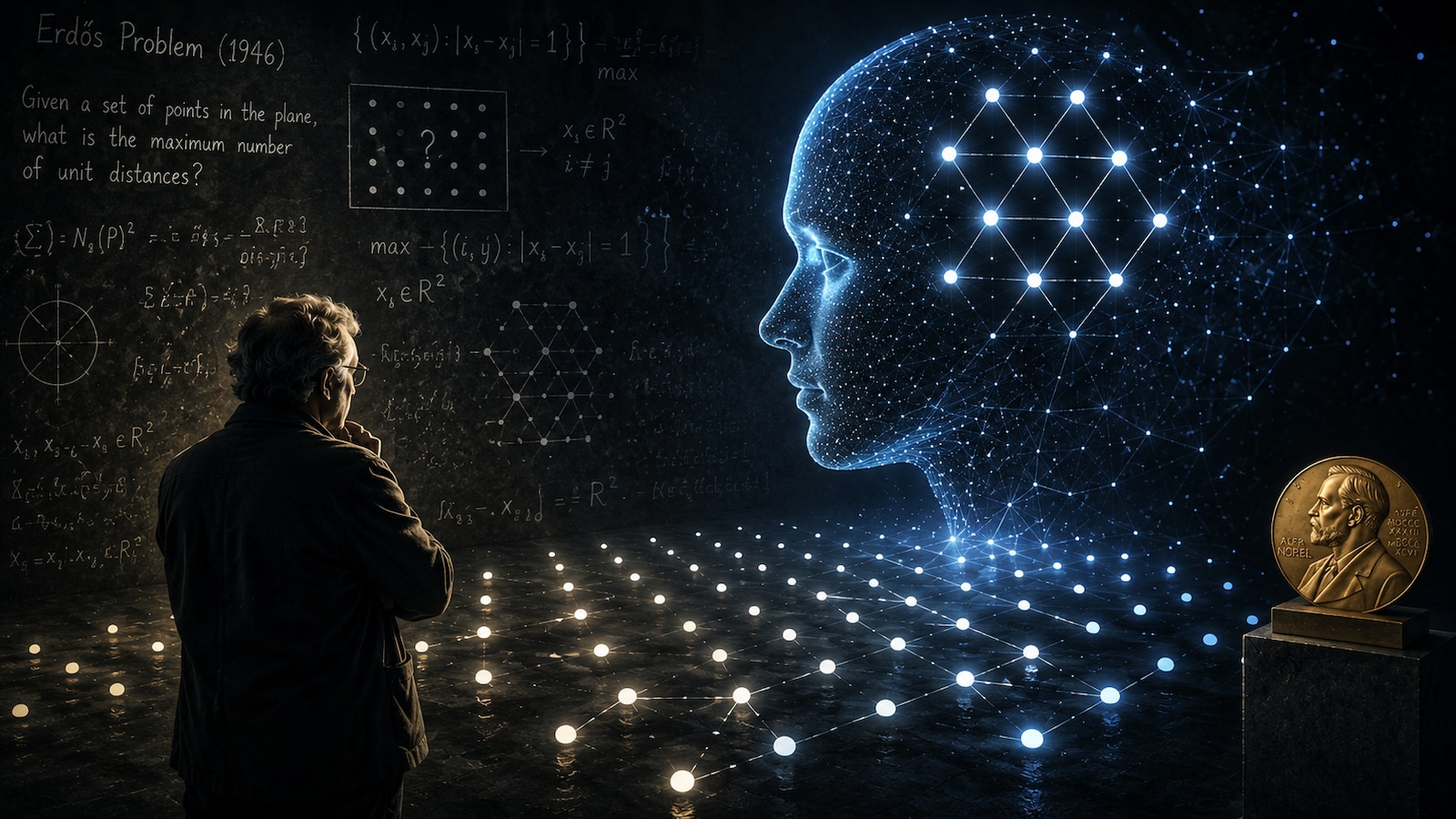
Here is the backstory, stripped of the academic jargon. Back in 1946, legendary Hungarian mathematician Paul Erdos posed a simple question: if you place a bunch of dots on a flat sheet of paper, what’s the absolute best way to arrange them so that as many pairs of dots as possible are exactly one unit apart? For decades, mathematicians believed simple square-grid style arrangements were among the strongest known answers.
Now, an internal general-purpose reasoning model from OpenAI has challenged some of those longstanding assumptions. Instead of simply crunching numbers through brute force, the system identified novel links between different areas of mathematics, mapping out a new infinite family of dot arrangements that surpassed previous known constructions. Mathematicians reviewing the work have reportedly verified the proof.
But here is why this matters to the rest of us, who are not necessarily interested in math or any of this technical mumbo-jumbo. This wasn’t a specialised tool built only for mathematics. It belongs to the same broader family of reasoning models now powering mainstream AI systems used for writing emails, planning holidays, or drafting essays. And those systems may now increasingly be stepping into domains once considered exclusive to elite human expertise.
“This exemplifies the shift to AI-driven breakthroughs poised for Nobels in physics, chemistry, and medicine,” Dr. Srinivas Padmanabhuni, AI expert and CTO of AiEnsured tells NDTV. He points out that unlike earlier narrow tools like AlphaFold, we are now entering a very different era. “Interesting times ahead… our scientists are now in a literal competition with AI for the Nobel Prize.”
Dr. Shubham, Assistant Professor of Economics at Christ University, Bengaluru, tells NDTV: “As many mathematicians have argued, breakthroughs in mathematics often come from seeing old problems differently.” “He adds that if OpenAI’s result holds, it may mark the beginning of AI as a genuine partner in deep scientific discovery rather than just a computational tool.”
Think about that for a second. We may be now going beyond talking about AI replacing copywriters or customer service agents and looking at AI entering the race for the highest intellectual honours humanity has to offer. The sheer momentum of this transition is dizzying as technology evolves at a pace that is leaving traditional systems of education and policy struggling to keep up.
“The speed is so fast, it’s getting a little scary,” warns Ansh Mehra, AI educator and founder of The Cutting Edge Group. He believes we are at a critical crossroads where understanding reasoning models can no longer remain a niche hobby. “It’s high time we educate people about reasoning models because if we don’t, it’ll be like discovering fire and only letting a few people learn, leaving everybody else out in the cold.”



