


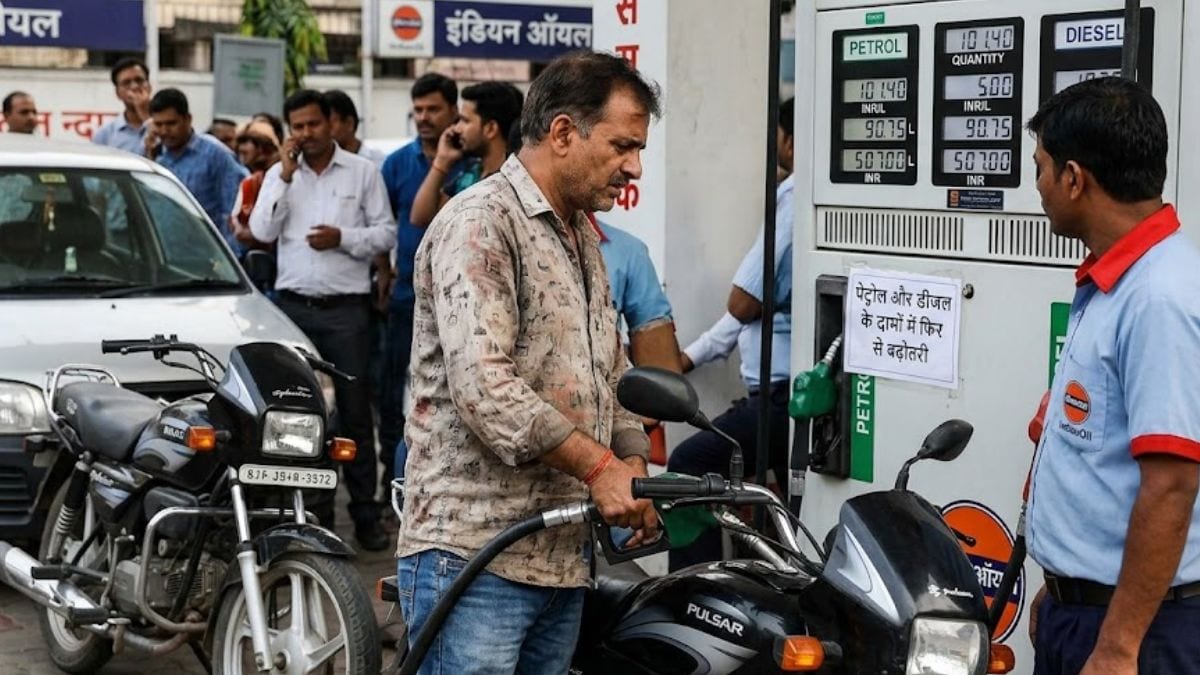
Fuel Price Hike: Petrol and diesel prices were hiked for the fourth time within the last 11 days amid the ongoing Iran war. With the latest hike of over Rs 2, petrol prices have crossed Rs 100 per litre in Delhi.
On Monday, petrol prices were increased by Rs 2.61. Meanwhile, diesel prices were hiked by Rs 2.71. With this revision, petrol will now cost Rs 102.12 per litre in Delhi. Similarly, diesel will now cost Rs 95.20 per litre in the national capital.
Check revised rates for petrol:-
| City | New rate (per litre) | Price hike |
| Delhi | Rs 102.12 | +2.61 |
| Kolkata | Rs 113.51 | +2.87 |
| Mumbai | Rs 111.21 | +2.72 |
| Chennai | Rs 107.77 | +2.46 |
The latest hike will add pressure on households already dealing with inflation. The increase in the price of diesel will increase the cost of logistics, thereby, impacting the cost of daily essential items. Milk and bread are already selling at a higher price due to previous hikes in fuel prices.
Check revised rates for diesel:-
| City | New rate (per litre) | Price hike |
| Delhi | Rs 95.20 | +2.71 |
| Kolkata | Rs 99.82 | +2.80 |
| Mumbai | Rs 97.83 | +2.81 |
| Chennai | Rs 99.55 | +2.57 |
The last fuel hike was announced on Saturday (May 23) when petrol prices were raised by 87 paise and diesel prices went up by 91 paise. CNG prices were also increased in Delhi by Re 1 per kg to Rs 81.09 on Saturday.
Why Fuel Prices Were Hiked Again?
The ongoing Iran war has disrupted the global oil supply. The disruption at the Strait of Hormuz, a critical route for oil-carrying vessels, has shot up crude oil prices significantly. For several weeks, India’s oil marketing companies (OMCs) continued to sell regular petrol and diesel at old prices despite buying crude oil at a higher price.
However, after two months of Iran war (which began on February 28), losses suffered by OMCs became unsustainable. According to estimates, the three OMCs — Indian Oil Corporation (IOCL), Bharat Petroleum Corporation Limited (BPCL) and Hindustan Petroleum Corporation Limited (HPCL) — were cumulatively bearing a loss of over Rs 1,000 crore every day. Thus, the government had to raise prices.
Speaking on the fuel price hike and its impact on OMCs, Sourav Mitra, Partner – Oil and Gas, Grant Thornton Bharat, said, “The recent back-to-back price hikes will offer partial relief to OMCs, but not a full cushion. Even if the Middle East situation stabilises, it will take time for risks around the Strait of Hormuz to fully ease, keeping crude prices elevated-likely above $90 per barrel. Combined with a weakening rupee, this continues to pressure OMC margins, and they could still face under-recoveries.”
He added, “Going forward, some calibrated price revisions may be required. The government will need to balance OMC financial health against the impact on consumers.”
It is worth mentioning that fuel prices in India had been stable since April 2022. In fact, prices were reduced by Rs 2 per litre prior to the 2024 Lok Sabha elections. Therefore, the latest hikes come after a long gap of four years.



