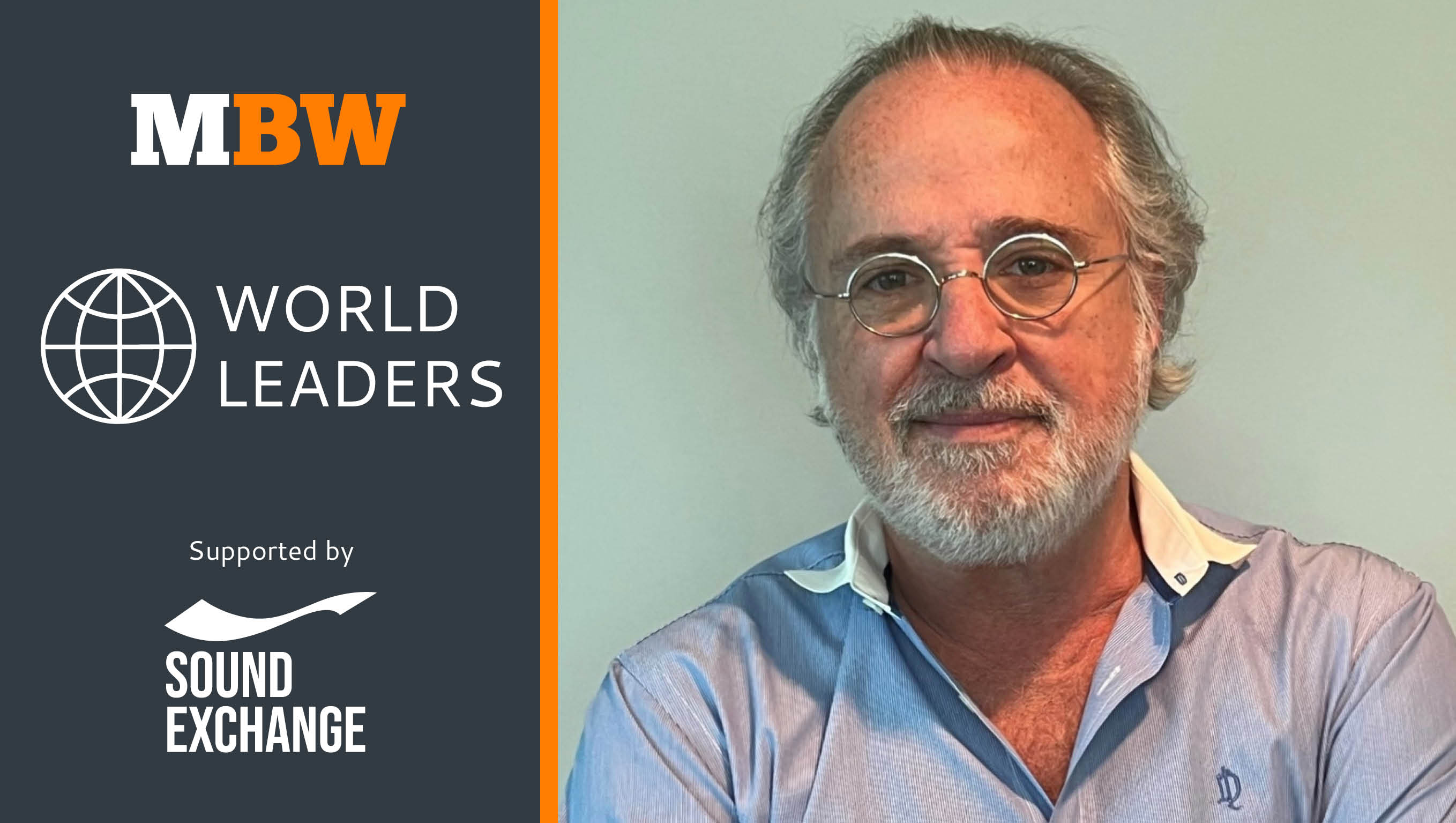
MBW’s World Leaders is a regular series in which we turn the spotlight toward some of the most influential industry figures overseeing key international markets. In this feature, we speak to Phil Rodriguez, founder and CEO of Latin America-focused Move Concerts. World Leaders is supported by SoundExchange.
For decades, Latin America sat on the margins of the global touring business. Today, it is one of its growth engines.
Phil Rodriguez hasn’t just witnessed that transformation. He’s helped drive it. The Move Concerts CEO began his career in 1977, promoting the Jackson 5 in Caracas, Venezuela. Nearly five decades later, his résumé includes everyone from The Rolling Stones and U2 to Ed Sheeran, Shakira, Iron Maiden and Bruno Mars.
The shift is reflected in Move’s current scale: the independent concert promoter has more than 30 stadium shows on the books across the region in 2026.
“Our business is mountains and valleys, and this year we have some solid content across the board,” says the straight-talking Rodriguez. “We kicked off the year with a stadium run with My Chemical Romance, we’ve got two runs with Ed Sheeran, we’ve got IronMaiden, we’ve got Slayer, plus Karol G... Call me at the end of the year, but on paper it all looks great.”
MBW catches up with Rodriguez following the first leg of Sheeran’s Loop stretch through Latin America — a run into “extremely rare” territory, including the Dominican Republic, Guatemala and Quito, which he later admits was, in places, “crazy” — with a second leg through the southern cone still to come.
“We broke up the tour into two parts,” explains Rodriguez. “Ed really wanted to go deep on this tour, so we did markets that we usually do not do: Dominican Republic, Puerto Rico, Guatemala, Costa Rica, Colombia, Ecuador, and Peru — the northern rim. Then in November we’re going to do the Southern Cone: Chile, Brazil, Argentina, and Paraguay. From a routing, freight and flight perspective, it made sense.”
Move is headquartered in Miami, Florida, with offices across Argentina, Brazil, Colombia, Costa Rica, Peru, and Puerto Rico. The latter branch co-promoted Bad Bunny’s landmark 30-night residency in the Puerto Rican capital of San Juan in 2025, alongside Rimas Entertainment.
“Bad Bunny, obviously, is a phenomenon — and a phenomenon that’s taken over ten years to build,” says Rodriguez. “Noah Assad, his manager, and Benito [the rapper’s real name] have been brilliant in the way they’ve piloted his career, developed it slowly, and created a base with their fans and a whole brand. Hats off — not only was the talent there, but there was a brilliant team behind it.”
In recent years, Move has pushed beyond pure promotion. Its management and concert divisions operate independently of one another while sharing certain synergies. The management arm grew out of a single artist signing and now sits alongside a record label, while the core touring business has leaned harder into stadiums, new arena openings and a fast-growing pipeline of Latin artists.
Here, Rodriguez gives his take on the lasting impact of Bad Bunny’s Puerto Rico residency, the infrastructure gap still holding back parts of South America, and why he isn’t losing sleep over Live Nation’s expansion into his backyard…
YOU’VE DESCRIBED BAD BUNNY’S PUERTO RICO RESIDENCY AS A GAME-CHANGER. WHAT DID IT ACTUALLY CHANGE?
Not so much it was a game changer — the whole execution of the album was brilliant: the marketing, the whole concept from beginning to end of the way the album was brought out, the whole concept of the residency, which was: “I’m not going to tour, come to my house and see me.” It had so much to do with the record and the vibe of the record, which was very much about pride in Puerto Rican music and culture, so it was so finely woven and so brilliant in the execution.
“I don’t think it’s a game changer, but we’re now seeing a lot of this residency/semi-residency concept.”
I wasn’t in England for Oasis, and I know for many people that was an emotional moment — but I’ve never seen an event really touch the soul of a people, of a community, of an island, like this did. Everybody was affected, not only economically but just in terms of pride, on an island that’s been through a lot.
I don’t think it’s a game changer, but we’re now seeing a lot of this residency/semi-residency concept. Harry Styles, for instance, is doing multiples in seven cities in different locations instead of a world tour. Everybody puts in their spice — everybody cooks their own gumbo.
IN WHAT WAYS DOES THIS LATIN EXPLOSION FEEL BIGGER THAN THE SHAKIRA AND RICKY MARTIN WAVE OF DECADES EARLIER?
Essentially, I think it’s three factors. Number one, music and videos being streamed versus CDs in the 1990s — all new music is worldwide, in real time now. Streaming has been fundamental in the explosion of not only Latin music but in the overall trend of music becoming globalized; music lovers all over the world can access different genres in real time, at low or zero cost.
Number two, the growth of Latin immigration all over the world, from the USA to Europe to Australia, etc. That created a ticket-buying base for Latin artists to tour markets that weren’t viable in the 1990s.
And number three, the new explosion was driven primarily by urban music — reggaeton, etc. That genre translated more easily to the general market, as it went hand in hand with hip-hop, took off in clubs and discos, and grew from there.
WITH LIVE NATION EXPANDING AGGRESSIVELY INTO LATIN AMERICA, HOW DOES AN INDEPENDENT — EVEN A LARGE ONE LIKE MOVE — COMPETE WITH THAT?
Well, we compete in the sense that we’re in the same game. But at the same time, I think we each have our own little recipe, we all have our strengths and weaknesses, and we bring that to the table. I’ve always said we’re a boutique operation — we put TLC into all our shows.
I’ll give you an example: we’re a recognized player where we work, we’ll do maybe 120 shows in the region — so it’s not 1,000 shows a year. That gives us more time. I’m not going to say the other guys are cookie-cutter, because that’s not what I imply, but it’s different if you have x amount of shows to address versus x5 or x10.
SO IT STILL FEELS LIKE THERE’S ENOUGH ROOM AT THE TABLE FOR EVERYONE?
I’ve always said there’s enough fish out there for everybody to eat. Listen, I’ve lost artists that I had a history with to Live Nation, but we gained others. I think you have to be creative, think outside the box, be aware of what might be going on — maybe you strike first. But I firmly believe there’s enough food for everybody, and not everybody likes one model. There’s things Live Nation is doing in our region which I think are great, and will help raise the tide for everybody, and vice-versa. I don’t see it as some dark force encroaching upon us.
Photo Credit: Fred Duval/ Shutterstock
YOU’VE BEEN WORKING WITH ED SHEERAN FOR CLOSE TO TWO DECADES. WHAT DOES A PARTNERSHIP LIKE THAT LOOK LIKE AT THIS STAGE?
Ed’s got a great team, he’s got a great vibe — what you see is what you get. We’ve worked together now for 17, 18 years, so it’s almost like a high school reunion every time we get together.
Same thing with Iron Maiden — with artists you work with over the years, when you see each other four or five years later you go, “How are you doing? How’s the family?”
It’s always a pleasure, no stress. With Ed, it was a good run, and we did some crazy stuff — Quito was crazy, Dominican Republic was crazy.
WHAT’S HAPPENED IN THE LAST TEN YEARS TO MAKE MARKETS LIKE THAT VIABLE FOR A-LIST ARTISTS?
God, some of these markets — Costa Rica, for instance — I’ve been working for decades, literally, and it’s always been kind of a cool stop. Costa Rica’s got a great vibe, it’s got surfing, the rainforest. I’m not going to say it’s artist-friendly in that sense, but it’s a market that most artists enjoy stopping off in, and it routes on the way to Mexico, on the way back from Mexico, or if you’re going to Colombia — so Costa Rica was always there. It’s just getting busier as our business gets busier.
The new thing is going to be Guatemala, with the Gallo Arena they’re going to open up. I believe they’re shooting for the end of next year. I think that’s going to make a massive difference and bring Guatemala forward as a touring spot. I’ve always said that, when there’s a new venue, business normally grows around 30%, simply because you not only have the content, but you have people wanting to check out the new venue. The short answer is every company in this business is looking to grow internationally.
IS LATIN AMERICA’S GROWTH SHIFTING THE GLOBAL INDUSTRY’S CENTER OF GRAVITY?
My view is that our business is becoming more globalized in every sense. It is an international music “gumbo” that includes different Latin genres, K-Pop, J-Pop, Afrobeats, etc. I’m fascinated with what’s going on in India, and how that’s going to grow.
“My view is that our business is becoming more globalized in every sense.”
Someone just sent me a projection of the world population by year 2050 — Africa and India are going to dominate by leaps and bounds, and I think that’s going to impact touring, music genres, everything. That’s the way of the world. The USA/UK center of gravity is shifting.
ON THE STADIUM BOOM — DOES LATAM HAVE THE INFRASTRUCTURE TO CAPTURE THAT, OR IS IT STILL LEAVING MONEY ON THE TABLE?
It’s an embarrassment that the biggest city in South America — São Paulo, Brazil — doesn’t have an arena. When your biggest indoor facility tops out at 8,000, you go to a stadium for anything above that unless you want to do multiples.
Would there be as many stadium shows if Lima and São Paulo had arenas that could hold 18,000–19,000? I don’t think so. I’m not going to say it would kill the stadium business, not at all, but that’s one of the reasons that we’ve leaned more on stadiums from my perspective. And some of these shows are scaled down, with the upper bowl closed, because of the lack of a big arena.
“It’s an embarrassment that the biggest city in South America — São Paulo, Brazil — doesn’t have an arena.”
When arenas start coming up over the next few years, that’s going to open up a different dimension. Now Buenos Aires has an arena, with projects for some other ones. Chile has an arena, there’s a project for one in Lima, you now have two arenas in Bogotá, you’ve got the arena in Guatemala — so slowly but surely you’re going to start getting more arenas everywhere.
THERE’S BEEN TALK OF “BLUE DOT FEVER” — TOURS NOT SELLING. IS THAT JUST A SNAPPY PHRASE, OR IS THERE SUBSTANCE TO IT?
Obviously the tendency of the press is to get a hook and run with it, and I get it. But listen, throughout the years, there have been shows that sold and shows that didn’t sell. Nowadays they’re just more visible because of the blue dots, but nobody can tell me that three or four years ago there weren’t tours that were stiffing — of course there were.
Sometimes people think the potential is there, and it turns out it isn’t. It is what it is. If everybody had a 100% batting average, everybody would be a promoter. So even with all the data and analytics, it’s not a perfect science.
BUT IS IT FAIR TO SAY IT IS A SOFTER SCENARIO FOR MID-LEVEL ARTISTS?
The big challenge — which continues — is the cost of touring. It impacts every touring artist, but those in the mid to lower range are hurt the most, for obvious reasons.
YOU’VE CALLED LIVE MUSIC AN “ACCESSIBLE LUXURY” THAT PEOPLE WILL PAY FOR EVEN WHEN THEY’RE CUTTING BACK ELSEWHERE. DOES THAT STILL HOLD UP?
Absolutely. I’m bullish about our business. Music and sports are the last tribal experience, and it’s the one moment where you can forget everything and all your problems, disconnect and enjoy yourself, share with friends, and it’s not a crazy expense.
“I’m bullish about our business.”
Hell, man, I’m seeing it now here in America with how much tickets are for the World Cup. And the tickets to see the Knicks play in New York are crazy.
MOVE HAS EXPANDED INTO ARTIST MANAGEMENT AND A RECORD LABEL. WHAT WAS THE IMPETUS FOR THAT?
I’ll be totally honest with you, I had fuck all to do with it. That was something our office in Argentina did during Covid — everybody was trying to figure out during Covid, “What do we do? Where do we go?” Records and recording was something everybody did during Covid — you could be in a studio at home, recording and putting music out.
So that really started with one artist, and now we have, I believe, six artists on the label, and it’s driven by Argentina. I step in and help out whenever I can, whether it’s through a contact, securing a record deal, distribution, whatever.
It wasn’t only because of Covid — it was about trying to find new ventures and revenue to keep the team working, but there’s also the obvious synergy with Move Concerts: some of these artists, we promoted in Argentina, we promoted in Peru, etc. So one vertical would help feed the other. It’s been a wonderful challenge.
YOU HAVE KEPT MASTERS IN-HOUSE. WHY WAS THAT IMPORTANT TO YOU?
It was something that I pushed for from day one. Because I believe with any artist you can speak with, if you have the option of having ownership — whether it’s now or eventual ownership of those masters — you want to do that. To me, that’s a no-brainer. Same thing with publishing.
HOW DO YOU MAKE THE NUMBERS WORK IN THAT REGARD?
It’s a licensing deal with the distributor, and with publishing it becomes an administrative deal. So it’s pretty much almost the same — at least that’s been our experience. We’ve gotten some really solid record deals, I have a great relationship with Warner Latin, they’ve been a great team to work with. And listen, at the end of the day, if you have a hit, everybody’s going to be happy. So that’s the objective. It’s the old saying, right? Success has many fathers, and failure is like a nobody.
IF YOU COULD CHANGE ONE THING ABOUT THE GLOBAL MUSIC INDUSTRY, WHAT WOULD IT BE AND WHY?
I can’t think of one thing in global terms, but I would definitely get rid of the ludicrous Student Discount law in Brazil. It helps no one and only distorts ticket scaling. The law stipulates that 40% of ticket inventory has to have a 50% student discount. This distorts the pricing, as we are forced to increase the non-student ticket prices to compensate for the discount — so the end result is artificially higher prices for the non-student tickets.
WHERE DOES MOVE GO FROM HERE? WHAT’S THE PLAN FOR THE NEXT FIVE YEARS?
We’re going to continue doing what we’ve always done. We’re obviously always looking at new areas. At the same time, because of what’s happening in the overall scene in our business, we’re doing a lot more Latin content and I think there’s a lot we can offer these artists going forward. But the nationality or genre doesn’t matter, our business is to sell tickets — it’s to put asses in seats.
SoundExchange was independently formed in 2003 to build a fairer, simpler, and more efficient music industry through technology, data, and advocacy. The only organization designated by the U.S. government to administer the Section 114 sound recording license, SoundExchange collects and distributes digital performance royalties on behalf of 700,000 music creators and growing.