























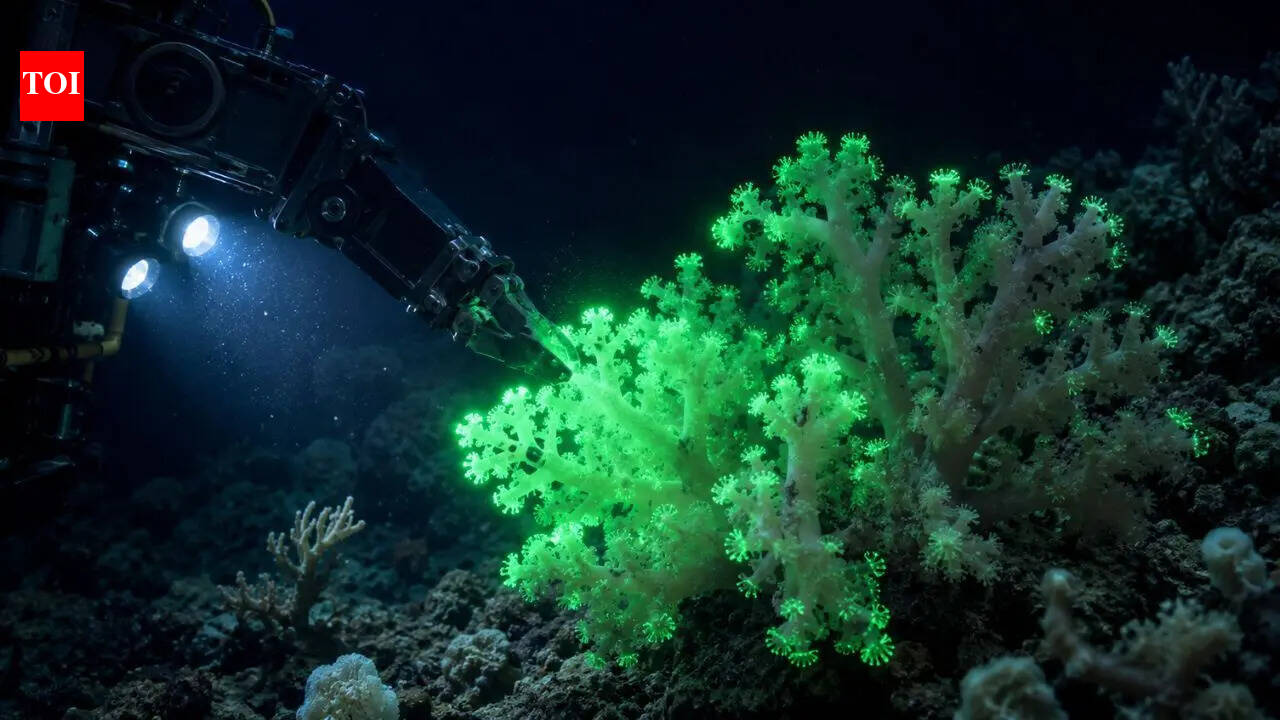
At several hundred metres below the surface, the limestone caves around Minamidaito Island are mostly untouched by sunlight, currents, and routine marine surveys. The landscape is narrow, uneven, and difficult to navigate even with modern submersibles. During one of those deep exploratory dives last year, a remotely operated vehicle passed close to a colony of precious coral and disturbed a cluster of tiny yellow animals attached to its surface. For a split second, they emitted a green glow.The light vanished almost immediately. It was not bright enough to illuminate the cave or be visible from a distance, but it was enough to interrupt the routine pace of the survey. The organisms had not been catalogued before, and the brief reaction triggered a closer investigation that later identified an entirely new coral-associated species with a rare form of bioluminescence.
Rare glowing coral species found 385 metres below the Pacific
As reported by Bioscience, the expedition took place in May 2024 as part of a deep-sea cave survey led by the Japan Agency for Marine-Earth Science and Technology, known as JAMSTEC. Researchers were using a robotic vehicle to inspect submerged limestone formations near Minamidaito Island, a remote Pacific island east of Okinawa.While manoeuvring through the cave system, the vehicle’s manipulator arm brushed against colonies belonging to the coral genus Pleurocorallium. Attached to those corals were small yellow polyps, unlike anything the team expected to encounter in that setting.The response came instantly after contact. Green light flickered from the tentacle area of the organisms for only a moment before disappearing again. The reaction appeared localised and short-lived rather than continuous, which immediately separated it from many known glowing marine animals that emit steady or repeated light displays. Video captured during the dive later became central to the analysis.
Scientists traced the glowing organism to the Zoantharia lineage
Detailed examination placed the organism within Zoantharia, a group that includes sea anemones and colonial coral-like animals. The species has now been named Corallizoanthus aureus, with the second part of the name referring to its distinct golden-yellow appearance.Its anatomy differs from its nearest known relatives in several ways. The tentacle count is slightly higher, the musculature surrounding the oral disc is arranged differently, and the body colouring is unusually vivid for animals living in such a dim environment.The species also appears highly selective about where it lives. Every observed specimen was attached directly to precious coral colonies, suggesting it survives as an epibiont, an organism that grows on another living animal without necessarily harming it. Back aboard the research vessel, scientists attempted to understand the source of the green flash. Measurements showed the emitted light peaked around 515 nanometres, placing it within the green portion of the visible spectrum.The glow was not constant. It appeared only after the tissue was physically disturbed or exposed to chemical stimulation. Undisturbed specimens stayed dark. Many marine organisms display fluorescent colours under blue lighting, but fluorescence depends on absorbing external light and re-emitting it. The new species behaved differently. The light originated from the animal itself. The team also ruled out luminous bacteria living in the coral tissue. Instead, the evidence points toward an internal biochemical reaction similar to those already documented in jellyfish and other marine invertebrates.Scientists suspect the process involves coelenterazine, a molecule widely used in oceanic bioluminescence. In the presence of oxygen and an enzyme called luciferase, the compound releases visible light through a chemical reaction occurring inside the animal’s tissues.
Scientists suspect the flash could help the organism avoid predators
The function of the glow remains uncertain. Inside a cave environment where visibility is already limited, a sudden flash may seem counterintuitive. Yet bioluminescence in deep-sea ecosystems often serves purposes that are indirect rather than communicative.One possibility being considered is the so-called burglar-alarm effect, an old ecological idea first proposed decades ago. Under this theory, a small organism emits light when attacked or disturbed in order to attract a larger predator that may threaten whatever is trying to eat it. In open ocean species, these reactions can unfold rapidly. A fish bites a smaller animal, the smaller animal flashes, and the light draws attention from an even larger predator nearby. Whether that chain of events operates inside confined cave systems is still unknown.