





















Heading into Monday’s trade, it was an anxious time for Dalal Street. Following the events of Friday in US markets, where indices reacted negatively to an overwhelmingly positive jobs data – sparking fears that a rate cut may not be coming anymore – the entire Dalal Street was expecting a bloodbath today.
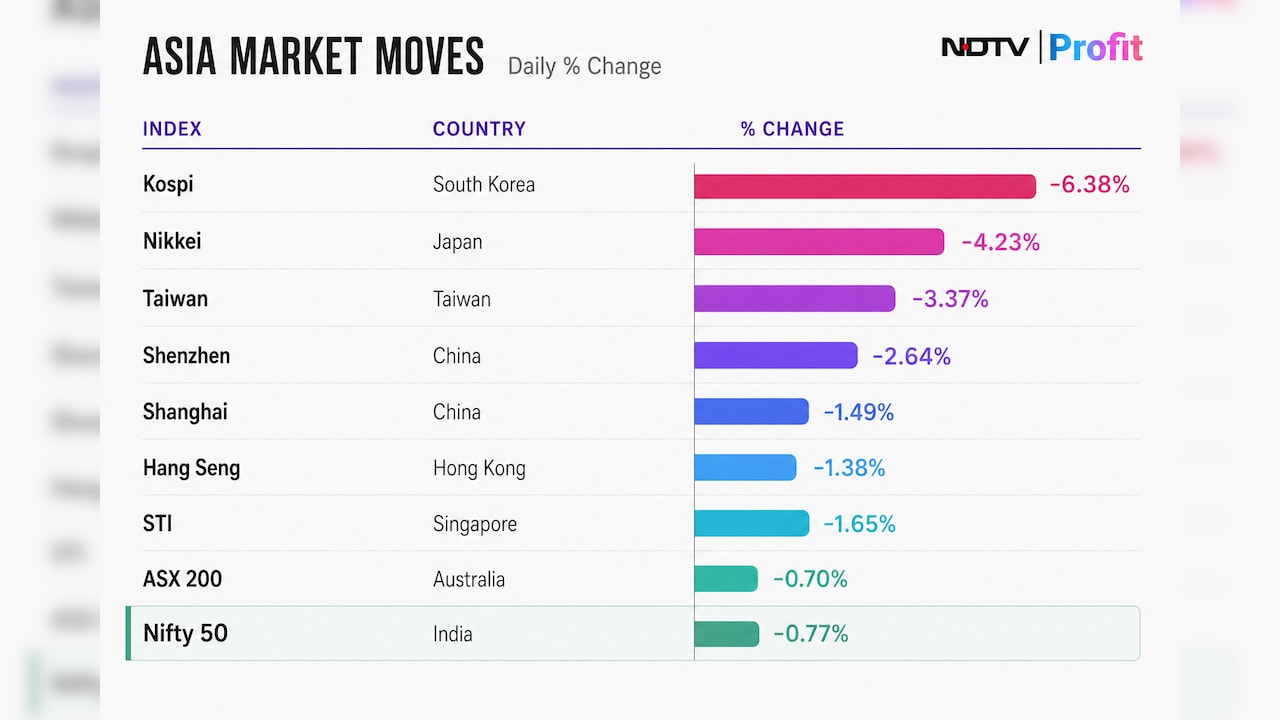
These fears were accentuated by the performance of Asian peers, with indices in South Korea, Japan and Taiwan trading with cuts of more than 3%, at the very least.
However, what has transpired can be seen in a largely positive light. Even though Nifty 50 is still trading with cuts of around 0.65%, it has outperformed almost all Asian peers and appears relatively unscathed from weak global cues that were threatening to destabilise the markets again on Monday.
But why?
Asian Recovery Took The Edge Off
The first reason is one that had little to do with India specifically, as Asian markets staged a sharp recovery from their morning lows. Harshal Dasani, Business Head at InvAsset PMS, explains:
“South Korea’s market, which was down nearly 9% in early trade, has recovered significantly, while Japan and Taiwan have already moved back into positive territory. As panic selling eased across the region, risk appetite improved and helped stabilise sentiment in domestic markets.”
India As An Anti-AI Trade
Friday’s selloff on Wall Street was rooted in strong jobs data killing rate cut hopes. However, the broader anxiety in Asian markets, particularly in South Korea, Taiwan and Japan, stemmed from their deep exposure to the global AI and semiconductor supply chain.
All these indices have appreciated significantly on the back of AI, DRAM and semiconductor wave, to a point where it is being feared that the bubble might already be too big.
India, by contrast, does not carry the same concentrated semiconductor or hardware exposure. That relative insulation – one some market participants have begun calling the “anti-AI trade” positioning – means India doesn’t bleed as sharply when AI sentiment wobbles. Dasani adds that the recovery in technology stocks globally did, however, provide an indirect cushion:
“The current global market cycle continues to be driven by AI-related spending, semiconductor demand and large technology companies. While India does not have a direct semiconductor heavyweight ecosystem comparable to global peers, the closest listed proxy is the IT sector.
“As global technology stocks recovered, Indian IT also attracted buying interest, helping cushion the broader market from deeper declines.”
Decoupled From US Rate Anxiety
The other structural factor working in India’s favour is its growing decoupling from US interest rate cycles. The RBI is now increasingly charting its own monetary course – one guided by domestic inflation and growth dynamics rather than mirroring Fed moves.
That gives Indian equities a degree of insulation when US macro data reshapes rate cut expectations, as it did on Friday.
Essential Business Intelligence,
Continuous LIVE TV,
Sharp Market Insights,
Practical Personal Finance Advice and
Latest Stories — On NDTV Profit.



