


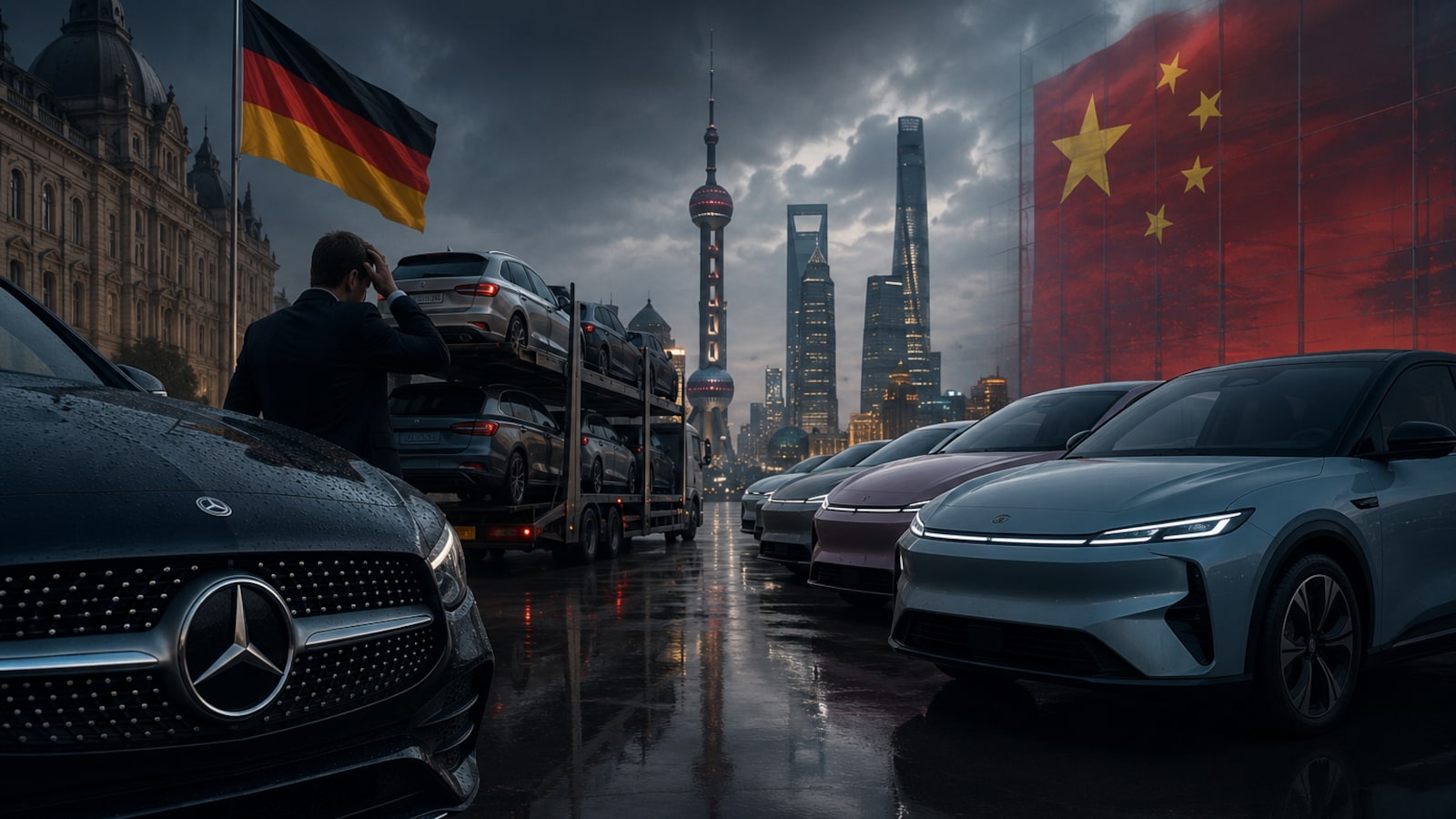
After decades of winning over Chinese buyers with its German engineering, Mercedes-Benz Group AG took the humbling step last fall of partnering with fast-food chain McDonald’s to hype its newest car.
In the “So Mc-Benz” campaign, Mercedes allowed a cheeseburger figurine to take the spot of its traditional three-pointed star on the all-electric CLA, a sedan it hoped would stop sales from sliding in the world’s largest car market. The ads were supposed to make the vehicle popular with China’s young and hip.
ALSO READ: Kaynes Technology Close To Finalising Deal With ‘One Of World’s Largest EV Makers’
It didn’t work. Mercedes sold only 1,153 units in China in the first half, a fraction of the more than 80,000 similarly priced SU7 sedans Xiaomi Corp. delivered in the period. The performance echoes the challenges BMW AG, Volkswagen AG and Porsche AG face in China, where they all reported second-quarter sales declines of at least 30%, worse than the overall market’s drop.
Meanwhile, the likes of Xiaomi and BYD Co. are taking customers from them, depriving the Germans of a key growth and profit driver. So far, none of them has found a way to arrest the downward spiral.
It’s not that they’re not trying. Most of them have partnered with Chinese companies to gain access to the latest EV technology and better understand what local drivers want. Mercedes built a long-wheelbase version of the CLA to appeal to Chinese tastes for a roomier back seat. It packed the car with software including AI-powered voice control and priced it from just 229,000 yuan ($33,943), roughly 40% cheaper than the European version.
Instead of winning clients, Mercedes had to concede that competing in China would require even further price cuts that would see it lose money on almost every electric CLA sold, according to people familiar with the matter. The company is limiting its push for the car until economics improve, the people said, asking not to be identified discussing internal commercial decisions.
Mercedes said the model was never meant to drive volume but rather show off the company’s latest technology in the hotly contested entry-level segment. The carmaker is “focusing on sustainable growth rather than purchasing short-term market share,” it said in an emailed statement. The company pointed to the electric GLC, a compact sport utility vehicle introduced in China last month, as doing well in terms of market feedback and pre-orders.
Chinese manufacturers, meanwhile, are willing to endure significant pain to win market share. BYD’s first-quarter profit tumbled 55% to its lowest level in more than three years as the price war takes its toll. Geely Automobile Holdings Ltd.’s income also fell in the period.
At this point, significant parts of German carmakers’ offerings are simply priced out of China, according to JPMorgan analyst Jose Asumendi. While the overall Chinese market is down due to a protracted real estate crisis that’s weighing on spending, German companies are losing out more because their lineups tend to be pricier and feature more combustion-engine cars, a segment that’s in decline. BMW slashed its margin outlook due to the China slump, putting it on course to be the least profitable major European automaker this year.
Managers including Mercedes Chief Executive Officer Ola Källenius expect the market to remain brutally competitive for years to come.
The problem isn’t only price. In many cases, German carmakers still operate on the development-to-market schedule of the gasoline era, refreshing products every four years or longer, and teasing snippets of new cars long before drivers can buy them. But in China, the EV market has come to resemble the frenzied pace of consumer electronics, with brands rejuvenating cars as fast as 18 months and having a new model ready for mass purchase right off the bat.
“And while it’s being sold, you’re already making the next iteration,” said Xing Zhou, an automotive adviser at AlixPartners who has worked in both Germany and China. “There’s no way that this industry will go back to the old way.”
That’s fueling a fundamental shift in brand perception in China, where Mercedes, Audi and BMW are losing their luxury edge because they’re perceived as trailing local manufacturers on software and EV technology.
Part of why the electric CLA is flopping is because rivals led by Xiaomi’s SU7 dominate the segment at that price point with more advanced automated-driving functionality, a mobile-phone first entertainment system and hipper branding, said Li Yanwei, who advises the China Automobile Dealers Association.
The CLA’s sporty design tries to cater to a younger crowd, ignoring Mercedes’ traditional middle-aged customers who tend to have families and prefer bigger interiors, he added. The CLA “is in an awkward place where it’s not the most affordable
and not the most luxurious,” Li said.
That’s kind of what Flora Li and her husband felt when they went shopping for their second car. They looked at a range of electric models including the CLA, the SU7, and the Z7 sedan China’s SAIC Motor Corp. is making in partnership with tech company Huawei Technologies Co. When testing the vehicles, the CLA’s automated-driving software didn’t convince her, and the car was slow in responding to voice commands, she said.
“The CLA’s handling was good for an EV and close to the feel of a gasoline car but just not as good as” some of the Chinese options, she said. Eventually, the couple bought SAIC’s Z7, persuaded by its Huawei-powered technology.
The experience shines a light on German carmakers’ struggles in China, a market they used to dominate with little effort. Their demise there started coming to the fore around 2023, after artificially high returns dissipated when shortages of chips and other components gradually eased.
That’s when local manufacturers, bolstered by state support but also superior EV technology and software, began to dominate. The government’s push of the industry has created some 150 domestic car brands, and they alone churned out some 500 new or updated models in the first half of the year, according to Volkswagen CEO Oliver Blume. It’s a “China Speed” foreign carmakers struggle to match.
The shift, which has accelerated since the start of this year, is starving the German carmakers of returns that help keep costly car production going in their home country. Blume in June said Volkswagen’s business model was essentially broken. The comments paved the way for his plan to cut 100,000 jobs and shutter German factories, triggering staunch opposition from powerful labor leaders.
In China, Blume is betting on partnerships with Xpeng Inc. and state-owned SAIC to rejuvenate the VW and Audi brands. The first of the new VW-Xpeng models, the ID.Unyx 08, went on sale only recently, meaning there’s little data to judge its success. Deliveries of the Chinese AUDI sub-brand’s E5 Sportback, which has been out for roughly a year, have been underwhelming despite the car garnering critical acclaim.
For BMW, which in June slashed its projected carmaking margin to as low as 1% because of the decline in China, the main test is around the corner. The company is about to embark on its most ambitious push in the country in years with the first two of its revamped Neue Klasse models, the electric i3 sedan and the iX3 SUV. The latter will open for pre-sales in China on Aug. 21. Both are long-wheelbase models catering to local drivers.
The manufacturer has spent more than €10 billion on the Neue Klasse line, arguing at the initial unveiling last September that the technology was setting new benchmarks. But nearly a year later, it’s unclear whether it can usher in a turnaround in China.
BMW hasn’t yet released a price for the Chinese iX3, seen key to win back favor with the country’s younger customers. To be competitive, the SUV probably would need to get a comparable sticker than Tesla’s Model Y, which starts at around 264,000 yuan. In Germany, BMW charges nearly twice for the iX3’s base version. The Model Y L, a roomier version designed specifically for the Chinese market, costs from 339,000 yuan.
While the jury is still out on BMW’s improved offering in China, early signs like the slow sales of the CLA don’t bode well for the Germans. Even high-end versions that appeal to European drivers looking for long Autobahn rides are struggling in China as competitors introduce equally efficient models faster, brimming with features catering to local tastes, like karaoke machines and seats that fold flat for car camping.
When Summer Chen, a 32-year-old tourism worker from Chengdu, went shopping for a new EV, Mercedes was at the top of her mind. Her family had owned an E300 sedan for around 10 years and she was ready to pay slightly more to stick with the venerable German brand. But when she checked out the CLA at a dealership, she was disappointed by what she felt was an old-fashioned user interface and clunky dashboard screens. In the end, she went for Tesla’s Model 3, citing its superior design.
“Smart features aren’t an advantage for Mercedes,” Chen said. “Whatever the company comes up with, Tesla, Xiaomi and Huawei can too.”
ALSO READ: This EV Manufacturer’s Gigafactory Was Built For Scooters. Now It’s Chasing Drones And Defence
Essential Business Intelligence,
Sharp Market Insights,
Practical Personal Finance Advice, Daily Fuel, Gold and Silver Prices and Latest Stories — On NDTV Profit.



