



Creators from around the world have signed a declaration in Paris calling for the protection of human creativity as artificial intelligence reshapes the creative industries.

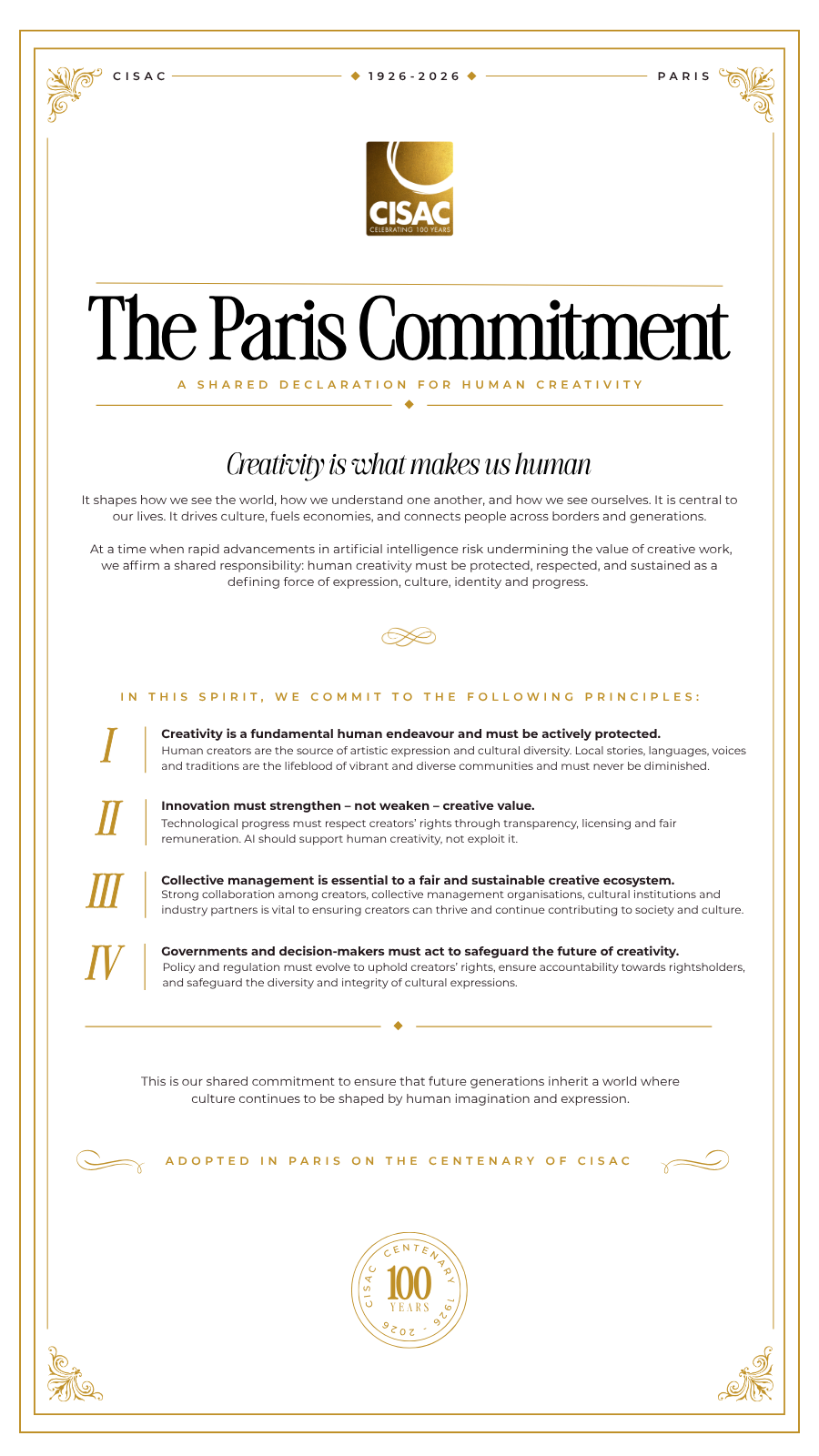
The Paris Commitment was adopted on Thursday (June 4) during the centenary General Assembly of the International Confederation of Societies of Authors and Composers (CISAC).
It urges governments, technology companies and cultural industries to ensure human creators remain protected, recognized and fairly remunerated in the AI era, according to CISAC.
The declaration was unveiled before an audience of more than 450 creators, policymakers, collective management leaders and cultural industry representatives, CISAC said.
It was signed live on stage by creators from around the world, following a video in which creators from across CISAC‘s network reflected on the role of creativity in human life, identity and culture.
The Paris Commitment opens with the words: “Creativity is what makes us human.”
“Creativity is one of the deepest expressions of our humanity,” said Björn Ulvaeus, the ABBA co-founder and CISAC President since 2020.
“The Paris Commitment sends a united message from creators around the world: human creativity must continue to be valued, respected and protected.”
“At a time when rapid advancements in artificial intelligence risk undermining the value of creative work, we affirm a shared responsibility: human creativity must be protected, respected, and sustained as a defining force of expression, culture, identity and progress,” the CISAC declaration states.
The four principles set out by CISAC cover the protection of human creativity and cultural diversity, transparency and fair remuneration in AI systems, the role of collective management, and action by governments to safeguard creators’ rights.
On technology, The Paris Commitment states that “innovation must strengthen – not weaken – creative value”, and that “AI should support human creativity, not exploit it”.
“The Paris Commitment sends a united message from creators around the world: human creativity must continue to be valued, respected and protected.”
Björn Ulvaeus, Cisac
The commitment comes amid an international debate over the use of copyrighted creative works to train generative AI, and over the transparency, consent and remuneration owed to the creators whose works are used, according to CISAC.
A study commissioned by CISAC and published in 2024 estimated that generative AI could take 24% of music creators’ revenues by 2028 if current trends continue, as previously reported by MBW.
The European Union‘s AI Act, passed in 2024, introduced copyright-compliance and transparency obligations for AI developers.
Ulvaeus has pressed the EU to keep those obligations intact, leading a delegation of creators to Brussels in May 2025 and warning that creators’ interests must not be “cast aside” in the rush to AI.
In the UK, the government proposed a “text and data mining” exception that would let AI developers train on copyrighted works unless rightsholders opted out, prompting opposition from across the music industry.
More than 1,000 musicians, including Kate Bush, Annie Lennox and Damon Albarn, released a silent album, Is This What We Want?, in February 2025, its track list spelling out “The British government must not legalize music theft to benefit AI companies”.
More than 400 artists and industry figures, among them Elton John, Paul McCartney, Dua Lipa and Coldplay, signed a letter urging Prime Minister Keir Starmer to back transparency requirements for AI training.
The UK government reversed course in March 2026, with Technology Secretary Liz Kendall saying the government “no longer has a preferred option” on AI copyright reform after the approach was “overwhelmingly rejected by the vast majority of the creative industries”.
The debate has also reached the courts. In the US, the major record companies sued AI music platforms Suno and Udio in 2024, alleging “mass infringement” of copyright.
Universal Music Group settled with Udio in October 2025 and agreed to build a licensed AI music service.
Warner Music Group has since reached its own settlement with Udio.
Suno continues to face copyright lawsuits from major music companies and European rights organizations.
In Germany, collecting society GEMA won a copyright ruling against OpenAI in November 2025 over ChatGPT‘s reproduction of song lyrics.
The court rejected OpenAI‘s argument that authorization for text and data mining justified storing and reproducing the lyrics.
“The internet is not some kind of self-service buffet, and creative achievements by human beings are not simply templates for use free of charge,” said GEMA CEO Dr Tobias Holzmüller.
GEMA is also pursuing a separate case against Suno in Munich.
Adopted in Paris, where modern authors’ rights first took shape and where CISAC was founded in 1926, the declaration marks the organization’s centenary.
CISAC says it represents more than 5 million creators through 227 member societies in 111 countries, and that its members collect more than €14 billion in royalties each year.
Speakers at the 2026 General Assembly included creators and cultural leaders from music, audiovisual, visual arts and publishing, alongside representatives from WIPO, the African Union, the European Parliament and Deezer.
The declaration followed a day of discussions on the future of creativity in an AI-driven world, bringing together creators, economists, academics and technology experts, CISAC said.
Creators, rights organizations and supporters worldwide are invited to add their names to the declaration through a public signing campaign, CISAC said.
The Paris Commitment closes with a pledge to ensure “that future generations inherit a world where culture continues to be shaped by human imagination and expression”.Music Business Worldwide



