


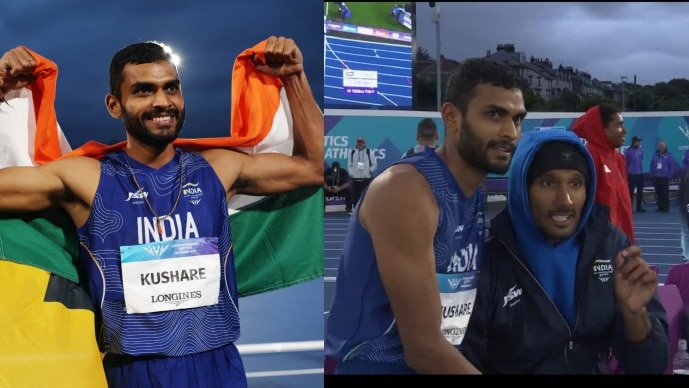
Tejaswin Shankar’s competition lasted one jump. His evening lasted the whole final.
He was not even supposed to take that jump. The start list had him down as DNS (Did Not Start). Then, to the mild surprise of those tracking the competition, he walked out with the other finalists anyway. CWG Day 5 Highlights
The 2022 Commonwealth Games bronze medallist rose for his opening attempt at 2.05m on Monday night in Glasgow, felt something give in his knee, and folded to the mat. He did not clear the bar. He would not get another attempt. He limped off, and later put a name to what the wince already suggested: patellar tendinitis, a knee condition flaring up at the worst possible time, had ended his night. By the rules of the competition, that should have been that.
It was not that.
Three Indians had walked out for the men’s high jump final that evening: Sarvesh Kushare, Aadarsh Ram Jothi Shankar, and Tejaswin. One went out early. The other two did not get to finish alone, because the one who left the competition never left the pit.
TEJASWIN: THE NON-STRIKER
Glasgow was cold enough that evening for most withdrawn athletes to head straight for the warmth of the mixed zone and a hot drink. Tejaswin zipped up his jacket instead and stayed pitch-side, planted at the edge of the apron where the bar kept climbing without him. Between attempts, Sarvesh and Aadarsh drifted over to him the way batters drift towards a senior pro at the non-striker’s end.
Not all of it was gentle encouragement.
After Sarvesh missed his first two attempts at 2.25m, Tejaswin floated a piece of high-jump gamesmanship: skip the height altogether, save the jump, and go straight for 2.28m instead. “Why don’t you skip this and try clearing 2.28m in one attempt? You will win gold,” he suggested.
Sarvesh was not interested in the shortcut. “No, no, I will clear 2.25m,” he said, and did exactly that on his final try. Tejaswin, for his part, has since waved off any suggestion that he did anything heroic. He was, he said, just a sounding board.
There is a version of this story where none of that matters, where Tejaswin is a name in the results column marked DNF and nothing more. Instead, he gave two teammates something more useful than sympathy under pressure: someone to check their technique against, sport’s oldest specialisation, in real time, self-taught by a man no longer allowed to compete in it. It did not clear a single bar for Sarvesh. It just meant he was never alone with the pressure.
By the time the bar reached 2.25m, only Sarvesh and Jamaica’s Romaine Beckford were still standing. Both cleared it. Both then missed 2.28m, and with nothing left to separate them on the night, it went to countback. Beckford held the better record at the lower heights (he cleared 2.25m in his first attempt) and took gold.
Sarvesh took silver, and with it, the first Commonwealth Games medal an Indian man has ever won in the high jump beyond a bronze. Aadarsh finished fifth with 2.15m. England’s Jack Kimani claimed bronze at 2.20m.
EXTRAORDINARY YEAR FOR SARVESH
For Sarvesh, the year had already been extraordinary before Glasgow. Earlier this month he became the first Indian to clear 2.30m, breaking a national record Tejaswin himself had held for eight years, and he arrived in Scotland fresh off a third-place finish in Monaco, only the fourth Indian to reach a Diamond League podium in any event. None of it had come easily. He grew up in Devargaon, a village in Nashik built on onion farming, where his father and childhood coach improvised landing pits out of corn husks, cotton and whatever agricultural waste was lying around, because there was no foam mattress to be had.
He did not compete nationally until he was nearly 20, a late bloomer by the sport’s usual clock, and it has taken him a decade of gold at domestic meets to arrive at a night where the only man who could match him for pedigree in the pit was the one standing beside it in a tracksuit, offering advice instead of competing for the same medal.
TEJASWIN IN TEARS
That man had his own night to mourn. Tejaswin had walked into the final believing a medal was well within reach.
“I really believed I could win a medal here. But, to not do that, to not even make the first jump stings,” he told reporters afterwards, before explaining what had gone wrong.
“It is just overuse of patellar tendinitis. That’s why it’s called the jumper’s knee.”
He insisted, not entirely convincingly, that the warm-up had gone well and that he had walked out feeling as sharp as he has all year.
“I am still in the best shape of my life. I will try and come back. I still have two days,” he said, and then the composure that had carried him through the interview gave way.
He is now a doubtful starter for the decathlon, the event he switched to in 2022 and has since made his own, winning Asian Games silver and turning himself into the country’s most credible all-round athlete. Two days is not much time for a tendon to forgive an evening like that one.
But he had made his choice before the tears came, when the competition still had two more rounds to run and his own night had already ended. He stayed in the cold, and Sarvesh still had to clear every centimetre of that bar on his own. What Tejaswin gave him was not a medal, but one less thing to carry alone while doing it.
Sarvesh Kushare has his history now, a Commonwealth Games silver that no Indian man had managed before him. Somewhere in the small print of how he got there is a teammate who could not jump, and would not leave.
– Ends



