


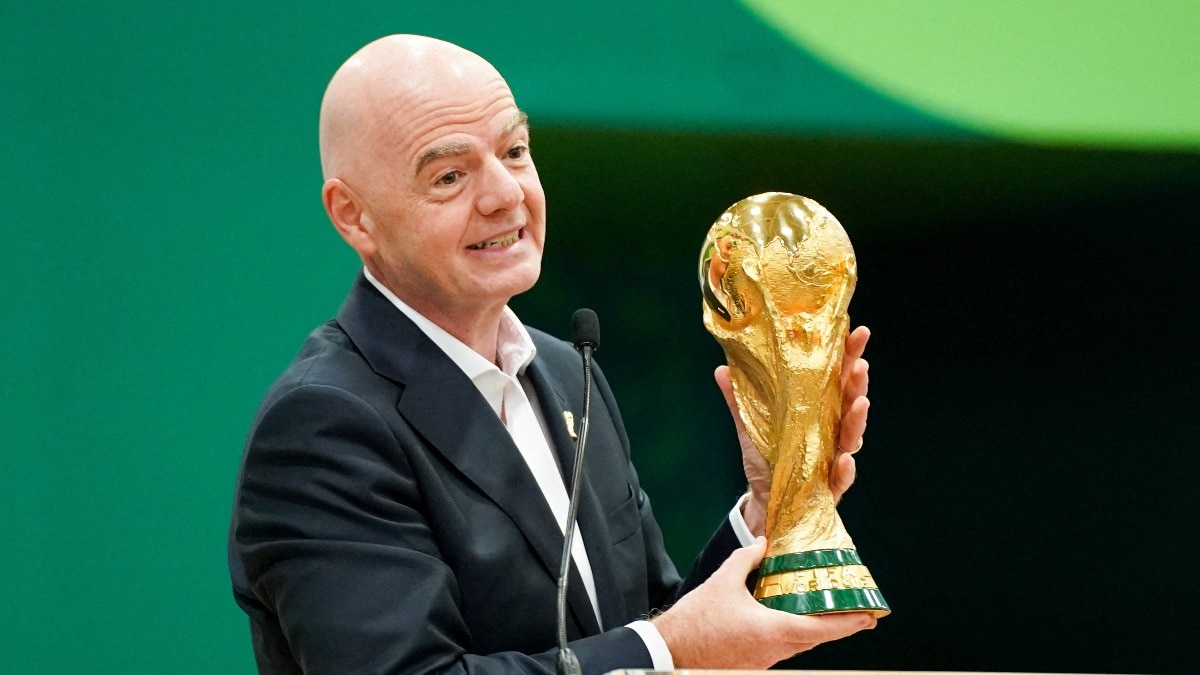
FIFA president Gianni Infantino said football’s governing body cannot dictate who the United States allows into the country for the World Cup, defending FIFA’s handling of visa-related issues and urging critics to “chill and relax” as the tournament prepares to get underway.
Speaking during a 66-minute press conference in Mexico City on Wednesday, the eve of the 2026 FIFA World Cup, Infantino addressed a range of controversies that have emerged in the build-up to the tournament, including the denial of entry to Somali referee Omar Artan and concerns surrounding Iran’s participation in matches hosted in the United States.
Artan was set to make history as the first referee from Somalia to officiate at a World Cup after being included in FIFA’s final list of match officials. However, he was denied entry after arriving at Miami International Airport from Istanbul.
A US official said on Tuesday that Artan was refused admission because of an alleged “association with suspected members of terror organizations.”
Infantino described the situation as unfortunate but stressed that FIFA’s influence has limits when it comes to decisions taken by governments.
“Believe me when I tell you, or don’t believe me if you don’t want, but we try always to find solutions, always,” Infantino said.
“But then we need to respect that we are not the kings of the world who can rule over governments and police forces and I don’t know what. We are a sports organization, we try to do our best with the means that we have.”
The FIFA president said the organisation continues to work behind the scenes whenever problems arise but cautioned against reacting too quickly in public.
“It is unfortunate what happened to Omar, the referee from Somalia, but again we don’t control everything,” Infantino said.
“We try, we’ll discuss, we’ll see. Maybe sometimes it’s good as well to chill, relax. We work on everything, we try to resolve everything.”
He argued that public pressure and immediate criticism do not always help resolve sensitive matters involving immigration authorities and national governments.
“Sometimes to immediately start screaming and shouting has the opposite effect in terms of finding a solution,” he said.
“We always try to find solutions, always. But then we need to respect that we are not the kings of the world who can rule over governments and police forces.”
Pressed on what he meant by asking people to “chill,” Infantino clarified that FIFA was actively working to address concerns rather than ignoring them.
“I don’t mean to chill and do nothing, I mean to trust us that we are working behind the scenes, trying to understand,” he said.
“There are things we are told, things we are not told. We always try to make things positive and find a solution.”
Infantino pointed to Iran’s participation in the tournament as an example of FIFA’s efforts to navigate complex political and logistical challenges. The Iranian team has based itself in Tijuana, Mexico, and will travel into the United States for matches before returning across the border.
“It has been successful to bring Iran to play in America, I don’t know who would’ve managed to do that,” Infantino said.
“We don’t live on the moon, we live on planet Earth and we try our best.”
Despite the visa-related issues that have surfaced in the final days before kick-off, Infantino said FIFA has no regrets about awarding hosting rights to the United States, which is staging the tournament alongside Canada and Mexico.
The FIFA chief also addressed ongoing investigations by attorneys general in California, New Jersey, New York and Texas into the tournament’s ticket-pricing structure.
FIFA DEFENDS TICKET PRICING
FIFA has faced criticism over the cost of tickets, with some seats for the July 19 final in New Jersey priced as high as $8,680. Following backlash, the governing body released a limited number of $60 tickets through national federations for supporters.
Infantino insisted FIFA remained comfortable with its approach and welcomed the investigations.
“Let me say that we are very relaxed about it because before starting to sell seven million tickets, we checked what we would do with the best lawyers or experts,” he said.
According to Infantino, FIFA sold around 800,000 tickets for matches in Los Angeles and San Francisco and received only four complaints from customers.
“In California, we sold 800,000 tickets for the games in Los Angeles and San Francisco. Out of the 800,000 we had three customers who complained. The fourth one has come since,” he said.
“These cases were solved before the investigations started. We welcome any investigations. We’ll present everything and make our case. But it’s most important that every dollar that we generate goes back into football.”
The FIFA president added that the average ticket price for the tournament was below $500 and comparable to prices seen during playoff games in major American sports leagues.
The World Cup, co-hosted by the United States, Canada and Mexico, begins on Thursday at the Estadio Azteca in Mexico City, where hosts Mexico will face South Africa in the opening match of the biggest tournament in football history.
As FIFA prepares to launch the expanded 48-team competition, Infantino maintained that the organisation would continue working to resolve issues behind the scenes, while accepting that ultimate authority on matters such as visas rests with national governments.
“We always try to find solutions,” he said. “But we need to respect that we are not the kings of the world.”
– Ends



